
Brand + Keyword Search Campaigns
Brand + Keyword Search Campaigns in 2026: What Changed and What Actually Works Now
AI Max rewired how brand terms behave in auctions. PMax is quietly eating branded traffic. CPCs on your own name jumped 34% in 12 months. Here’s the honest picture — and how to respond.
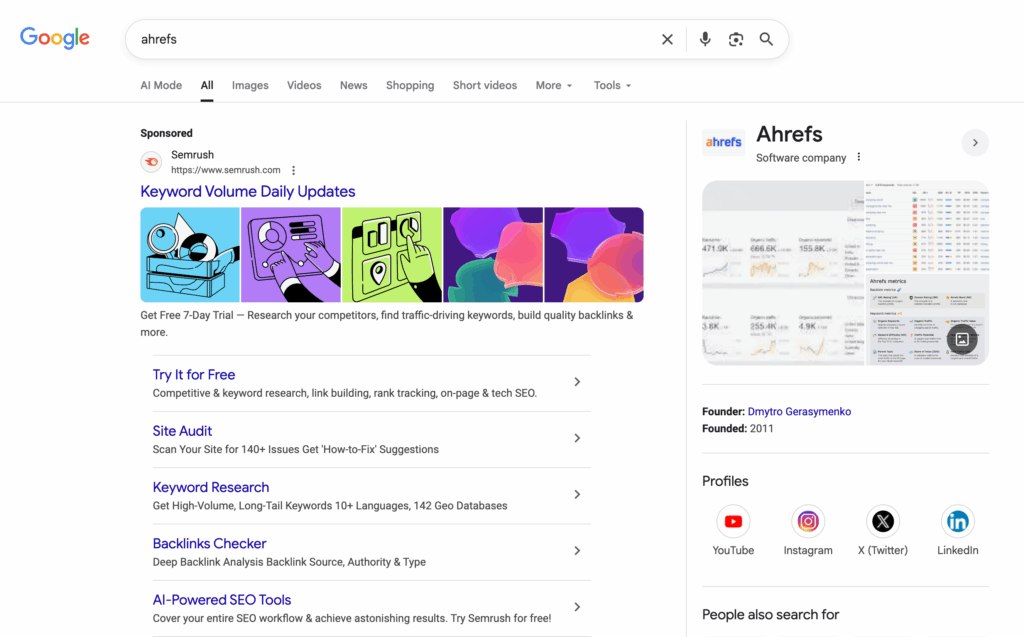
Something shifted in branded search over the past 18 months, and not everyone has caught up with it yet. The old mental model — brand campaigns are cheap, safe, and basically a formality — doesn’t hold the way it once did. Costs on branded terms are higher, the auction is more crowded, and Google’s own AI features are now actively competing with the campaigns you set up to defend your own name.
This isn’t a crisis, but it is a reckoning. The mechanics have changed enough that the default playbook — “run an exact-match brand campaign, bid low, move on” — now leaves real money and traffic on the table. So let’s go through what actually happened, and what to do about it.
What Actually Changed in 2025–2026
Let’s be specific, because the vague “AI is disrupting everything” framing isn’t useful when you’re trying to decide how to structure an ad account on Monday morning.
1. AI Max is live — and it changes how brand queries flow
Google’s AI Max for Search, which moved out of beta and scaled to hundreds of thousands of advertisers globally through 2025, is the single biggest structural change to search campaigns in years. It isn’t a campaign type — it’s a settings layer that sits on top of your existing Search campaigns and does two things: expands query matching beyond your declared keywords, and can auto-generate ad copy and dynamically select landing pages.
For branded search specifically, this creates a new friction point. If you’ve built a dedicated brand campaign and also have AI Max enabled on a non-brand campaign, there’s now a genuine risk that the AI Max campaign starts matching brand-adjacent queries that you intended to own exclusively. Google added brand exclusions to AI Max in May 2025, which is the right fix — but only if you actually configure them.
If you run AI Max on any non-brand campaign, you must add your own brand as a brand exclusion inside AI Max settings, or the feature may bid on your branded queries and inflate your costs. This step does not happen automatically when AI Max is enabled.
Starting February 26, 2026, Google also rolled out text guidelines globally — a governance layer letting you specify up to 25 term exclusions and 40 messaging restrictions per campaign for AI-generated copy. If the AI Max copy generation touches brand claims or compliance-sensitive language, these controls matter. The oft-cited 27% conversion lift Google reports for AI Max is specifically for campaigns that previously relied heavily on exact and phrase match; the all-campaign average is closer to 14%.
2. Dynamic Search Ads are being upgraded into AI Max
In April 2026, Google announced that DSA campaigns are formally being upgraded to AI Max. The reasoning makes sense — DSA’s core mechanism (expanding beyond keyword targeting using website content) is now integrated into AI Max with broader intent signals. For accounts that relied on DSA as a brand-adjacent catch-all, this migration needs deliberate attention. The match logic is different, and the guardrails available are more powerful but also more necessary to configure.
3. Performance Max cannibalization is a documented, measurable problem
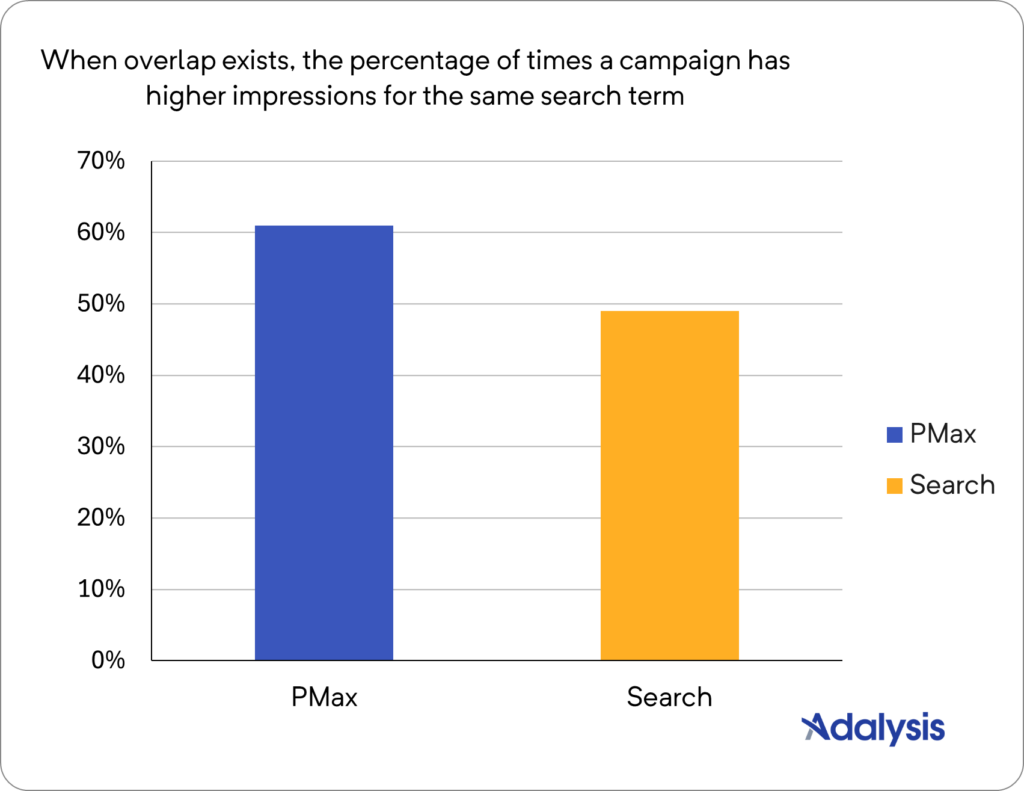
An Optmyzr analysis of 503 accounts in February 2025 found that 91.45% of those accounts had keyword overlap between their Search campaigns and PMax. In the scenarios where overlap occurred, Search campaigns won on conversion performance nearly twice as often. The implication is uncomfortable: a significant chunk of what PMax reports as conversions may simply be traffic it intercepted from your own Search campaigns.
“When you factor in the cannibalization of both branded and non-branded Search traffic, the actual incremental value PMax delivers is meaningfully lower than what the dashboard reports.”
— Savo Group analysis, citing Optmyzr, Adalysis, and Smarter Ecommerce data, Feb 2026This is especially relevant for brand campaigns. PMax does not inherently respect your branded Search campaign’s territory. Prior to the brand exclusion feature (which Google added in 2023), PMax would freely compete with your brand campaign for your own brand queries. Even today, the exclusion needs to be manually configured, and many accounts aren’t doing it.
4. Branded search CPC inflation is real and accelerating
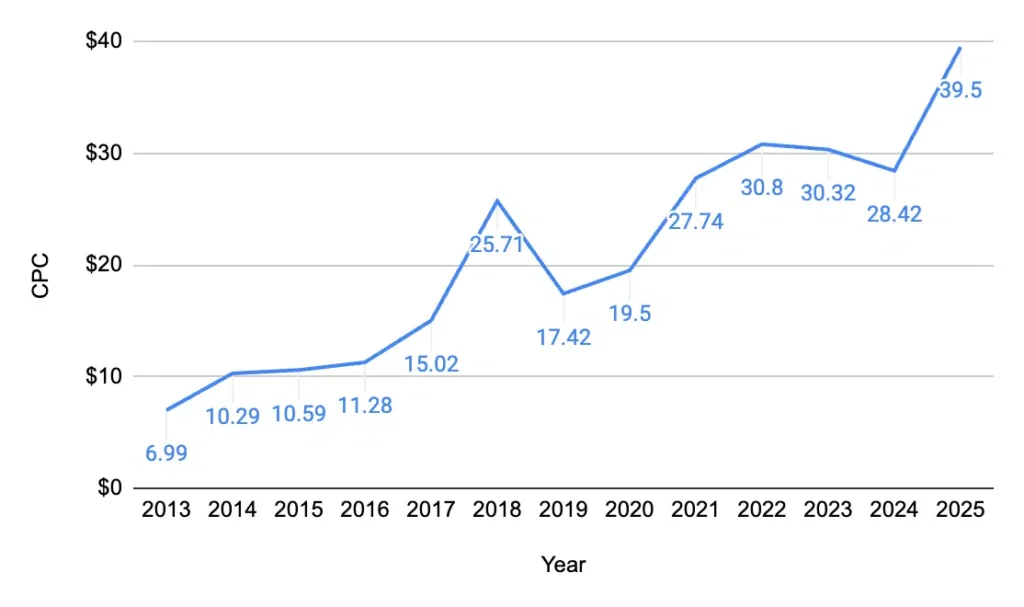
Dreamdata published benchmark data in December 2025 showing branded search CPCs rising 34% year-over-year, accompanied by a 29% drop in CTR. This combination — more expensive clicks that fewer people are taking — is putting pressure on branded search ROI in a way that wasn’t visible a couple of years ago.
Two dynamics are driving this. First, broad match and AI Max on competitor campaigns are increasingly entering brand auctions without competitors explicitly targeting your brand name. Second, some competitors are deliberately bidding on brand terms as a standard tactic. Either way, an auction that used to be nearly yours alone is now contested, and you’re paying for the privilege of still winning it.
Overall cross-industry average CPC in 2026 sits at $5.42, up modestly from $5.26 in 2025, per WordStream’s analysis of 13,474 US search campaigns. The branded search increase of 34% exceeds this market-wide trend significantly. Source: Dreamdata, Dec 2025
The Incrementality Problem Nobody Wants to Talk About
Here’s the uncomfortable truth that most PPC agencies don’t lead with: branded search has the lowest measured incremental ROAS of any major digital channel.
Stella analyzed 225 geo-based incrementality tests conducted between August 2024 and December 2025. The median incremental ROAS across all channels was 2.31×. Google Search branded came in at 0.70×. That’s below 1.0. For every dollar spent on branded search, these advertisers were generating 70 cents in incremental revenue — meaning the campaign was not only failing to add revenue, it was cannibalizing organic clicks that would have converted anyway.
| Channel | Median Incremental ROAS | Assessment |
|---|---|---|
| Tatari CTV | 3.30× | Strong |
| Google Performance Max | 2.98× | Strong |
| 2.96× | Strong | |
| Meta (Facebook/Instagram) | 2.92× | Strong |
| Cross-channel median | 2.31× | Baseline |
| Google Search — Branded | 0.70× | Often non-incremental |
Source: Stella DTC Digital Advertising Incrementality Benchmarks, 2025. Based on 225 geo-based tests, Aug 2024–Dec 2025. 88.4% reached 90%+ statistical significance.
That figure needs context. An incremental ROAS below 1.0 doesn’t mean branded search is always wrong — it means that for many accounts, most of the conversions attributed to branded campaigns would have happened organically. Which is actually the optimistic case: it means your brand is strong enough that people are finding you without paid help.
But it also means that the platform-reported ROAS for branded search is often dramatically inflated. Stella’s research found that the gap between platform-reported ROAS and true incremental ROAS often reaches 2–3×, with some accounts (particularly heavy branded search spenders) seeing 5–10× inflation. That’s a meaningful budget allocation error.
So should you just stop running brand campaigns?
No — and this matters. There are specific, defensible reasons to keep a brand campaign running even when the incremental lift is low:
- Competitor defense: If competitors are actively bidding on your brand, pausing your own campaign hands them cheaper, higher-CTR positions. A brand-defended SERP looks very different from an undefended one.
- Messaging control: Your organic listing shows sitelinks and a snippet Google writes. Your ad shows what you write. For product launches, promotions, or time-sensitive messaging, the paid ad is the only lever you control.
- Affiliate and partner protection: If you have affiliates who are authorized to bid on your brand, or worse, ones who aren’t but do anyway, having your own campaign active gives you both data and auction presence to limit the damage.
- AI Overviews coverage: As Google expands AI Overview placements, ads inside AI Overviews are increasingly pulling from AI Max-eligible Search campaigns. A brand campaign properly configured with AI Max may give you incremental presence in AI Overview results that your organic listing doesn’t capture.
A B2B SaaS company paused branded paid search for the month of January 2025, replacing it with monitoring of organic branded performance. Baseline was set from January 2024 data.
Organic didn’t fully replace paid traffic volume, but efficiency metrics — contacts and deals per impression — improved dramatically. The conclusion: branded paid search was cannibalizing organic performance more than it was adding. The company chose to run brand campaigns only when competitors are detected in the auction. Source: More Than Media Marketing, April 2025
The honest answer is that branded search is contextual. The right decision depends on your competitive environment, the strength of your organic presence, whether you have affiliates or partners bidding on your name, and whether your brand campaign is serving a genuine messaging function or just intercepting traffic you’d get anyway. The only way to know for your account is to run an incrementality test.
How to Structure Brand Campaigns in 2026
Given everything above, here’s how I’d think about brand campaign architecture today. This isn’t gospel — account context varies enormously — but it reflects what the data points toward.
Separate brand campaigns from non-brand. Always.
This hasn’t changed, but it’s worth restating because the temptation to consolidate has grown with Performance Max’s all-in-one promise. A dedicated brand campaign gives you independent budget control, separate bidding, clean performance data, and — critically — the ability to tell PMax and AI Max campaigns not to touch your branded queries via exclusions.
If you combine brand and non-brand keywords in the same campaign, you lose visibility into which queries are incremental and you make accurate budgeting nearly impossible. The branded keyword CTR and CPC are so different from non-brand that mixing them produces averages that mislead you about both.
Configure AI Max brand exclusions if you run non-brand campaigns on AI Max
In Google Ads, go to your non-brand campaign settings, open AI Max, and add your brand as a brand exclusion. At the ad group level, you can also set brand inclusions — which limits specific ad groups to showing only on brand queries. For complex accounts (retailers with multiple owned brands, agencies managing co-branded products), this ad-group-level granularity matters a lot.
A note on priority rules: if a brand appears in both an inclusion list and an exclusion list, exclusions win. Build brand lists carefully, especially if your brand name overlaps with common generic terms.
Add brand exclusions to Performance Max
This is the most commonly missed step in accounts that run PMax alongside a brand campaign. Without explicitly excluding your brand from PMax, the campaign will bid on branded queries and report those conversions, making PMax look more effective than it actually is. Set the brand Search campaign at higher priority and exclude your own brand from PMax entirely — or run a separate brand-only PMax if you want PMax coverage of branded queries with proper attribution separation.
Brand Campaign Architecture Framework (2026)
- Dedicated brand Search campaign — exact + phrase match on your brand name, brand + product, brand + category. Separate budget, separate bid strategy (usually Target CPA or Target ROAS if enough conversion volume). Never mix with non-brand.
- Brand exclusions on all non-brand campaigns — add your brand to the exclusion list in AI Max settings for every non-brand Search campaign. Add brand exclusions to every PMax campaign. Document this in a campaign setup checklist so it doesn’t get skipped on new campaigns.
- Run an incrementality test before scaling brand spend — geo-based holdout or Google’s native Conversion Lift experiment. Run for at least 4 weeks. If incremental ROAS is below 1.5×, reconsider budget allocation. If competitors are active in your branded auction, factor the defense value into your threshold.
- Monitor search term reports weekly for branded traffic in PMax — look for your own brand name appearing in PMax search term reports. If it appears, your exclusions aren’t working or weren’t applied to a new campaign. Fix immediately.
- Trademark your brand name and set up a Google trademark complaint process — you can’t prevent competitors bidding on your brand name, but you can prevent them using your brand name in their ad copy. Trademark registration gives you standing to file complaints with Google’s trademark team.
Bidding Strategy for Brand Campaigns: What the Data Says
Brand campaigns used to be almost universally managed on manual CPC bids because the traditional wisdom was: you know your brand converts well, keep the CPC low, harvest the traffic. That logic is less clean now.
Smart bidding on brand campaigns: pros and cons
The case for Target CPA or Target ROAS on brand campaigns has grown as conversion volume has increased for most advertisers. Google’s smart bidding genuinely performs well when it has sufficient data — roughly 30+ conversions per week is the threshold where the learning period stabilizes. If your brand campaign has enough volume, smart bidding can improve conversion rate by adjusting bids by device, time of day, audience segment, and query variation in ways that manual bidding misses.
The risk is that smart bidding can push CPCs up on brand terms when it judges that higher-intent queries warrant higher bids. If you’re in a competitive branded auction, this can compound the CPC inflation problem. A reasonable approach: start with Target Impression Share at 90%+ for brand campaigns to ensure visibility, then switch to Target CPA once you have 60+ days of conversion data.
Your Quality Score on branded keywords is typically high — sometimes 10/10 — because your ad is clearly the most relevant result for your own brand name. This means you’re paying well below your bid. Don’t confuse a low average CPC on brand campaigns with a reason not to care about the absolute CPC trend. The 34% YoY increase is on top of already-favorable Quality Score discounts.
What to bid on: branded keyword taxonomy
Brand campaigns often get set up with just the company name on exact match and then forgotten. There’s more to it. A complete brand keyword set should include:
- Brand name alone — exact and phrase match
- Brand + product/service — e.g. “[Brand] CRM”, “[Brand] enterprise plan”
- Brand + navigational — “[Brand] login”, “[Brand] help”, “[Brand] pricing” (these convert differently and may warrant different landing pages)
- Brand + review/comparison queries — “[Brand] reviews”, “[Brand] vs [Competitor]” — these are high-intent, late-stage queries you want to own with a controlled landing page rather than let competitors capture
- Common misspellings — especially for brands with unusual spellings
The review and comparison queries deserve special attention. WordStream’s data shows that the audience searching “[Your Brand] vs [Competitor]” is in active evaluation mode. If you’re not bidding on it, you’re leaving competitor ads on that SERP with no response from you. A dedicated landing page that addresses the comparison honestly tends to outperform generic brand landing pages for these queries.
When Competitors Are Bidding on Your Brand
Competitor brand bidding has become more common, partly because broad match and AI Max on competitor campaigns are now entering branded auctions automatically, even without explicit targeting. The Dreamdata research linked this dynamic directly to rising branded CPCs.
What you can control
You cannot stop competitors from bidding on your brand name — Google’s policy allows it. You can stop them from using your brand name in their ad copy if your brand is trademarked, by filing a trademark complaint with Google. This limits their ad’s quality and relevance signals somewhat, but doesn’t remove them from the auction.
What you can control:
- Your organic brand presence: Investing in SEO for branded terms — particularly “[Brand] alternatives,” “[Brand] pricing,” and “[Brand] reviews” — reduces the volume of traffic you need to capture via paid. Dreamdata’s own team implemented this strategy after observing rising branded CPCs.
- Your Quality Score advantage: Your own brand campaign will almost always have higher Quality Score than competitors bidding on your name, because your ad, landing page, and brand signals align. This means you’ll win most branded auctions at lower CPCs than competitors pay for the same clicks.
- Your ad copy and extensions: When you’re competing in your own branded auction, make your ad unmistakably the right choice. Callout extensions with pricing, reviews, trust signals; sitelinks to key pages; structured snippets with product names. The competitor ad is generic by definition. Yours shouldn’t be.
A different but related brand search issue: unauthorized affiliate partners bidding on your brand name and collecting CPC commissions for conversions that would have happened through your own campaign or organically. This is common in industries with large affiliate networks (e-commerce, financial services, travel).
The mechanics: a loyal customer who’s already decided to buy searches your brand, clicks an affiliate ad instead of your own, and the affiliate collects a commission for a sale you drove through brand building. You paid for the customer acquisition; the affiliate is paid for the click.
Detection requires monitoring branded SERPs regularly (automated tools exist for this) and auditing affiliate traffic for conversion patterns that match existing customers. Some brands report affiliate brand bidding accounting for 5–15% of branded paid search spend — effectively a tax on their own marketing investment. Source: BluePear, June 2025
How to Actually Measure Brand Campaign Value
Platform-reported conversions are close to useless for understanding whether your brand campaign is adding value. This is the fundamental measurement problem, and it’s gotten worse as AI bidding has taken over more of the conversion attribution machinery.
The only reliable methods are:
Geo-based holdout testing
Split your geographic market into a test region (where brand campaigns run) and a control region (where they’re paused or significantly reduced). After 4–6 weeks, compare conversion rates, revenue per session, and organic brand search volume between the two groups. Google lowered the minimum spend and conversion thresholds for Conversion Lift experiments in 2025, making this more accessible at smaller account sizes. As of mid-2025, over half of brands and agencies reported using incrementality testing as a regular practice, up from a small minority five years prior.
Marketing Mix Modeling
MMM assigns revenue impact to each channel using regression across historical data, accounting for lag effects and channel interactions. Google’s Meridian is an open-source MMM tool; commercial options like Northbeam, HockeyStack, and Wicked Reports also exist. MMM is slower (weeks to set up and calibrate) and less granular than holdout testing, but it gives you a portfolio-level view of how brand campaigns interact with other channels.
Simple organic traffic check
A rough but quick signal: when you pause brand campaigns or reduce spend, does branded organic traffic and direct traffic increase? If it does — and it usually does, partially — that’s evidence of organic substitution. The case study above found organic branded CTR improving from 45% to 65% during a brand campaign pause, which tells you something concrete about the substitution rate for that account.
| Method | Accuracy | Setup complexity | Time to results | Best for |
|---|---|---|---|---|
| Geo-based holdout test | High | Medium | 4–6 weeks | Validating brand campaign value |
| Google Conversion Lift | High | Low (native in Google Ads) | 4+ weeks | Quick initial incrementality check |
| Marketing Mix Modeling | High (portfolio level) | High | Weeks to months | Budget allocation across channels |
| Organic traffic substitution check | Directional | Low | 2–3 weeks | Quick signal before formal testing |
| Platform-reported ROAS | Misleading for brand | None | Immediate | Not recommended as sole measure |
Brand Search in the Age of AI Overviews
One more structural shift worth addressing: Google’s AI Overviews are now a standard feature in US search results and expanding globally. The initial instinct was that AI Overviews would crush ad performance by answering queries without clicks. The picture is more nuanced.
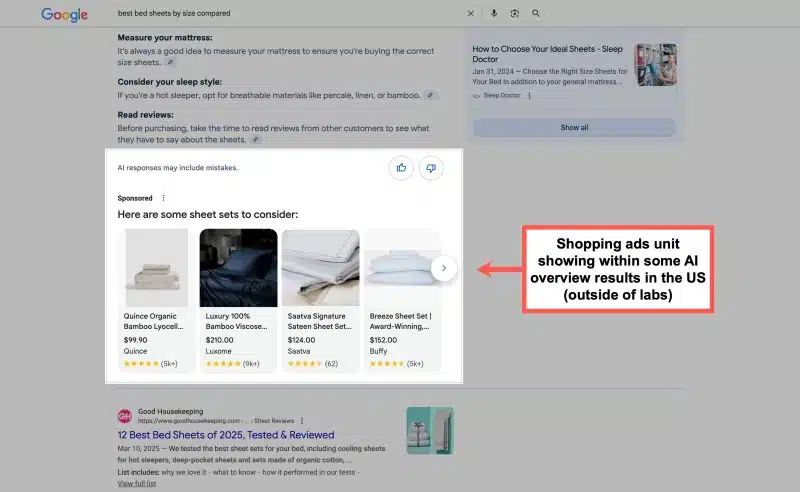
Google has integrated ads into AI Overviews — both Shopping ads and text ads can appear within or alongside the AI-generated answer block. Research from Search Engine Land found that paid CTR on queries showing AI Overviews can drop compared to traditional results, but the ads that do appear get different positioning than in traditional SERPs.
For brand queries specifically: if someone searches your brand name, the AI Overview is likely to summarize who you are, link to your site, and potentially show your ad. This is generally positive — your presence is reinforced in multiple places. The scenario to watch is branded comparison queries (“[Brand] vs [Competitor]”), where AI Overviews may summarize a comparison that doesn’t favor you, regardless of what your ad says. Owning the comparison-intent organic content on your own site is the best hedge here.
Google has explicitly positioned AI Max as the mechanism for advertisers to capture traffic inside AI Overviews. If AI Overviews are appearing for your key branded queries and your brand campaign isn’t AI Max-eligible (or AI Max is disabled), you may be underrepresented in AI Overview ad placements. This is an emerging area — worth testing, but not yet well-documented with independent data outside of Google’s own claims.
The 2026 Brand Campaign Audit Checklist
If you want to put all of this into practice quickly, start with this audit. Most of these are one-time fixes that significantly change how your account handles branded traffic.
- Dedicated brand campaign exists and is separated from non-brand campaigns with independent budget
- Your own brand is added as a brand exclusion in AI Max settings on all non-brand Search campaigns
- Your own brand is excluded from all Performance Max campaigns via brand exclusion
- Search term report checked weekly — no instances of brand terms appearing in PMax reports
- Brand keyword set is complete: brand name alone, brand + product, brand + navigational, brand + comparison, common misspellings
- Brand comparison queries (“[Brand] vs [Competitor]”, “[Brand] alternatives”) have dedicated landing pages
- An incrementality test has been run in the past 12 months to validate brand campaign spend
- If incrementality ROAS is below 1.5×, budget has been rebalanced toward higher-incrementality channels unless competitive defense justifies retention
- Branded SERP is monitored regularly for unauthorized affiliate bidding
- Text guidelines configured in AI Max if auto-generated copy touches brand voice or compliance requirements
- Brand name is trademarked; a process exists to file Google trademark complaints for competitor copy misuse
Honest Assessment: What Brand Campaigns Are Good For, and What They’re Not
There’s a tendency in PPC commentary to either defend branded search enthusiastically (because agencies bill for managing it) or dismiss it entirely (because the incrementality data is damning). The honest position is somewhere between.
Brand campaigns are valuable when they’re serving a genuine strategic function: competitor defense, messaging control, navigating affiliate chaos, or covering high-value bottom-funnel intent signals you can’t get organically. They’re wasteful when they’re running on autopilot without any incrementality evidence, set up to capture traffic that would convert anyway.
The 2026 environment has made the question sharper because costs are higher, the auction is more complex, and AI features are creating new categories of leakage if you’re not actively managing them. The accounts that handle this well are treating branded search as a tactical question that gets revisited regularly — not a permanent line item that never gets questioned.
Running an incrementality test is not a radical act. Google has made Conversion Lift accessible at lower spend thresholds than ever. If you’ve never done it, the result will tell you something genuinely useful about where your brand actually stands in the organic-to-paid handoff — and that knowledge is worth more than any individual keyword optimization.