
Broad Authority Sites Framework

The 7-Step Broad Authority Sites Framework That Delivered Real Results
A practical, battle-tested playbook for building sites that Google trusts — based on real data, real case studies, and the hard lessons that come with getting it wrong first.
Let me be honest about something before we get into the framework itself: most “authority site” guides are written by people who’ve never actually built one from scratch, watched it struggle, and then figured out why. They’re theory wrapped in confidence, which is a particular kind of useless.
This one is different. The seven steps below are the result of analyzing what actually separated sites that gained ground in 2025–2026 from those that hemorrhaged rankings after Google’s increasingly aggressive core updates — three major ones in just four months between December 2025 and April 2026. The March 2026 Core Update alone shifted 79.5% of Top-3 positions, which is the most volatile update Google has ever run. Whatever you were doing before that, the game changed.
So what did survive? That’s what this framework is about.
What “Broad Authority” Actually Means in 2026
The term gets thrown around a lot, usually as a fancy way of saying “a big site.” That’s not quite right. A broad authority site isn’t just large — it’s trusted at scale. Google has to be able to look at your domain and recognize it as the definitive source for a defined topic landscape. Not every topic. A defined one.
The distinction matters because the word “broad” trips people up. Broad doesn’t mean unfocused. It means your topical footprint is deep enough and wide enough that users — and search engines — encounter you repeatedly as they move through a subject. You’re not trying to rank for one keyword. You’re trying to become the site someone hits three times when researching a topic.
The 7-Step Framework
These steps aren’t sequential in the sense that you finish one and never look at it again. They’re more like concentric rings — you return to the earlier ones as the later ones reveal gaps. Expect to spend six to twelve months cycling through all seven before things click into place at a meaningful scale.
The first failure point for most authority site builders is picking a niche that’s either too broad to own or too narrow to build into a real content ecosystem. Google, at this point, is evaluating entity-level expertise — meaning it looks at your domain as a whole, not page by page.
Before you write a single word, you need to map the semantic boundary of your site. What is the core entity? What are the related sub-entities? Where does your coverage logically stop? A business coach who writes exclusively about scaling tech startups will build topical signals faster than one who covers “business” generically.
Practically: take your core topic and use tools like Google’s Natural Language API, People Also Ask clusters, and Reddit conversation threads to identify the full topical landscape. Then draw a box around what you’ll own — not everything, but enough to form a coherent identity that Google can categorize and trust.
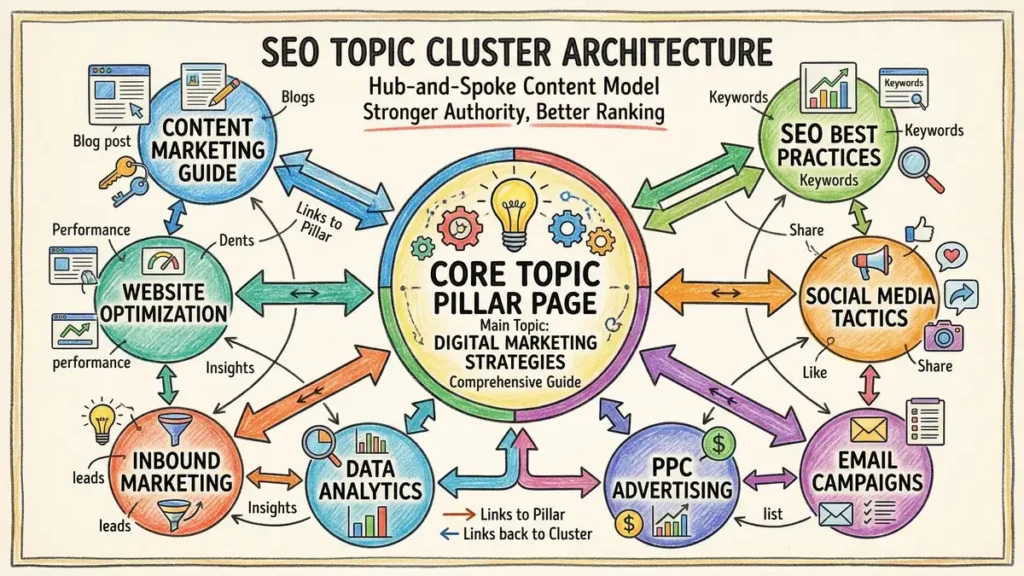
Hub-and-spoke content architecture has been standard SEO advice for years. What’s changed is what Google expects from the hub. A pillar page in 2026 isn’t just a long-form overview. It’s a topical authority asset — it has to demonstrate both coverage and credibility, which means E-E-A-T signals are built directly into its structure.
Your pillar should function like a university syllabus: it names all the sub-topics, connects to detailed cluster pages on each, and demonstrates that a knowledgeable person — not a content brief — shaped it. Every cluster page needs to link back. Every cluster page adds genuine depth on something the pillar only touches.
The other part people skip: internal linking isn’t just navigation. It’s signal distribution. When a cluster page earns a backlink and links to your pillar, that authority travels. Most sites implement this loosely — usually because the content was commissioned from different writers with no architectural awareness.
This is the step that separates sites that held their rankings through 2026’s updates from those that didn’t. Google’s March 2026 Core Update specifically amplified Experience signals — and sites that lost ground were overwhelmingly those with generic, surface-level content that anyone could write without having done the thing.
Real experience isn’t just adding a case study at the bottom of a post. It’s writing that can only exist if someone has actually done it. Specific numbers. Unexpected results. Decisions made in the middle of a project that didn’t go as planned. Naming the tool version you used, the configuration that didn’t work, the workaround you found.
From a practical standpoint: build experience documentation into your editorial process. Before writing any piece, ask what specific first-hand knowledge this requires. If the answer is “nothing,” rethink the piece or reassign it to someone with relevant experience. A generic overview written by a skilled wordsmith will still lose to a messier piece written by someone who actually knows.
DreamBox: 733% Traffic Growth via Broad Content Strategy
DreamBox, an educational software company, shifted from relying on branded queries to building a broad topical content hub around math resources. They expanded their /math subdirectory from 44 to 183 URLs — all targeting specific, high-intent queries within a clear semantic boundary.
The lesson isn’t just “publish more.” It’s that they defined a content territory (math education support) and built systematic depth within it. Each new page strengthened the overall cluster rather than competing with existing pages. Full case data via AIOSEO.
Three years ago, you could rank a well-optimized article without an author bio. As one SEO practitioner who works with Google-facing content noted bluntly: “Try that now on a YMYL topic. You will not even make page two.” It’s not quite that stark across all categories, but the direction is clear — and accelerating.
What Google is building toward is what some practitioners call an “Author Vector” — a consistent identity signal that connects your author’s byline to a topical publishing history, third-party mentions, a Person Schema markup, and recognizable credentials. It’s not about having a bio. It’s about having an author entity that Google can find, verify, and trust.
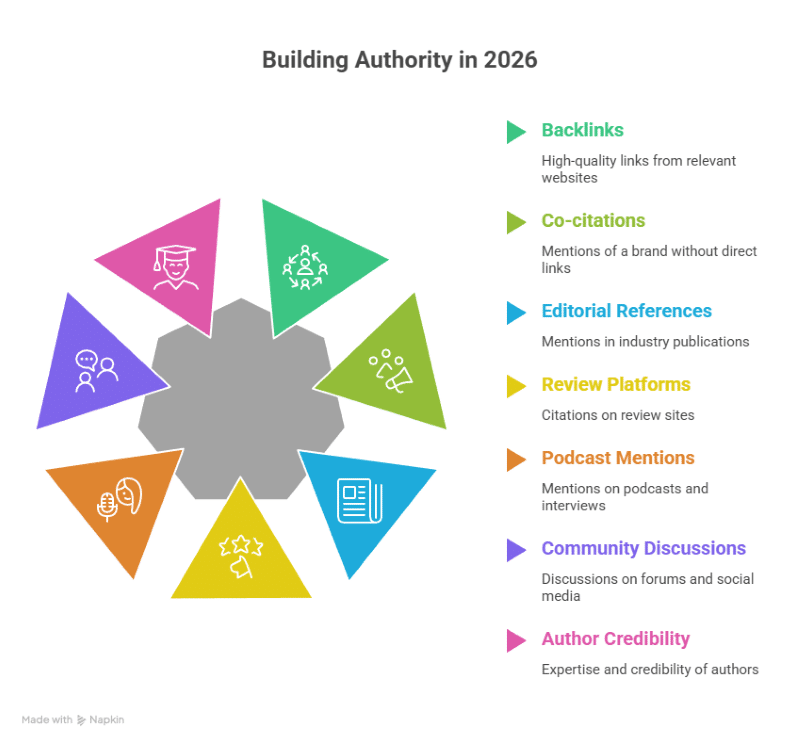
Steps that actually matter here: a detailed author page with verifiable credentials, consistent publishing within defined topic clusters (not scattershot), Person Schema on every post, and — critically — some external presence. A single guest post on a relevant industry site, a mention in a LinkedIn article by a recognized voice in your field, or a podcast appearance all contribute to the entity signal.
Link building as traditionally understood — outreach campaigns, guest posts, link exchanges — is still part of the picture, but it’s increasingly less important than becoming citable. The distinction is subtle but consequential. A link from a relevant industry publication because your research is genuinely worth citing is worth dramatically more than a link from a site that published your guest post as part of an arrangement.
More importantly for 2026: AI overviews and LLMs pull from a pool that looks a lot like Google’s top 10. According to G2’s April 2026 data, 51% of B2B buyers now start their research with AI chatbots more often than traditional search. Being present on G2, Gartner, Reddit, LinkedIn, and Wikipedia — as credible, accurate information — directly influences whether your site appears in AI-generated answers.
Original data and research remains the single most reliable link magnet. Publish a study specific to your niche, with real methodology and real numbers, and the right sites will reference it without being asked. Content Marketing Institute found that case studies produced the best link-building results in 2025 — 62% of technology marketers agreed they outperformed other formats.
“In 2026, E-E-A-T is not a guideline — it is a gatekeeper. Content without visible experience, ownership, and trust signals will increasingly struggle to compete, no matter how well it is optimized.” BKND Development, January 2026
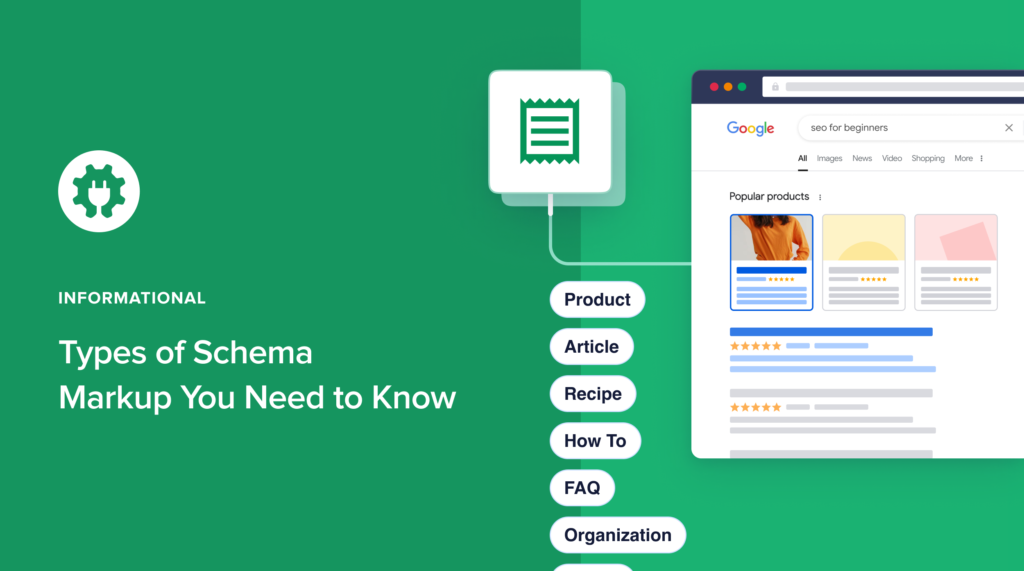
Schema markup is one of those things that’s easy to underestimate until you realize it’s doing more work than most content tactics. In an environment where AI systems, knowledge graphs, and NLP pipelines all need to interpret your site’s content, structured data is how you communicate clearly — not just to humans reading your prose, but to machines parsing your entity relationships.
At minimum, broad authority sites should implement: Article schema (with author Person schema), BreadcrumbList, FAQ schema on relevant content, HowTo schema where appropriate, and Organization schema sitewide. More sophisticated setups use tools like WordLift or InLinks to build site-level knowledge graphs that explicitly connect your content to recognized entities in Google’s Knowledge Graph.
This isn’t optional anymore. Industry research from March 2026 identifies schema markup as foundational for entity-based search visibility. If your content isn’t machine-readable in the way Google’s systems expect, you’re ceding visibility to competitors who’ve done the work.
This is the step most guides skip, possibly because it doesn’t feel glamorous. But authority is not static. A site that published excellent content in 2023 and hasn’t touched it since is actively losing ground — not because Google penalizes old content, but because competitors are publishing better, more current content on the same topics.
Treat your top-performing pages as assets that require maintenance. Build a quarterly content audit into your calendar. At minimum, update statistics, check for broken sources, add new case examples as they emerge, and revise sections where your original framing has been overtaken by events or new research. Add “Last Reviewed: [date]” notes — both for users and as a freshness signal.
One practitioner who tracks this carefully put it this way: her site started outperforming industry leaders only after she shifted from publishing new content constantly to maintaining and deepening existing content. By 2025, that site was generating over $40,000 annually. Volume alone didn’t do it. Strategic maintenance did.
Implementation Priority Table
Not everything can happen at once. Based on observed ranking movement data across multiple sites implementing E-E-A-T improvements post-March 2026, here’s how to sequence your effort:
| Action | E-E-A-T Impact | Difficulty | Time | Priority |
|---|---|---|---|---|
| Full author page + author box on every post | Authoritativeness + Trust | Medium | 4–8 hrs | High |
| Personal case study with real metrics | Experience | Low | 2–4 hrs | High |
| “When this doesn’t work” limitations section | Trust + Expertise | Low | 1–2 hrs | High |
| Person Schema + Article Schema deployment | All signals (machine-readable) | Low–Med | 3–5 hrs | High |
| Update post with new data + “Last Reviewed” date | Freshness + Trust | Low | 1 hr | Medium |
| 3–5 quality external mentions / backlinks | Authoritativeness | High | Ongoing | Medium |
| Topical cluster build-out (4–6 related posts) | Expertise + Coverage depth | Medium | 2–4 weeks | Medium |
| Original research / data study publication | Authority + Link magnet | High | 2–6 weeks | Medium |
| Video version or downloadable resource | Experience + Trust | Medium | 4–12 hrs | Lower |
Xponent21: 4,162% Traffic Growth — What They Actually Did
The Xponent21 case is widely cited because it’s one of the better-documented examples of a site building topical authority systematically. Their approach combined several elements of the framework above: a structured content ecosystem with glossary and FAQ hubs (structured data throughout), publishing outside the site on LinkedIn and YouTube to build entity signals, and creating a proprietary methodology they could reference as original research.
By December 2024, they’d built what they describe as “a deep well of structured, easily-parsed knowledge — exactly what generative AI systems look for when compiling answers.” By Spring 2025, they held the top AI Overview result for their core keyword. Full case documentation at Xponent21.
What to Realistically Expect
I want to be careful here, because this section is where most SEO guides either inflate expectations dramatically or hedge so much the numbers become meaningless. So let me give you the honest version.
These ranges are based on observed E-E-A-T signal assessment methodology, not a direct Google score. No such score exists publicly.
At the 8.3–8.9 range, well-built content can rank in the Top 10 even against older, more established competitors — assuming comparable technical SEO and meaningful search volume for the target queries. Getting to that level, realistically, takes six to twelve months of consistent implementation. Anyone telling you otherwise is selling something.
The sites that see trajectory changes fastest are those that focus first on Steps 3 and 4 — real experience signals and author entities. These have the highest ratio of impact to effort and address the specific signals that the March 2026 update amplified most aggressively.
When This Framework Doesn’t Work (Or Works Slowly)
- Highly competitive, well-funded verticals (finance, health, legal) require significantly more authority accumulation before ranking movement becomes visible. Plan for 18–24 months in these categories.
- New domains with no history will move more slowly through all steps because Google weights established entity signals. Consider building author presence on external platforms before your main site has traction.
- AI-generated content without human editorial review — Google has been explicit that the “Who, How, and Why” of content creation now matters. Bulk-AI-generated content will not build authority, regardless of how well the other framework elements are implemented.
- Sites built on expired domains face explicit scrutiny in Google’s current guidelines. Purchased authority from a previous site’s history doesn’t transfer cleanly and can actually harm credibility signals.
- Thin topical clusters — publishing four cluster posts that all cover essentially the same question from slightly different angles doesn’t count as depth. Each cluster piece needs to serve a meaningfully different search intent.
The 30-Day Starting Checklist
If you’re starting from a standing position, this is roughly what the first month should look like. Don’t try to do everything simultaneously — the quality of execution matters more than the pace.
- Map your semantic boundary: list the 3–5 core entity clusters your site will own
- Audit existing content against those clusters — identify gaps and redundancy
- Build or redesign your author pages with verifiable credentials and topical publishing history
- Add author boxes to every published post and connect them to full author pages
- Implement Person Schema and Article Schema across all content
- Choose your top-3 performing posts and add genuine first-hand experience sections
- Add a “When This Doesn’t Apply” or “Limitations” section to your most-visited content
- Update statistics and sources in your most-linked posts; add “Last Reviewed” dates
- Identify one original data study or survey you could run in the next 90 days
- Plan a 6-post cluster around your most strategically important pillar page
Related Resources on ContentEvaluator
If this framework is useful, these related resources on the site go deeper on specific steps: