

Why 97 percent of affiliate content earns almost nothing — and the specific funnel architecture, unit economics, and content-system design separating the 3 percent who earn at scale. This is not what you have been taught.
A Confession Before We Start
I spent two full years building what I thought was a proper affiliate site. Forty-three articles. A domain authority that grew, slowly, to something respectable. Eight monetisation streams. I tracked everything — CTR, EPC, ACOS, you name it. And at peak, during the most traffic I ever had, I made $2,340 in a single month from affiliate commissions.
That sounds fine until you know I had 38,000 monthly visitors. My revenue per thousand sessions was barely $60. Meanwhile, I kept reading about people doing eight times that number from sites half my size.
The gap was not in my traffic. It was not in my keyword research. It was not, as I wrongly assumed for a long time, even in my writing quality. The gap was in the funnel architecture — the invisible structural system that either accelerates a reader toward a high-intent decision or bleeds them out across dozens of low-friction, low-commitment content pages where nothing ever converts.
That lesson cost me roughly two years and what I estimate, conservatively, as $180,000 in foregone commissions. What follows is what I wish someone had put in front of me at the beginning.
“The difference between a $60 RPM site and a $400 RPM site is almost never the quality of individual articles. It is the system those articles live inside.”
The Reality Check Nobody Wants to Give You
Let’s start with some numbers that should make you uncomfortable.
According to Authority Hacker’s 2024 affiliate publisher survey — the most comprehensive dataset available on actual affiliate earnings — affiliate websites earn an average of $149.76 for every 1,000 visitors.[1] That is the mean. Means, in this industry, are catastrophically misleading because of extreme skew at the top.
The median affiliate site earns a fraction of that. Break it down: 35% of affiliates earn at least $20,000 per year, while roughly 1% earn more than $1 million.[2] That distribution is not a curve. It is a cliff.
Here is what that spread tells you: the difference between a top affiliate and an average one is not a 20% improvement. It is a 500–1,000% improvement. That kind of gap only opens when one group is doing something structurally different — not just better content, not just more links, but a fundamentally different system.
And here is the uncomfortable part: most of the content about affiliate marketing — including the courses, the YouTube channels, the Twitter threads from self-proclaimed “six-figure affiliates” — focuses almost exclusively on the wrong layer of the stack. They teach you keyword research, article length, link building, and CTA placement. All useful. All, individually, insufficient.
What they rarely teach is the funnel architecture that sits above all of that.
What a High-Earning Funnel Actually Is (And Is Not)
Before we go further, let’s be precise about terminology, because the word “funnel” is one of the most abused concepts in digital marketing.
A funnel, in the affiliate context, is not a sequence of pages. It is not a pop-up leading to an opt-in form. It is not an email autoresponder. All of those can be elements inside a funnel, but the funnel itself is something more fundamental: it is the designed pathway from a reader’s initial question to a transaction in which you participate.
High-earning affiliate content funnels share a specific anatomy. They have:
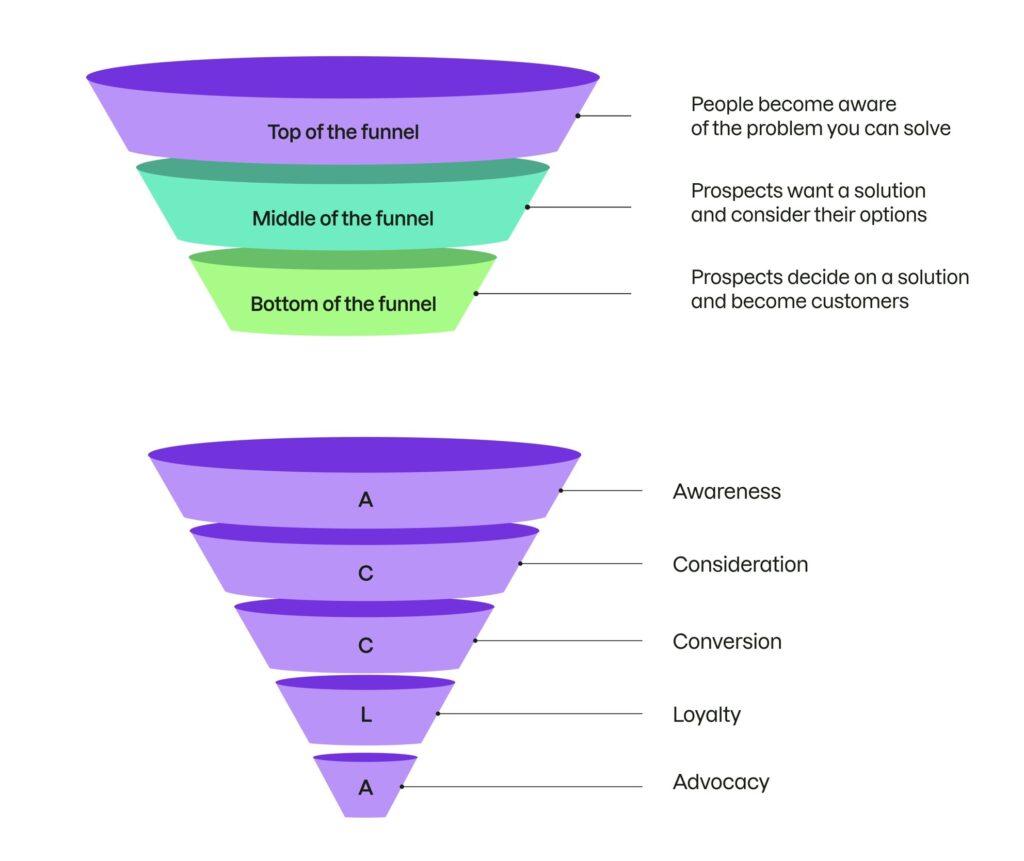
A discovery layer — informational content that captures readers at the moment they first realise they have a problem. This is the “what is” and “how does” content. High volume, low purchase intent, low direct conversion. The job here is not to convert. The job here is to build familiarity and trust, and to inject internal links that pull curious readers deeper.
A consideration layer — comparative and evaluative content. “Best X for Y.” “X vs Z.” “X alternatives.” “X review 2025.” This is where purchase intent begins. The reader knows what category of solution they want; they’re now figuring out which specific option. Conversion is possible but still rare. The job here is to establish your site as the most credible, most detailed, most honest source in the space.
A decision layer — “money pages” in the parlance of the affiliate trade. Highly specific, high-intent content targeting people who have effectively already made up their minds and just need permission to buy. “Best [Product] coupon,” “Is [Product] worth it?”, “[Product] vs [Specific Competitor].” These pages convert at 5–10× the rate of informational content. Most affiliate sites have almost none of these.
A capture layer (optional but increasingly critical) — an email list, a community, a lead magnet. Any mechanism that converts a visitor into a named relationship that can be re-engaged after the session ends.
The average affiliate site is inverted. It has a large volume of informational content that addresses general queries, a small number of half-hearted review posts, and almost no high-specificity decision-layer content. Traffic flows in at the top and leaks straight out the bottom, because there are no funnel walls — no internal linking architecture that guides a curious reader toward a purchase decision.
According to industry internal linking data, roughly 25% of web pages receive zero internal links, and on large affiliate sites, fewer than half of pages get sufficient internal linking to be reliably discovered by both users and search engines.[3]
The Unit Economics That Almost Nobody Calculates
This is where it gets genuinely uncomfortable, because when you run the numbers on affiliate content you quickly realise that most of the content being produced — even by experienced publishers — should rationally never have been written.
Here is a worked example. Let me walk you through two content strategies for the same site in the same niche.
Scenario A: The Typical “Traffic-First” Site
This site publishes primarily informational content targeting high-volume, low-competition keywords. Good strategy on paper. The reality:
Average article production cost: $120 (freelancer) or 6 hours at $40/hr opportunity cost
Average monthly organic traffic per article: 850 sessions (after 12 months of maturation)
Content type: 70% informational, 20% comparison, 10% decision-intent
Blended conversion rate: 0.8% (mix of high-info, low-intent traffic)
Average commission per conversion: $22 (mid-tier ecommerce product)
Monthly RPM per article at scale: $0.008 × 850 × $22 = $149.60 / 1,000 sessions
Annual revenue at 100 articles × 850 sessions each: 85,000 sessions × $0.14976 = ~$12,730/year
Total content investment (100 articles): $12,000
Year 1 ROI: 6.1% (before hosting, tools, and link building costs)
Scenario B: The Funnel-Architected Site
Same niche. Same total budget. Different structural decisions about content mix, internal linking, and monetisation layer:
Content mix: 40% informational (discovery), 30% consideration, 30% high-intent decision
Production cost per article: Same $120 — but higher-intent articles are longer and better-sourced ($180 avg blended)
Traffic distribution: Lower total volume, but higher-intent distribution
Blended conversion rate: 2.4% (weighted toward decision-layer pages)
Average commission: $38 (SaaS and high-ticket products deliberately targeted)
Monthly RPM per article at scale: 0.024 × 850 × $38 = $775.20 / 1,000 sessions
Annual revenue at 65 articles × 850 sessions each: 55,250 sessions × $0.7752 = ~$42,830/year
Total content investment (65 articles): $11,700
Year 1 ROI: 266% (before costs)
Same niche. Same budget. The funnel-architected site produces 3.4× the annual revenue from 35% fewer articles. The difference is entirely structural.
Five Frameworks That Actually Explain High-Earner Behaviour
1. The Content Gravity Model
Here is a mental model I developed after years of failing at affiliate and then finally understanding why a few sites make most of the money. I call it the Content Gravity Model.
Think of each article on your site not as a standalone asset but as a gravitational body. Like planets, articles have mass — determined by their specificity of intent, their depth, their authority signals, and their proximity to a transaction. Articles with high mass pull readers toward conversion. Articles with low mass let readers drift away.
Informational content — “what is affiliate marketing?” “how does SEO work?” — has almost zero mass. It attracts enormous numbers of visitors, but it exerts no gravitational pull toward conversion. The visitor lands, reads, learns something, and floats away. No purchase intent was created or accelerated.
High-specificity decision content — “[Tool X] vs [Tool Y]: Which Is Better for [Specific Use Case]?” — has enormous mass. The visitor arriving on this page has already completed 90% of their purchase journey in their own head. The article’s job is to provide the remaining 10% of confidence they need.
Every piece of content you publish should either (a) have high intrinsic gravitational mass — meaning it attracts readers at high purchase intent — or (b) be a launching pad that actively fires readers toward high-mass content through well-engineered internal links.
Content that does neither — that sits in the informational middle, attracting moderate traffic but neither converting nor funnelling — is the silent killer of affiliate RPM. It exists to satisfy keyword research tools, not real business economics.
Diagnostic test: For every article on your site, ask: “Does this page have gravitational mass (high-intent direct conversion possible), or is it a launch pad (explicit internal links toward money pages), or is it neither?” Anything in the third category is destroying your overall site RPM by diluting your traffic-weighted conversion average.
2. The EPC Thesis: Stop Thinking in Commissions, Start Thinking in Earnings Per Click
One of the durable structural advantages that high-earners have over average affiliates is that they think in EPC — Earnings Per Click — rather than in individual commission rates or traffic volume.
EPC is the true unit of affiliate business performance. It is calculated simply:
EPC = Total Commissions Earned ÷ Total Clicks to Affiliate Links
The reason EPC matters more than commission rate is that it integrates conversion quality. An affiliate program paying 40% commission on a $10 product ($4 per sale) with a 0.5% conversion rate produces an EPC of $0.02. An affiliate program paying 20% commission on a $500 product ($100 per sale) with a 2% conversion rate produces an EPC of $2.00 — 100× better.
Here is the counter-intuitive insight that separates sophisticated affiliates: your EPC is largely determined by your content type, not your offer selection.
The same affiliate offer promoting the same SaaS product will have radically different EPCs depending on whether the reader arrives from a “what is CRM software?” article (EPC near zero) or from a “HubSpot vs Salesforce for small business” article (EPC potentially $4–$8).
3. The Trust Velocity Thesis
Here is the insight that almost no affiliate marketing course addresses, and the one that I believe explains the most variance in long-run earnings: trust is not binary. It is a velocity.
A reader does not either trust you or not trust you. They move along a trust gradient at a speed determined by your content quality, your transparency, and the accumulated signal your site sends with every click.
High-earning affiliate funnels are engineered to accelerate trust velocity. They do this through specific, measurable techniques:
Adversarial honesty — actively listing the weaknesses of products they are promoting, including situations where a competitor would genuinely be a better choice. A 2024 Awin/Forrester analysis found affiliate-sourced buyers had 21% higher average order values than buyers from other channels.[4] This is partially explained by the trust premium that content-driven affiliate readers arrive with. You only sustain that premium if you are genuinely honest.
Specificity of claim — the difference between “this tool is great for teams” and “in a 12-person growth marketing team running three simultaneous campaigns, this tool reduced reporting time from 4.5 hours to 40 minutes per week.” The second statement is credible because it is falsifiable. Vague praise accelerates nothing.
Explicit contrarianism — disagreeing with conventional wisdom on record. This is uncomfortable but powerful. When your site has a documented position that can be proven wrong and you defend it anyway, readers who agree feel genuine affiliation. Those who disagree at least respect the intellectual commitment. Generic content, which never takes a position that could be wrong, builds no trust at all.
Sites that publish genuinely contrarian affiliate content — “I tested [product] for six months and here is why I am no longer using it” — consistently earn higher EPC from the remaining promotional content on the site. The mechanism is counter-intuitive: demonstrating willingness to earn zero in some scenarios dramatically increases belief in your recommendations when you do make them.
This is a testable hypothesis, not a platitude. Run it: publish one genuinely negative review of a product you previously promoted. Track whether your EPC on other affiliate links on the same site changes over the following 90 days. In most niches, it goes up.
4. The Offer Leverage Multiplier (OLM)
Not all affiliate verticals are created equal, and most people pick their affiliate offers based on commission rate rather than the economics that actually determine returns. The Offer Leverage Multiplier is a framework for evaluating the true earning potential of any affiliate programme.
OLM = Commission per sale × Conversion rate × Repeat purchase rate × Refund resistance
Let’s put real numbers to this:
| Offer Type | Commission | Conversion Rate | Repeat / Recurring | Refund Rate | Effective OLM | Verdict |
|---|---|---|---|---|---|---|
| Amazon ecommerce (avg) | $8 | 1.8% | Low | 8% | $0.13/click | Weak |
| SaaS recurring (e.g. email tool) | $45/mo recurring | 1.5% | High (LTV 24mo+) | 3% | $1.53/click | Strong |
| Finance / insurance CPA | $120 flat | 2.0% | None | 1% | $2.38/click | Excellent |
| High-ticket course (info product) | $200 | 0.6% | Rare | 15% | $1.02/click | Variable |
| ecommerce with loyalty program | $35 | 2.2% | Medium (30% re-buy) | 5% | $0.88/click | Decent |
SaaS recurring affiliate programmes — where you earn a percentage of a monthly or annual subscription for the lifetime of the customer you refer — represent the highest true OLM of any affiliate category. PartnerStack-tracked SaaS affiliate revenue grew 34% year over year, outpacing ecommerce affiliate growth at 11%.[5] The smart money has already moved.
Finance and insurance CPA programmes follow closely, with typical flat fees of $50–$200 per qualified lead and very low refund risk — because a lead, once submitted, cannot be “returned.”[6]
Amazon Associates, the programme that the majority of beginner affiliates default to because of its familiarity and ease of integration, ranks near the bottom of this analysis. Category commissions run 30–60% below open-network medians, and the 24-hour cookie window is structurally punitive for content affiliates whose readers often take 3–7 days to make purchase decisions.[7]
5. The Internal Link as Revenue Architecture
The last framework is the one that physically surprised me when I first understood it properly, and it may be the most actionable thing in this article.
Internal links are not a navigational tool. They are, in a well-architected affiliate site, literal revenue channels. Each internal link pointing from a low-intent informational page to a high-intent money page is a pipe through which purchase-motivated readers can flow.
Topic-cluster research suggests clustered content drives roughly 30% more organic traffic than isolated keyword posts.[8] But the revenue impact of internal linking goes beyond SEO. Consider the following traffic arithmetic:
Informational pillar article: “Complete Guide to Email Marketing Software” — 12,000 monthly visitors, conversion rate 0.3%, EPC $0.20 → $720/month gross
With 3 contextual internal links to decision-layer pages:
— Assume 4% internal link CTR (conservative) → 480 additional visitors to money pages per month
— Money page conversion rate: 3.5%, EPC: $1.80
— Additional monthly revenue from internal link flow: 480 × 0.035 × $51.43 = +$864/month
Total article contribution: $720 + $864 = $1,584/month — vs. $720 without the link architecture. A 120% increase in revenue from the same traffic.
The mechanism scales. A site with 80 informational articles each containing 3 contextual internal links to 10 high-quality money pages generates a constant, compounding internal traffic flow that dwarfs the direct conversion of the informational content itself.
The Unpopular Take: Most “Content Strategy” Advice Is Structurally Wrong for Affiliates
I want to be direct about something because I think it is causing genuine harm to the people who are trying hardest to build this correctly.
The dominant content strategy advice in the SEO industry — build topical authority through comprehensive coverage of a subject; write for search intent; produce content for every stage of the funnel — was primarily developed and validated for informational publishers and SaaS companies acquiring users through education. It was not designed for affiliate publishers.
When you apply “build topical authority” advice naively to an affiliate site, what happens? You end up with hundreds of low-monetisation informational articles that do a fine job of covering the topic comprehensively — and a site-level RPM that stays stubbornly low because the traffic distribution doesn’t support the revenue model.
The subtle difference: a SaaS company publishing informational content has its own product to convert readers into. Every informational reader is a potential customer. An affiliate publisher has no such luxury. The reader who arrives from “what is email marketing” and reads your complete guide and leaves educated is worth exactly $0 if you haven’t engineered a path to something that generates a commission.
Topical authority matters for affiliate sites, but the goal is not comprehensive topic coverage — it is positioning yourself as the definitive authority on product decisions within the topic. That is a fundamentally different content strategy.
High Authority + High Decision Content (Ideal)
Ranked for both informational and commercial keywords. Strong internal link flows from discovery to money pages. Trust built through depth, honesty, and specificity. EPC and RPM consistently above $200–$400/1k sessions.
High Authority + Low Decision Content (Traffic Trap)
Large organic audience, high topical authority, reasonable domain authority. But traffic is primarily informational. Money pages are sparse, underlinked, and underoptimised. RPM in the $40–$90 range despite impressive traffic. This is where most “successful” blogs secretly live.
Low Authority + High Decision Content (Fragile)
Focused primarily on money pages and comparisons with minimal supporting content. Ranks briefly, then loses ground as Google downgrades thin authority signals. High RPM while rankings hold; catastrophic when they don’t. Over-dependent on paid traffic or aggressive link building.
Low Authority + Low Decision Content (Death Zone)
The site that followed every generic content advice thread and ended up with 90 informational articles, three half-hearted reviews, and $200 in annual affiliate income. Tragically common. More content is not the solution.
The Failure Probability Model
Based on the data available and patterns visible across affiliate publishing, here is a framework for estimating the probability that any given affiliate content project reaches profitability within 24 months:
Failure Probability = f(offer OLM, content mix ratio, link architecture quality, niche competition, budget adequacy)
Let’s make this concrete. Below are five common affiliate site profiles and their estimated 24-month success probability:
The numbers here are deliberately conservative. The actual failure rate for random-entry affiliate projects is probably higher. According to Authority Hacker’s survey, affiliate marketers with over three years of experience earn 9.45× more than new affiliates — not because they know more SEO, but because over time they stumble, consciously or not, into better structural decisions.[9]
The Capture Layer: Why Affiliates Who Build Email Lists Earn 66% More
There is one structural element that separates high-earning affiliate operations from everyone else more reliably than any other single variable, and it is not a content strategy decision. It is an email list.
The data on this is unambiguous: affiliates using email marketing earned 66.4% more than those who did not, according to the most comprehensive publisher survey available.[10] That is not a rounding error. That is a fundamental business model difference.
Here is why the email layer is so powerful in the affiliate context, and it is a reason I have rarely seen articulated properly:
When a reader lands on your site from Google, you have one session to influence their behaviour. In that session, they may or may not click your affiliate link. If they do click, they may or may not convert. The median affiliate session produces approximately $0.10–$0.30 in expected revenue. That is all you get from that visitor — unless they return.
Email converts the session model into a relationship model. A subscriber who arrived six months ago and has since received 24 emails from you — including reviews, recommendations, and genuine opinions — arrives at an affiliate link with 10× the trust of a first-visit cold reader. Email conversion rates on affiliate offers typically run 3–5%, compared to 0.5–1.5% for cold organic traffic.[11]
The compounding mathematics are brutal in your favour if you play them correctly. Consider a site building 300 subscribers per month from a 2% email opt-in rate on 15,000 monthly organic sessions:
Month 1: 300 new subscribers, list = 300, send rate 2/month → minimal revenue
Month 12: List = ~3,200 (accounting for ~5% monthly churn), 2 emails/month @ 4% conversion @ $22 avg commission → $5,632/month from email alone
Month 24: List = ~6,100, same send frequency → $10,728/month from email alone
Combined with organic revenue: A site earning $3,000/month from organic traffic alone now earns $13,728/month — a 4.6× multiplier on the same traffic volume, purely through the email capture infrastructure
And yet: only 23% of affiliates use email marketing as a primary traffic source.[12] The majority are leaving the most reliable, compounding revenue channel completely untouched.
The 2026 Layer: AI Search and What It Changes (And What It Doesn’t)
I would be doing you a disservice to not address what has changed most dramatically in affiliate publishing over the last 18 months: the rise of AI-generated answers in search, and the disruption this has created for informational-content-dependent affiliate publishers.
The disruption is real. According to Fintel Connect’s 2025 publisher sentiment data, 69% of publishers are concerned that Google algorithm changes and AI Overviews are reducing traffic and affiliate revenue.[13] Remoby’s 2026 affiliate statistics analysis is blunter: “If you run affiliate as a pure content channel, 2026 is worse than 2025.”[14]
Here is my read on what this actually means for funnel strategy, stripped of the panic:
AI-generated search answers are devastating for exactly the kind of content that was always the weakest part of affiliate sites: generic informational content with no original analysis. “What is affiliate marketing?” “How does a VPN work?” — these queries are being answered at the search results page level, and organic CTR for informational content in AI Overview categories has dropped significantly.
What AI search does not reliably replace: highly specific, experience-based, quantitative comparative analysis. “I used [Product A] and [Product B] for six months and here are the specific metrics from my actual campaigns” — this is content that AI cannot generate because it requires genuine lived experience that doesn’t exist anywhere to train on. It is also the content that sits at the decision layer, which means it is precisely the content that drives the highest affiliate RPM.
AI Overviews are cannibalising the traffic from the content type that generated the least affiliate revenue. They are not materially cannibalising high-intent, experience-based, decision-layer content — because that content is, by definition, not reproducible at scale by AI systems that have no genuine product experience.
The affiliate publishers most threatened by AI search are those whose entire strategy depended on informational content volume. The ones most insulated are those who have built deep, honest, experience-first decision content. The irony: Google’s AI push has made the funnel-architecture-first approach more correct, not less.
The structural response for 2026 and beyond is clear: accelerate the shift toward decision-layer content, invest in genuine product testing and first-person experience documentation, and build the email capture layer that insulates you from search traffic volatility entirely.
How to Evaluate Content Before You Write It
Here is a pre-writing evaluation framework that I run through mentally before committing any resources to a new affiliate content piece. If you use nothing else from this article, use this.
For every proposed article, score it on four dimensions (0–10 each), then calculate the expected value:
Gravity Score — How close to a purchase decision is a reader who searches this query? (0 = purely informational, 10 = “I have my wallet open, which button do I press”)
Launch Pad Score — If this article has low gravity itself, does it have clear, logical internal link opportunities to high-gravity pages? (0 = none, 10 = 5+ obvious and contextually natural links)
Defensibility Score — How hard would it be for an AI system or a generic human writer to produce something equally compelling on this topic? (0 = trivially replaceable, 10 = requires genuine hands-on testing)
Offer Match Score — How clearly does a high-OLM affiliate offer match the intent of this query? (0 = no natural fit, 10 = reader is already thinking about buying this exact type of product)
Articles scoring below 25 across these four dimensions on a 40-point scale have no business being written for an affiliate site — regardless of how attractive the keyword volume looks in your research tool of choice. Write them if you want topical coverage, but do not expect them to contribute meaningfully to revenue without exceptional execution of the launch-pad function.
Articles scoring 30–40 should be your priority queue. They are hard to write, they require genuine expertise, and they produce the kind of content that earns the RPM that makes affiliate publishing sustainable as a business.
You can test the quality and structure of your finished affiliate articles using a content evaluation tool before publishing. Run your completed draft through ContentEvaluator.Online — it provides structured feedback on depth, readability, and structural quality that can catch weaknesses in affiliate articles before they go live. The scoring methodology helps identify whether your content is genuinely competitive or just adequate.
Building the System: What a Real Affiliate Content Engine Looks Like
Everything above is analysis. What follows is actionable architecture — the actual operating system of a high-earning affiliate content programme, translated into decisions you can implement today.
Step 1: Niche + Offer Selection (The Decision That Outweighs Everything Else)
I cannot overstate how much this initial decision matters. Picking the right niche and offer category is worth more than all subsequent content, SEO, and CRO work combined, because every unit of effort you invest is multiplied by the OLM of your core offer category.
The current high-OLM rankings by category, based on PartnerStack, Impact, and Cognitive Market Research data for 2024–2025:[15]
- SaaS with recurring commissions (22.5% of SaaS MRR going to affiliates on average) — highest compound value, slowest initial ramp
- Finance / insurance CPA ($50–$200 per lead) — highest EPC per click, lowest refund risk, highest content quality bar
- B2B software with enterprise components — lower volume, but revenue per affiliate often outperforms consumer categories significantly; Aragon built nearly $1M in net revenue from just 2,000 affiliates[16]
- Health and wellness (specific product categories, not general) — health and wellness is the most profitable niche in raw revenue terms[17], but competition and regulatory sensitivity are high
- Luxury / high-ticket physical goods — strong AOV when it works, but conversion rates are unforgiving and trust requirements are extreme
Step 2: Content Mix Ratio (The 40-30-30 Architecture)
Based on the unit economics analysis above, the optimal content mix for a new affiliate site targeting maximum RPM within 12–18 months is approximately:
40% Discovery content — broad informational coverage that builds topical authority and captures early-funnel traffic. These articles exist to build the trust layer and to serve as launch pads with aggressive internal linking to decision content. Judge them on launch-pad score, not on direct conversion.
30% Consideration content — comparison articles, category round-ups, “best X for Y” content. Mid-funnel. These must be genuinely better-researched than competitors, with real opinion and documented methodology. The rise of AI Overviews is making lazy “best of” content structurally weaker — you need genuine editorial differentiation here.
30% Decision content — in-depth single-product reviews, specific A/B comparisons, discount pages, “is X worth it” verdict pieces. This is where your RPM is made. This content should consume a disproportionate share of your research time and production quality investment.
Step 3: Internal Link Architecture (The Revenue Plumbing)
Before publishing any article, map its internal link relationships. Every discovery article should contain 3–5 contextual internal links to relevant consideration or decision content. Every consideration article should contain 2–4 links to relevant decision pages. Every decision page should be linked to from every topically-related discovery and consideration article in the cluster.
Ahrefs’ recommendation of 3–5 contextual internal links per article represents the minimum viable architecture for affiliate sites.[18] High-performing affiliate sites consistently exceed this on their pillar content.
The specific language of internal link anchors matters. Avoid generic “click here” or “learn more” anchors. Use descriptive, intent-signalling anchors: “read my 6-month review of [Product]”, “see the full [A] vs [B] comparison”, “get the current discount on [Product]”. These anchors both pass stronger SEO signal and achieve higher click-through from readers.
Step 4: Email Capture (Non-Negotiable From Day One)
Install an email capture mechanism before you publish your first article. The most effective lead magnets in affiliate niches in 2025–2026 are not generic newsletters. They are:
Decision tools — “Which [Category Tool] Is Right for You?” quiz or calculator that delivers a personalised recommendation via email
Genuine shortlists — “The 7 [Category] Tools I Actually Use and Why” — a curated, opinionated list that a first-time visitor cannot get from a 30-second Google search
Update subscriptions — “Get notified when commission rates and deals change in [Niche]” — extremely high-intent opt-in because it signals the subscriber is actively in purchase consideration mode
Step 5: Measurement That Actually Guides Decisions
The standard affiliate metrics most publishers track — pageviews, organic rankings, commission total — are insufficient for good strategic decisions. Add these to your measurement stack:
Article-level EPC — total commissions attributed from each page divided by total outbound affiliate clicks from that page. This is the most important per-article performance metric and the one almost nobody tracks.
Internal link CTR by source article — which discovery articles are most successfully funnelling readers to money pages? This tells you which launch-pad articles are performing their structural function.
Session depth by entry content type — are readers entering on informational content going deeper into the funnel, or leaving? If session depth from informational articles is below 1.3 pages, your link architecture is failing.
An Original Synthesis: The 4S Model for Affiliate Content Dominance
I want to leave you with something you can use as a shorthand — a framework that didn’t exist before I wrote it, built from everything above. I call it the 4S Model.
The four variables that determine whether an affiliate content programme reaches high-earning status are: Structure, Specificity, Signal, and System.
Structure is the funnel architecture — the ratio of discovery to consideration to decision content, and the internal link graph that connects them. Bad structure is the single most common reason for affiliate underperformance.
Specificity is the precision and depth of your content’s claims. Specific content builds trust faster, ranks more durably (because AI cannot replicate genuine testing), and converts at dramatically higher rates. Vague content — the kind that could have been written about any of 50 competitors — is worthless in the 2026 affiliate environment.
Signal is the E-E-A-T infrastructure of your site — the proof that you have genuine Experience, Expertise, Authoritativeness, and Trustworthiness in the vertical you’re covering. This means author bylines with verifiable credentials, citations to primary research, honest disclosure of affiliate relationships, and the willingness to say unflattering things about products you could profit from promoting uncritically.
System is the infrastructure around the content — the email capture layer, the measurement stack, the content replenishment process, and the compounding reinvestment cycle (commissions → content investment → more commissions). Individual articles are not a business. The system they operate inside is.
The 3 AM Conclusion
Here is what I wish I could go back and tell the version of myself who was measuring keyword volume and optimising H2 tags while the real problem — the architecture — was never addressed:
Affiliate content is a plumbing business, not a writing business. The writing is the surface everyone can see and everyone critiques. The plumbing is invisible until you look at the RPM data and realise that two sites with similar content quality are producing radically different revenues, because one has proper pipes and the other is losing revenue at every joint.
The pipe system — funnel architecture, internal links, offer selection, email capture — is unglamorous work. It does not produce good Twitter screenshots. It does not get discussed in most affiliate courses. It requires sustained structural thinking rather than the more intuitive task of writing good articles about things you find interesting.
But it is the difference between $60 RPM and $400 RPM. It is the difference between a site you are secretly ashamed to put in a case study and one that other people reference as a benchmark. And it is, once you understand the mechanics, entirely learnable and entirely implementable — no dark arts required.
The first step is the hardest one: stop auditing your content quality and start auditing your structure. Print out your site architecture. Map your internal links. Calculate your content mix ratio. Compute your article-level EPC. Do the unit economics honestly.
What you will find, almost certainly, is that the problem was never your writing.
The problem was your system.
— If you want to quantify exactly how your content performs before publishing, the ContentEvaluator.Online tool provides structured scoring that helps you identify structural and quality gaps before an article goes live. Start with your highest-traffic existing content — the diagnosis is usually illuminating.
Sources & References
- Authority Hacker (2024). The State of Affiliate Marketing: Benchmark Report. Average RPM figure of $149.76 per 1,000 visitors for affiliate websites. authorityhacker.com
- Authority Hacker / PayScale (2024). Affiliate earnings distribution: 35% of affiliates earn $20,000+/year; approximately 1% exceed $1M. Cited via EntrepreneursHQ statistics roundup.
- Ahrefs internal linking research (2025–2026); JetOctopus large-site crawl data. “25% of web pages receive zero internal links.” Cited in Digital Applied internal linking guide.
- Awin/Forrester (2024). Affiliate-sourced buyers had 21% higher average order values. Cited via DesignRush affiliate statistics.
- PartnerStack (2025). SaaS affiliate revenue growth of 34% YoY, outpacing ecommerce affiliate growth at 11%. Median SaaS programs averaging 22.5% recurring commissions. Rewardful SaaS Affiliate Benchmarks.
- Cognitive Market Research (2025). Finance and fintech programs commonly pay flat fees of $50–$200 per qualified lead. Cited in Udonis affiliate statistics roundup.
- Amazon Associates program commission structure. Amazon category commissions run 30–60% below open-network medians per SQ Magazine affiliate data.
- Search Engine Land / Ahrefs topic-cluster research. “Clustered content drives roughly 30% more organic traffic than isolated keyword posts.” Cited in Digital Applied.
- Authority Hacker (2024). “Affiliate marketers with over three years of experience earn 9.45× more than new affiliates.” Cited in EntrepreneursHQ.
- Publisher survey data (2024). “Affiliates using email marketing earned 66.4% more than those who did not.” Cited via Marketing LTB affiliate statistics.
- Email conversion rate benchmarks for affiliate offers vs. organic traffic: FirstPageSage (2024–2025) and Post Affiliate Pro conversion rate research.
- Authority Hacker (2024). 23% of affiliates use email marketing as a primary traffic source. Cited in Marketing LTB.
- Fintel Connect (2025–2026). 69% of publishers concerned about Google algorithm changes and AI Overviews reducing affiliate revenue. Fintel Connect affiliate statistics.
- Remoby (2026). “If you run affiliate as a pure content channel, 2026 is worse than 2025.” Remoby 2026 affiliate benchmark analysis.
- Impact (2025); PartnerStack (2025); Cognitive Market Research (2025). Affiliate program commission structures by vertical.
- Rewardful case study: Aragon AI affiliate program. “In less than two years, Aragon built a network of 2,000 affiliates and drove nearly $1M in net revenue.” Rewardful SaaS affiliate benchmarks.
- Statista (2025). Health and wellness cited as most profitable niche with over $5.5 trillion in revenue. Cited via EntrepreneursHQ.
- Ahrefs (2025). “3–5 contextual internal links per article” recommendation. Cited in Digital Applied internal linking guide.