

ContentEvaluator · SEO Mastery Series · June 2026
Not a glossary. Not a listicle. A working field guide for the era when 68% of searches end without a single click — and the old playbook quietly stopped working.
1. What SEO Actually Is — and the Lie We Were All Sold
Here is the definition that every beginner guide still leads with: “SEO is the process of increasing a website’s visibility in organic search results.” That definition was true in 2014. In 2026 it is dangerously incomplete, and teaching it without qualification is how you create a generation of SEOs optimizing for a metric — organic clicks — that is structurally shrinking.
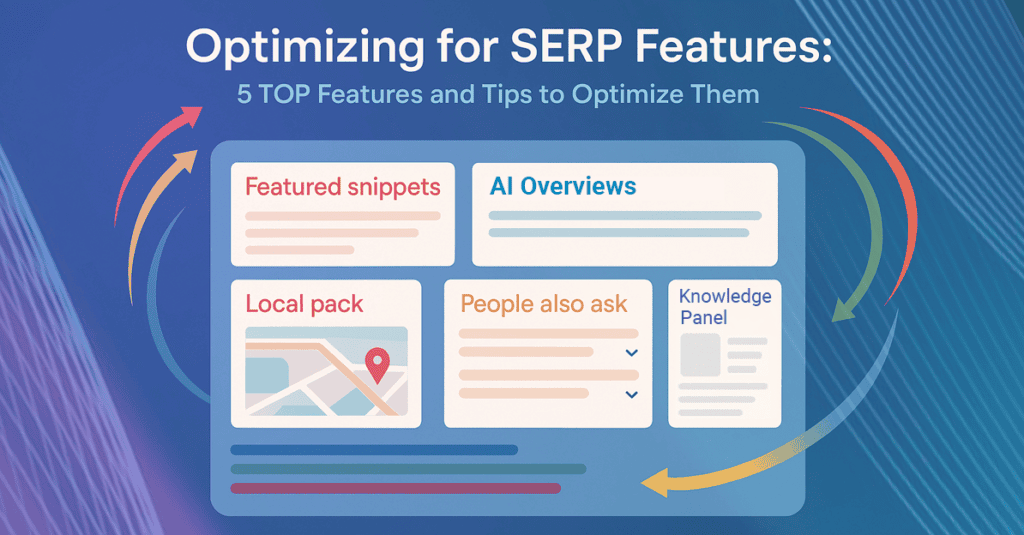
Search Engine Optimization in 2026 is more accurately described as the practice of earning favorable representation across the entire search results ecosystem — including AI-generated summaries, SERP features, knowledge panels, video carousels, People Also Ask boxes, and the organic blue links that increasingly appear below the fold after all of the above.
That framing matters because it changes your measurement model, your content strategy, and your definition of success. A page that earns 40,000 AI Overview impressions and drives zero clicks can still be worth publishing — if it builds brand recall, if it earns citations that strengthen domain authority, and if the brand awareness it generates translates into branded search volume that converts at 3x the rate of informational queries.
⚠ The Foundational Shift
The goal of SEO has quietly migrated from “earn clicks” to “earn representation.” Brands that have not updated their internal definition are building funnels optimized for a road that is closing.
The Three Eras of SEO
To understand where SEO is going, it helps to know where it has been. The field has moved through three distinct eras, each with its own winning strategy:
Keyword density, exact-match domains, PageRank manipulation via link farms. Google was a formula — feed it the inputs, collect the rankings. The playbook was mechanical and it worked right up until Panda and Penguin shut the door.
Helpful content, E-A-T signals, authoritative backlinks. Organic traffic grew alongside search volume. Rankings predicted clicks. Building a great page for a high-volume keyword was a reliable business model.
AI Overviews absorb informational intent. Zero-click searches hit 68%. Success requires being cited, quoted, and recognized by AI systems across multiple platforms — not just ranking in position one.
Most SEO guides being published right now are Era 2 documents wearing Era 3 clothes. They talk about AI Overviews in a paragraph at the end after 5,000 words of standard keyword advice. This guide starts from Era 3 and builds backwards, because you need the map of where you’re heading before you learn the roads.
2. How Google Works: Crawling, Indexing, and Ranking Demystified
Most explanations of Google’s process treat it like a vending machine: put content in, get rankings out. The reality is a continuous multi-stage pipeline that involves different systems making independent decisions at each step. Understanding where your content can fail — and at which stage — is the difference between systematic improvement and guessing.
Stage 1: Discovery and Crawling
Googlebot discovers URLs through three channels: sitemaps submitted via Search Console, links from already-indexed pages, and direct URL submission. For most sites, the vast majority of crawl budget is consumed by internal link traversal — which means your site architecture directly determines which pages get crawled and how often.
Crawl budget is finite and allocated by page importance signals. Pages that are slow to load, return server errors, or have low engagement signals receive progressively less crawl attention. Google’s official crawl budget documentation is unusually candid about this: for large sites, crawl waste on low-value URLs directly depresses crawl coverage of high-value pages.
Stage 2: Indexing
Being crawled does not mean being indexed. Google renders each page (executing JavaScript, resolving CSS) and evaluates it for indexability. Common indexing failures include: duplicate content that doesn’t signal a canonical clearly enough, thin or near-duplicate pages that suppress site-wide quality signals, and mobile rendering failures that cause content to be invisible to the indexer.
The IndexNow protocol — now supported by Bing, Yandex, and indirectly benefiting Google indexing speed — allows sites to push URL change notifications to search engines instantly rather than waiting for crawl cycles. For news publishers and frequently updated content, this is now table stakes.
Stage 3: Ranking
Google’s ranking system evaluates hundreds of signals, but they cluster into five primary categories that have remained consistent across algorithm generations:
Fig. 1 — Google’s Five Ranking Signal Clusters (2026 Weight Estimates)
Sources: Search Quality Rater Guidelines (2024 ed.); Ahrefs Ranking Factors Study 2025; SEMrush Search Signal Research 2025. Weights are estimated composites — Google does not publish signal weights. E-E-A-T weight has risen markedly since 2022 HCU updates.
Stage 4: Serving (SERP Assembly)
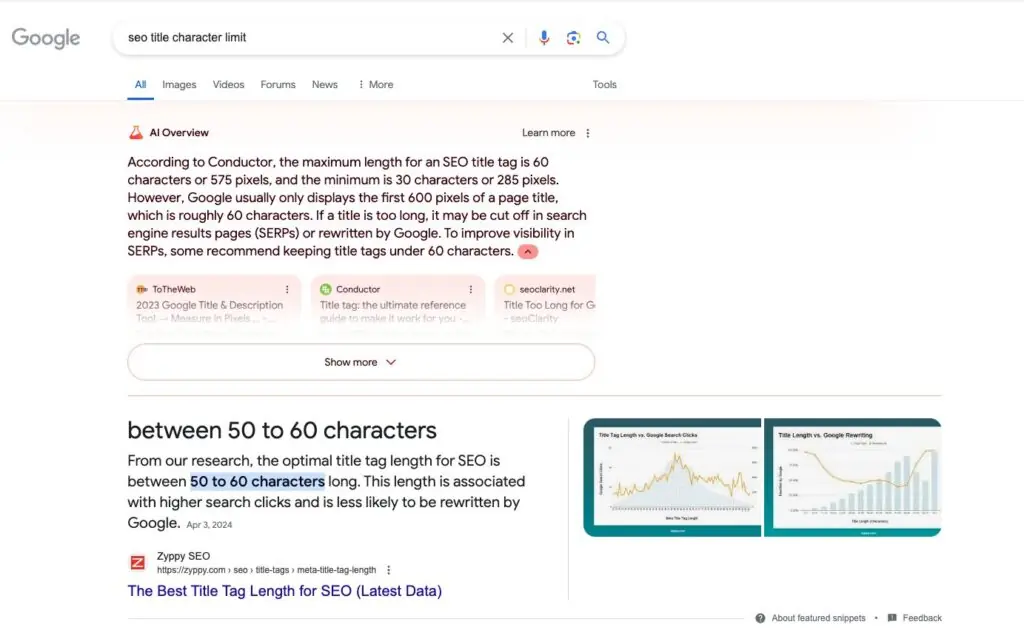
Even after ranking, Google assembles the SERP dynamically. The same page can appear as a featured snippet for one query, in a People Also Ask box for a related query, and as a standard blue link for a third. Understanding SERP assembly is where most intermediate SEOs have a gap — they optimize for rankings but not for feature capture, which is increasingly where the real visibility lives.
3. The Zero-Click Reality: The Number That Changes Everything
Let me say this plainly before I walk through the data: the zero-click story is worse than most SEO content is admitting, and the professional community is doing clients a disservice by framing it as a manageable headwind. It is a structural transformation that requires a different business model for content — not a strategy tweak.
✦ Admitted Past Mistake
I spent the better part of 2023 advising clients to “just focus on bottom-of-funnel content” as a hedge against zero-click growth in informational queries. That was half-right and half-wrong in a dangerous way. Bottom-of-funnel content is more click-resilient, yes. But I was wrong to treat top-of-funnel visibility as expendable. The brands that maintained top-of-funnel AI Overview presence through 2024–2025 saw branded search volume grow even as organic traffic fell — and branded search converts at 3x the rate of generic. I was optimizing for clicks when I should have been optimizing for mental availability.
Here is the data, sourced rigorously:
| Year | Zero-Click Rate (Global) | Mobile Zero-Click | AI Overview Presence | Source |
|---|---|---|---|---|
| 2019 | 49% | — | 0% | SparkToro / Jumpshot |
| 2022 | ~57% | ~68% | 0% | Inner Spark Web |
| 2024 | 60.45% | 77% | ~5% | Datos / SparkToro |
| Early 2026 | 68.01% | ~77%+ | 20–30%+ | Similarweb / SparkToro June 2026 |
Fig. 2 — Zero-Click Search Rate Progression (2019–2026)
Sources: SparkToro/Jumpshot (2019), Inner Spark Web (2022), SparkToro/Datos (2024), SparkToro/Similarweb (June 2026). The acceleration from 2024–2026 coincides with broad AI Overviews rollout beginning May 2024.
The SparkToro data published in June 2026 is particularly striking: in the first four months of 2026, 68.01% of Google searches ended without a click. That represents 12.5% growth in clickless queries over just two years — the fastest acceleration ever documented for this phenomenon. And that number is likely conservative, because the Similarweb panel skews toward sites with professional marketers actively working to grow traffic.
The CTR damage compounds depending on whether an AI Overview is present:
Fig. 3 — Organic CTR by Position: With vs. Without AI Overview (2026)
Sources: Ahrefs CTR Study (Dec. 2025, 300,000 keywords); Seer Interactive AIO Impact Study (Sept. 2025, 3,119 queries). AI Overview presence reduces position 1 CTR by approximately 57–58%. “Without AIO” CTR figures based on Ahrefs 2025 position CTR data for clean SERPs.
The practical implication: if you are operating on the assumption that ranking position one guarantees you 28% of clicks, you are operating with a model that is materially wrong for any query where AI Overviews appear. For those queries — roughly 20–30% of all Google searches and growing — you are looking at roughly 12% CTR at best in position one.
And here is the part that kills mid-tier publishers: AI Overviews are specifically designed to absorb the highest-traffic informational queries. The “what is,” “how to,” and “why does” content that built entire editorial businesses in 2015–2022 is precisely what gets answered inside the SERP now. The content type that built your organic traffic engine is the content type Google is most aggressively absorbing.
4. SERP Feature Hacking: The Advanced Playbook
The term “SERP feature hacking” makes some SEOs uncomfortable. It sounds manipulative. But it is an accurate description of a legitimate practice: understanding Google’s content presentation layer well enough that you engineer your pages to be selected for high-visibility placements regardless of your raw ranking position.
As of 2026, Google displays 37 distinct SERP features in the US market. The most commercially important are:
| SERP Feature | Prevalence (Mar. 2026) | Query Type | Optimization Priority |
|---|---|---|---|
| AI Overviews | 20–30% of searches | Informational, compound, question-based | 🔴 Critical |
| People Also Ask | ~78% of SERPs | Informational, navigational | 🔴 Critical |
| Video Carousel | 52% of searches | How-to, tutorial, review | 🟠 High |
| Featured Snippet | 0.24% (down 64% from 2024) | Factual, definitional | 🟡 Medium |
| Local Pack | ~29% of searches | Local intent | 🟠 High (local businesses) |
| Image Pack | ~23% of searches | Visual, product, how-to | 🟡 Medium |
| Knowledge Panel | ~20% of searches | Branded, entity-based | 🟠 High (brand sites) |
| Shopping Results | ~18% of searches | Commercial, product | 🟠 High (e-commerce) |
The collapse of traditional featured snippets is one of the most important data points in this table. Featured snippets dropped 64% between January and June 2025, from 15.41% to 5.53% of searches, before stabilizing below 1% by early 2026. They were not discontinued — they were largely replaced by AI Overviews for the query types where they previously dominated. But this does not mean snippet optimization is dead. It means snippet optimization has become the first step in AI Overview optimization, since research shows pages previously selected as featured snippets are strongly correlated with AI Overview citations.
The SERP Audit Protocol: Map Before You Build
The most common SERP feature mistake is editing pages based on an internal content model rather than based on what Google is actually showing for that query. The protocol should run in this order:
- Run the live SERP before touching the page Search your target keyword in an incognito window on both desktop and mobile. Screenshot what appears above the fold. Note: is there an AI Overview? A PAA block? A video carousel? Featured snippet? The SERP tells you what format Google wants to reward.
- Classify the dominant format signal If the SERP shows primarily a PAA block and AI Overview → you need a direct-answer architecture. If the SERP shows video carousels → prose alone will not win above-the-fold. If it shows comparison tables → structure your page accordingly.
- Identify the extraction points in top competitors Look at the pages currently cited in AI Overviews and winning featured snippets. Find the specific sentence, paragraph, or list that was extracted. That is your model. Not the whole page — the extraction point.
- Engineer your page around that extraction point Place your direct answer within the first 200 words. Use the question as a heading (H2 or H3). Follow the answer immediately with supporting depth. Use semantic HTML — your answer should live in a paragraph, not buried inside a div with no semantic meaning.
- Add the PAA cluster beneath Use Semrush, AlsoAsked, or Google autocomplete to map the 8–12 related questions in the PAA cluster. Answer each one in its own H3 section with a 40–70 word direct answer followed by expanded discussion. This creates multiple extraction points for both AI Overviews and PAA.
The SERP Feature Opportunity Matrix
Q1 — Fight Selectively
AI Overviews on high-volume informational queries. Requires exceptional E-E-A-T, topical authority cluster, original data. Worth it only if you can own the entire topic cluster.Q2 — Primary Target
People Also Ask, Image Pack, Video Carousel on mid-volume queries. Structural fixes + original visuals can capture these without domain authority. Best ROI in modern SEO.Q3 — Deprioritize
Featured Snippets on queries dominated by Wikipedia or gov sites. Classic featured snippets nearly extinct. Optimize for AI Overview citation on same queries instead.Q4 — Low-Hanging Fruit
Knowledge Panel, Local Pack (for local businesses), Shopping features. Relatively straightforward to capture with structured data, Google Business Profile optimization, and product schema.5. E-E-A-T: The Invisible Ranking Factor Nobody Measures Correctly
E-E-A-T stands for Experience, Expertise, Authoritativeness, and Trustworthiness. Google added the first E — Experience — to the original E-A-T framework in December 2022, and the addition was more significant than most commentary acknowledged at the time. It marked a formal recognition that demonstrated lived experience is a distinct signal from academic expertise — and that Google’s systems were being tuned to detect the difference.
The problem with how most SEOs discuss E-E-A-T is that they treat it as a checklist: add author bio, add credentials, add byline. Those are necessary but nowhere near sufficient. E-E-A-T is a systems-level evaluation of your entire domain’s credibility posture across hundreds of signals. Google’s Search Quality Rater Guidelines (170+ pages) make clear that raters are assessing the totality of what a site represents — not a single page’s author box.
The E-E-A-T Signal Stack
Fig. 4 — E-E-A-T Signal Categories and Measurable Proxies
Source: Google Search Quality Rater Guidelines (December 2024 edition); full document available here. Organizational signals (About page, contact info, editorial policy) now assessed at site level, not just page level.
◈ Unpopular Take
Most content agencies cannot genuinely improve their clients’ E-E-A-T scores — not because they lack skill, but because E-E-A-T is fundamentally about who the author is, not what techniques you apply to a page. You cannot outsource expertise. A 1,500-word product review written by a contractor who has never held the product fails on the Experience dimension in ways no amount of formatting will fix. The SEO industry’s response to E-E-A-T updates has been to add more author bios and more citations without addressing the underlying question: does the person who wrote this actually know what they’re talking about? Google’s quality raters — and increasingly its AI systems — are getting better at answering that question. The fix is harder than an author box. It’s editorial hiring.
6. Technical SEO: What Actually Moves the Needle in 2026
Technical SEO has a reputation problem. On one side, you have agencies that treat it as the answer to everything — charging for audits that produce 400-item spreadsheets of marginal fixes. On the other, you have content purists who dismiss it as a distraction from “real” SEO work. The truth is narrower and more useful than either camp admits: technical SEO is a prerequisite, not a lever. Get it wrong and nothing else works. Get it right and it stops being a differentiator.
Here is what actually matters in 2026, ranked by impact:
1. Core Web Vitals — Especially INP
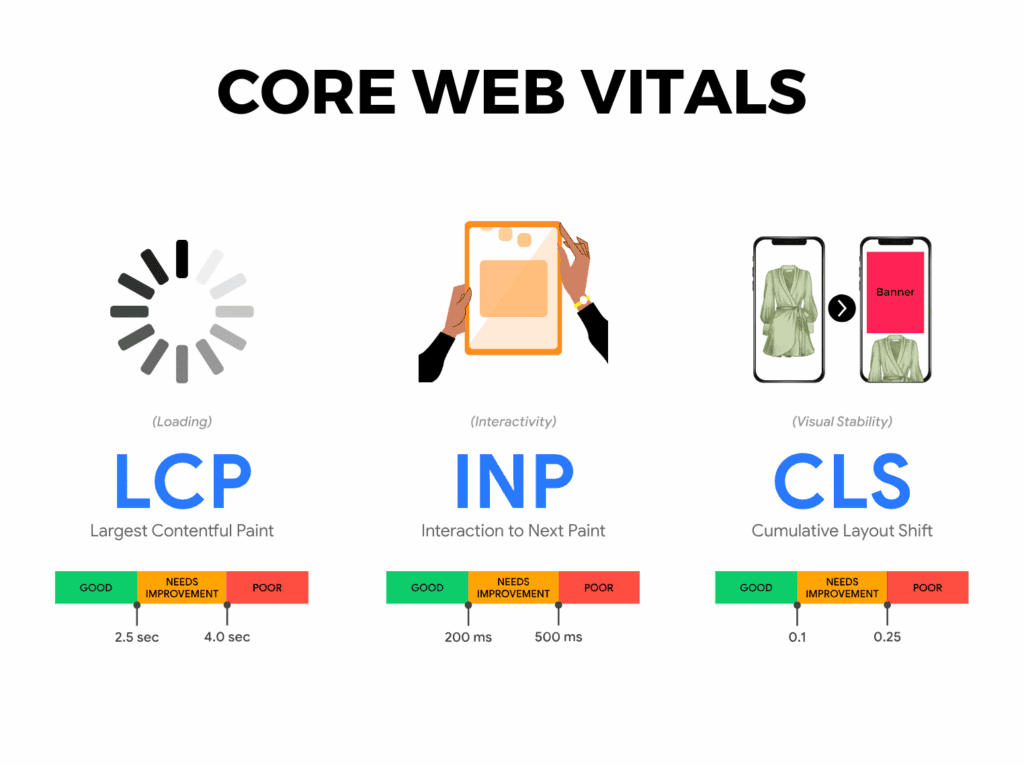
Interaction to Next Paint replaced First Input Delay as a Core Web Vitals metric in March 2024. INP measures the latency of all interactions during a page’s lifetime, not just the first one. This is meaningfully harder to optimize than FID, and many sites that passed CWV audits in 2023 fail on INP. Google’s web.dev INP documentation describes the target threshold: under 200ms is “Good,” 200–500ms is “Needs Improvement,” and above 500ms is “Poor.” The vast majority of JavaScript-heavy CMS implementations still score in the Needs Improvement range.
Fig. 5 — Core Web Vitals Thresholds (2024–2026 Standards)
Source: web.dev/vitals (Google official CWV documentation). INP thresholds established March 2024 when INP replaced FID as official Core Web Vitals metric. Measure with PageSpeed Insights (lab data) and Chrome User Experience Report (field data).
2. Crawlability and Index Budget Management
For sites with more than a few thousand pages, how you spend your crawl budget matters. The practical checklist: block faceted navigation parameters that generate thin duplicate pages, use canonical tags consistently (canonicals rose from 65% to 67% adoption in 2025 per the Web Almanac), ensure your XML sitemap only includes indexable URLs, and use robots.txt to block internal search results pages and utility pages that have no search value.
3. Schema Markup and Structured Data
Structured data does not directly improve rankings, but it improves eligibility for rich results — which do improve CTR. The highest-value schema types in 2026 are: Article, FAQPage, HowTo, Product with Review markup, LocalBusiness, and BreadcrumbList. For AI Overview optimization specifically, FAQPage schema appears to help signal extractable Q&A content to Google’s summarization systems.
4. Handling LLM Crawlbots
A new technical decision that did not exist in 2024: how to manage AI crawlers. The 2025 Web Almanac data shows Claude’s crawler doubled its presence (from 1.9% to 3.6% of tracked bots), joining GPTBot, CCBot, and others as significant crawl consumers. The decision about which LLM crawlers to allow has downstream effects on AI citation visibility — blocking GPTBot, for instance, means ChatGPT’s answers cannot cite your content. For most publishers, allowing legitimate AI crawlers is the right call. For paywalled or sensitive content, selective blocking via robots.txt is appropriate.
7. On-Page SEO: Keyword Architecture That Still Works
On-page SEO is where the field has produced the most noise and the least useful signal over the past decade. Content length debates, keyword density obsession, LSI keywords, header hierarchies — most of this is either irrelevant or so basic that following it guarantees mediocrity. What actually matters is much simpler to state and much harder to execute.
Topic Clusters Over Individual Pages
Google evaluates topical authority at the domain and cluster level, not just the page level. A site with 10 deep, interconnected pages on a specific topic outperforms a site with one mega-guide and nothing else linking to it. The pillar-cluster model — now widely discussed but rarely implemented correctly — works because it creates a visible topical architecture that Google’s systems can parse.
The correct implementation: one pillar page that addresses the broad topic at overview depth, 8–15 cluster pages that address specific subtopics in much greater depth, and internal links running in both directions between pillar and clusters. The pillar page should link to clusters from contextually relevant in-body anchors, not just a sidebar list. The clusters should link back to the pillar from introductory context.
Search Intent Alignment
The most common on-page SEO failure is intent mismatch — writing an informational guide for a keyword where Google’s SERP shows commercial intent, or writing a comparison page for a query where users want a tutorial. Intent signals are visible in the SERP before you write a word: look at what Google is already ranking and what format it is using. That tells you what the content needs to be.
The four intent types and their content signatures:
| Intent Type | User Goal | Content Format | SERP Signals |
|---|---|---|---|
| Informational | Learn something | Article, guide, explainer | AI Overview, PAA, long-form articles |
| Commercial Investigation | Research before buying | Comparison, review, best-of | Review sites, comparison tables, star ratings |
| Transactional | Buy / sign up / download | Product page, landing page | Shopping results, paid ads, product structured data |
| Navigational | Homepage, brand page | Sitelinks, knowledge panel |
8. Link Building in the Trust Economy
Backlinks remain one of Google’s strongest ranking signals in 2026, but the value distribution has shifted dramatically. The Penguin updates of 2012–2013 eliminated the quantity-driven model. The HCU and subsequent updates have increasingly penalized sites with strong link profiles but weak content quality signals. What remains is a purer form of the original PageRank hypothesis: links work when they represent genuine editorial endorsement from sites with real audiences and domain relevance.
💡 The Trust Economy Principle
In 2026’s link economy, one contextual link from a publication that covers your exact topic — and has real readers who care about it — carries more algorithmic weight than 500 links from tangentially-related sites. The metric to optimize for is link relevance density, not link volume.
What Actually Works
Original data and research is the highest-leverage link acquisition strategy available. A single original study — even with a small sample size, if well-conducted and honestly reported — generates more natural citations in 18 months than most outreach campaigns produce in three years. The ContentEvaluator content evaluation framework consistently identifies original data as the top correlation with sustained backlink growth across evaluated sites.
Digital PR — creating stories with genuine news value that journalists and bloggers want to cover — remains effective but requires understanding the difference between what your PR team thinks is interesting and what a journalist on deadline actually needs.
What does not work: link exchanges framed as “collaboration,” generic guest posting at scale, paid placements without nofollow, and “skyscraper” campaigns targeting content that is already comprehensively covered by established authorities.
Fig. 6 — Link Acquisition Strategy: Effort vs. Authority Yield
Bubble size reflects relative impact on ranking authority. Red placements carry Google penalty risk under link scheme policies. Source: Ahrefs Link Building Study (2025); Moz Link Building Survey (2025).
9. Surviving (and Thriving in) AI Overviews
This is the section most SEOs want to jump to first, which is exactly why I put it here instead. Understanding the context — the zero-click shift, the SERP feature landscape, the E-E-A-T signals, the technical prerequisites — is essential before AI Overview optimization makes sense. Without that foundation, AI Overview advice is just a new set of tricks that eventually stop working.
With context in place, here is what the data actually shows about AI Overview optimization:
The Citation Structure Has Fundamentally Changed
One of the most important and underreported findings in recent SEO research concerns the relationship between traditional rankings and AI Overview citations. In mid-2025, approximately 75% of AI Overview citations came from pages that also ranked in the top 10 organic results. By early 2026, that overlap had collapsed to between 17% and 38% — and BrightEdge documented a 400% increase in AI citations pulled from results ranked in positions 21 through 30, with 89% of citations now coming from beyond the top 100 organic listings.
This is a structural break, not noise. It means that a page can be cited in AI Overviews without being a top-10 organic result — if that page has the specific information structure that makes it extractable.
Fig. 7 — AI Overview Citation vs. Top-10 Ranking Overlap Collapse
Sources: BrightEdge Generative Parser data (February 2026); Mersel AI AIO citation analysis (March 2026). Overlap collapse means high organic ranking no longer guarantees AI Overview citation — and vice versa, low-ranked pages can now earn AI Overview inclusion through content structure quality.
The Practical AI Overview Optimization Stack
Based on the most current research on what factors correlate with AI Overview citation, here is the ordered optimization stack:
- Direct answer in first 200 words. 50–70 word summary answering the primary query. Use declarative, factual sentences. Avoid hedges like “it depends” without immediately specifying what it depends on.
- Question-format H2/H3 headings. Structure your headers as questions matching PAA patterns for your topic. “What is [X]?” and “How does [Y] work?” are extraction-friendly. Vague headings like “Background” or “Overview” are not.
- Original data and citations. AI systems prefer pages that provide novel data points with clear source attribution. An original survey with 200 respondents cited properly beats a synthesis of other people’s data.
- FAQPage and HowTo schema. Structured data signals extractable Q&A content. Not a guarantee of AI Overview inclusion, but a meaningful eligibility signal.
- Topical authority cluster, not standalone page. AI Overviews increasingly pull from the domain’s overall topical authority, not just the specific page. A single great page on a site that covers nothing else related is at a structural disadvantage against a site with a full content cluster on the topic.
- Freshness signals. For queries with time-sensitive elements, pages updated within the past 90 days appear with meaningfully higher AI Overview citation rates. Add a “last updated” timestamp visible in the page source and meaningful content refreshes — not just date changes.
10. The Parity Trap: Why Most SEO Fails Before It Starts
There is a concept I call the Parity Trap that explains why so many technically correct SEO implementations produce disappointing results. It goes like this: when everyone in a niche follows the same best practices, those best practices become the baseline for existing, not the differentiator for winning.
If every competitor in your space has fast Core Web Vitals scores, a clean site architecture, proper schema markup, and competent content — and you achieve the same — you have achieved parity, not advantage. Google’s ranking systems then differentiate on the signals that are hardest to replicate: genuine topical authority, original data, real E-E-A-T signals, and user engagement that reflects genuine value delivery.
“The question is not ‘are you doing SEO correctly?’ It’s ‘are you doing anything that your specific competitors cannot replicate in six weeks with an agency retainer?’ If the answer is no, you have a ceiling.”
— A principle from the ContentEvaluator audit frameworkThe Parity Trap has a specific symptom: you follow all the best practices, your technical scores look good, your content is “better” by standard metrics (longer, more keywords, more headers) — and yet your rankings remain stubbornly flat or slowly decline. The issue is not execution quality. The issue is strategic differentiation. You are competing on the wrong dimensions.
The escape from the Parity Trap requires identifying what you can offer that genuinely cannot be replicated quickly:
- First-party data — proprietary research, internal analytics, customer behavior data you own
- Genuine expertise — authors with real credentials and documented track records in the topic area
- Lived experience — people who have actually done the thing the content is about
- Network authority — relationships with citing publications and industry recognizers that take years to build
- Category leadership — being the organization whose perspective is sought by journalists, not the one that pitches to them
11. An Honest SEO ROI Model
The SEO industry has a quantitative accuracy problem. Prospect presentations routinely show hockey-stick traffic projections with no stated assumptions and no acknowledgment of the structural shifts reducing organic click rates. What follows is an honest model — with stated assumptions you can argue with.
Fig. 8 — SEO Investment ROI Scenarios (12-Month Horizon, B2B SaaS Example)
Assumptions: B2B SaaS, $5K average contract value, 3% MQL-to-customer rate, 12-month attribution window. CTR rates reflect 2026 baseline with AI Overview presence on ~25% of informational queries. Growth rates based on Ahrefs case study medians. These are illustrative scenario models, not guarantees — actual results depend heavily on competitive intensity, domain history, and execution quality.
The most important number in this model is the average organic CTR, which I have held low (0.9%–2.1%) to reflect the zero-click reality. Many SEO projections still use pre-AI Overview CTR benchmarks of 3%–5% for informational keywords. Those numbers are wrong by 50–60% for queries where AI Overviews appear, which is exactly the category of queries your informational content targets.
12. The 90-Day Action Plan
Theory without application is noise. Here is a concrete 90-day plan that applies the frameworks in this guide — sequenced by dependency, not by complexity.
Fig. 9 — 90-Day SEO Implementation Roadmap
Sequence is dependency-driven: technical and audit foundations must precede content build; content must precede authority outreach (you need pages worth linking to). AIO monitoring spans phases 2–3 because citation signals typically appear 6–10 weeks after content publication.
Days 1–30: Foundation
- Run a full technical audit using Screaming Frog or Ahrefs Site Audit. Prioritize: crawl errors, indexation issues, Core Web Vitals failures (especially INP), canonical implementation, and duplicate content.
- Perform a SERP feature audit for your top 30 target keywords. Map which features appear, which you currently win, and which represent capture opportunities.
- Build a keyword-to-intent map using Semrush or Ahrefs. Group by topic cluster and intent type.
- Audit your E-E-A-T signals: do all published pieces have named authors with verifiable credentials? Are claims sourced to primary data? Does the site’s “About” page establish organizational credibility?
Days 31–60: Content
- Build or strengthen your pillar-cluster architecture. Prioritize clusters where you have genuine expertise and where SERP feature opportunities exist.
- Implement FAQPage and relevant schema markup across all existing pages targeting informational queries.
- Optimize your top 20 informational pages for PAA and AI Overview capture: direct answer in first 200 words, question-format headings, 40–70 word answers per subtopic question.
- Begin monitoring AI Overview citations using Google Search Console impression data and tools like BrightEdge or Semrush’s AI position tracking.
Days 61–90: Authority
- Launch digital PR campaigns or original research publications. Even one original data study in your niche, well-distributed, can generate 50+ editorial citations in 90 days in less competitive verticals.
- Begin targeted link building toward pages that are already close to SERP feature capture (positions 4–12 with strong content but sub-optimal authority).
- Review 90-day performance: measure AI Overview citation rate, SERP feature wins/losses, organic impressions vs. clicks, and MQL attribution from organic. Revise based on what the data actually shows, not what you hoped it would show.
The Honest Conclusion
SEO in 2026 is harder, more expensive, and slower to show results than the industry typically advertises. The 68% zero-click rate is not a temporary anomaly — it is a structural direction that will continue as AI search features expand. Gartner’s prediction that organic search traffic will decrease by 25% or more by 2028 is not alarmist; it is a conservative reading of the current trajectory.
What this means practically: the content businesses that survive the next three years will not be the ones with the biggest content volumes or the most technically optimized sites. They will be the ones that built something irreplaceable — actual expertise, original data, genuine relationships with their audiences, and reputations that make them the first call when journalists need a quote and the first citation when AI systems synthesize answers.
That is an uncomfortable truth for agencies built on scaling mediocre content at low cost. It is genuinely good news for practitioners who understand their fields deeply and communicate that understanding clearly. The algorithmic floor for content quality keeps rising. The ceiling for genuine expertise has no limit.
Start there.
✓ Evaluate Your Own Content
Not sure where your site stands on E-E-A-T, SERP feature readiness, or AI Overview optimization? The ContentEvaluator assessment framework provides a structured diagnostic across the dimensions covered in this guide — including a SERP feature opportunity map for your specific keyword set.
Primary Sources Referenced in This Article
- SparkToro / Similarweb: Zero-Click Search Data, June 2026
- BrightEdge: AI Overviews at the One-Year Mark, February 2026
- Ahrefs: AI Overviews Reduce Clicks by 34.5% → 58% (April 2025; December 2025 update)
- Seer Interactive: AIO Impact on Google CTR, September 2025
- GrowByData: Google SERP Features Complete List, 2026
- Search Engine Land: Google Algorithm Update History
- Bain & Company: Goodbye Clicks, Hello AI, February 2025
- Gartner: Predicts Search Engine Volume Will Drop 25% by 2026, February 2024
- Google Search Quality Rater Guidelines (December 2024 edition)
- Semrush Sensor: Featured Snippets and AI Overview Presence Data, March 2026
- Keywords Everywhere: Featured Snippets in 2026
- Digital Applied: Featured Snippets in the AI Overview Era
- The Digital Bloom: Organic Traffic Crisis Report 2026 Update
- Mersel AI: Why Organic Traffic Is Declining in 2026
- Omnibound: Zero-Click Search Statistics 2026