

Every guide starts with the same definition. They’re all wrong by about ten years. Here’s the honest version — including the math on what a ranking position is really worth in a world where 60% of searches end without a click.
The “free traffic” definition isn’t technically wrong — it’s just uselessly incomplete. It describes the billing model (no cost-per-click) while hiding the actual mechanism (SERP feature competition, click-share redistribution, and AI citation dynamics) that determines whether any traffic arrives at all. You can rank #1 for a solid keyword and watch your organic traffic fall for six months straight. That’s not a paradox anymore. That’s Tuesday in 2026.
I spent most of 2023 running content operations that were, in hindsight, optimized for a SERP that no longer exists. We chased volume keywords, built topic clusters, earned decent links — and watched our click-through rates compress year after year. The wake-up moment came when a page ranking #2 for a 12,000-monthly-search keyword was delivering 180 visitors per month. Position two. Twelve thousand searches. One hundred and eighty clicks. The math had broken.
This article is my attempt to give you the full, uncomfortable picture — and then the actual playbook for fixing it.
- The Argument: Organic Traffic Is Still the Most Valuable Channel
- The Counterargument: The Click Is Being Systematically Eliminated
- The Synthesis: The VISIT Framework for 2026
- Unit Economics: What a Ranking Position Is Actually Worth
- The “Fast” Part: Tactics That Move the Needle in 30–90 Days
- The Compound Engine: Long-Term Traffic Architecture
- The AI Citation Layer: GEO, AEO, and the New Traffic Source You’re Ignoring
- Measurement in the Age of Zero-Click
Part I — The Argument: Organic Traffic Is Still the Most Valuable Channel on the Internet
Before we get into the dark parts, let’s be precise about what makes organic traffic structurally superior to almost every other traffic source, because that foundation matters for understanding where to fight.
Organic traffic is the channel that compounds. A well-ranked page keeps earning clicks 18 months after you published it, with zero incremental spend. Paid search goes dark the moment you stop funding it. Social reach is algorithmically throttled on a timeline you don’t control. Email requires list-building that itself depends on some other traffic source. Organic is the gravity well that everything else orbits.
The Three Structural Advantages That Nothing Has Replaced
Intent precision. Someone typing “best CRM software for a 10-person remote team” into Google has already done the cognitive work of identifying a problem, scoping a solution category, and committing to research. No social ad reaches that level of purchase proximity at the moment of maximum openness. That’s why, according to SE Ranking’s 2025 data, the #1 organic result captures a 39.8% click-through rate — more clicks than positions 3 through 10 combined.
Compounding authority. Every backlink earned by a great piece of content increases the domain authority that lifts every other page on your site. The traffic value of a link earned today extends years into the future. Paid media creates no such residual.
Trust asymmetry. Users trust organic results more than ads. That trust differential shows up in conversion rates, time on site, and brand recall. For most niches, an organic visitor who converts is worth more per sale than a paid visitor who converts — because the journey that led them there required you to earn their attention rather than interrupt it.
The argument for organic traffic doesn’t require you to pretend the landscape is rosy. It only requires you to recognize that, despite everything — AI Overviews, zero-click behavior, agentic browsers — organic search still drives more than half of all web traffic. Google still sends 345 times more traffic to websites than ChatGPT, Gemini, and Perplexity combined, per Ahrefs’ 2025 measurement. The channel is being compressed, not collapsed.
Part II — The Counterargument: The Click Is Being Systematically Eliminated
Here’s where I need you to feel genuinely uncomfortable, because the dominant SEO industry narrative — “just keep publishing good content” — is dangerously incomplete in ways that will erode your organic channel without your analytics screaming at you until it’s too late.
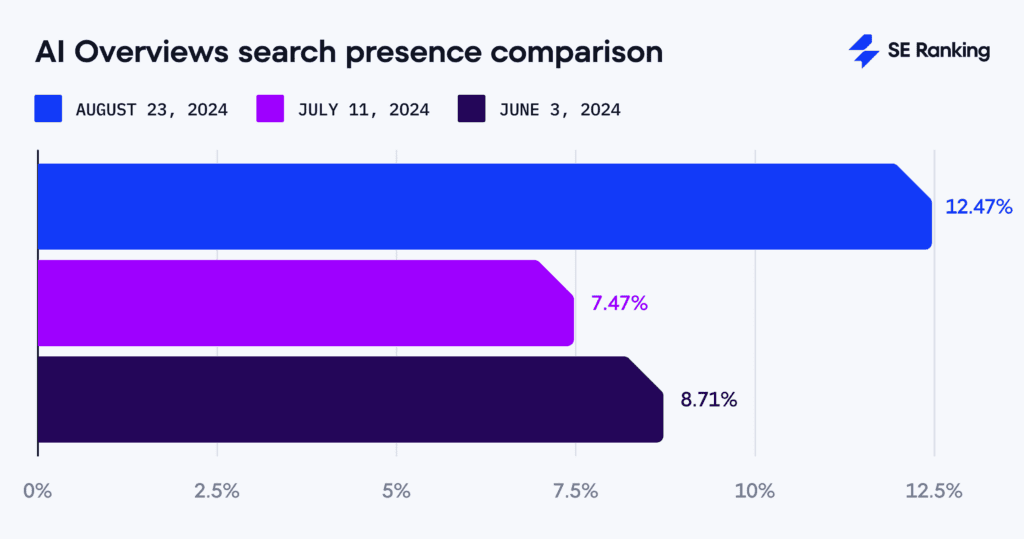
In Q1 2026, 25.11% of Google searches triggered an AI Overview, up from 13.14% in March 2025. When an AI Overview appears, position-1 CTR drops by approximately 34.5%. Organic CTR with an AI Overview present: 0.61%. Without: 1.62%. (Sources: Semrush, ALM Corp, Demand Local.)
Let’s work through the brutal arithmetic. Take a keyword with 10,000 monthly searches. No AI Overview present: position 1 earns roughly 39.8% CTR = 3,980 visitors. AI Overview triggers on that query: CTR crashes to approximately 0.61% even for top results = 61 visitors. That’s not a 35% traffic loss. That’s a 98% traffic loss on the queries where Google decides to answer the question itself.
Five Forces Compressing Organic Click Volume in 2026
The Digital Strategy Force’s May 2026 analysis identified five independent mechanisms that converged on Q1 2026 simultaneously — and the fact that they’re independent is what makes the situation structurally serious rather than cyclical.
Force 1 — AI Overviews (Google’s own answer engine). Triggered on 25.11% of queries in Q1 2026, per a 21.9-million-search study. Click-through rates in AI Overview SERPs are a fraction of non-AIO results. The queries most affected are the informational, top-of-funnel content that historically drove discovery for content-heavy websites.
Force 2 — Agentic browsers. OpenAI’s ChatGPT Atlas launched in October 2025 with an agent mode that browses on behalf of users — visiting sites but rarely generating a referrer signal the destination site can attribute. Perplexity Comet reached the same surface in July 2025. These tools complete research tasks without ever producing an organic session in your analytics.
Force 3 — Training crawlers. AI training bots reached 49.9% of all AI bot traffic but return disproportionately fewer referrals — they consume your content without sending readers.
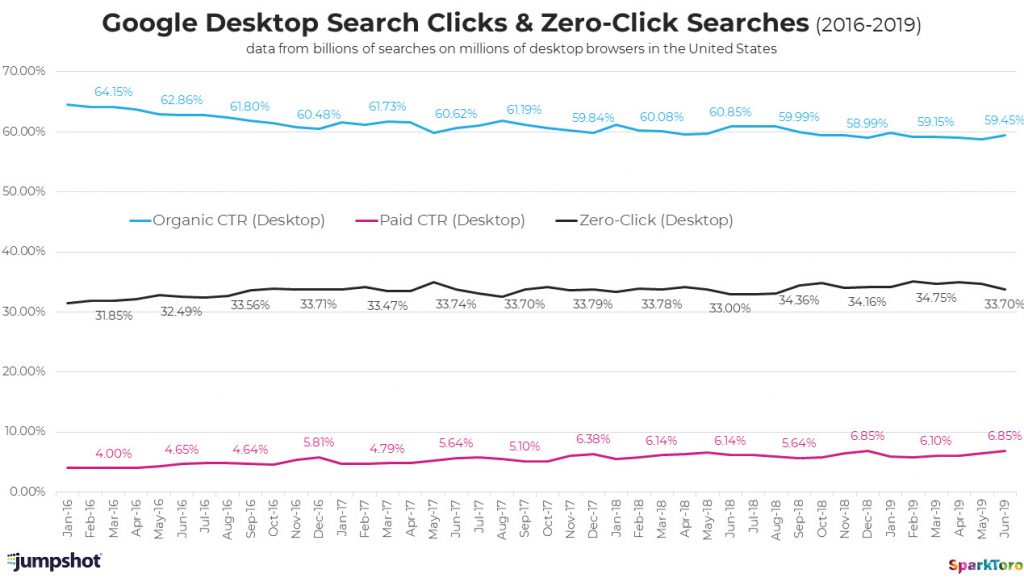
Force 4 — Zero-click behavior. Sixty percent of all Google searches now end without a click to any website, according to SparkToro/Datos research. On mobile, that figure reaches 77%. Users found what they needed before they ever left the results page.
Force 5 — Generative AI adoption velocity. Generative AI hit 53% U.S. population adoption in 2026 faster than the internet itself adopted, per Digital Strategy Force analysis. The size of the audience substituting AI-based answers for traditional search clicks is now majority-scale.
The result: ALM Corp’s February 2026 analysis found organic click share down 11 to 23 percentage points across multiple verticals between January 2025 and January 2026. Text ads gained 7 to 13 percentage points in that same period. HubSpot lost 70%–80% of its organic traffic between November 2024 and Q2 2025, with CEO Yamini Rangan publicly attributing the shift to AI Overviews resolving queries before users clicked.
This is not SEO doom-scrolling. This is structural reality you need to plan around. Which brings us to the synthesis.
Part III — The Synthesis: The VISIT Framework
The two positions above — “organic traffic is the most valuable channel” and “the click is being systematically eliminated” — are both true simultaneously. The resolution isn’t to pick a side. It’s to change what you’re optimizing for.
I’ve been building toward what I call the VISIT Framework — a synthesis of how organic traffic actually works in the AI Overview era. Not what it used to be. Not what you wish it were. What it actually is now.
The VISIT Framework: Organic Traffic for the AI SERP Era
Five dimensions that determine whether your organic strategy creates compound value or gradually erodes it.
The Math You Need: Unit Economics of a Ranking Position in 2026
Most SEO articles talk about CTR in the abstract. Let me give you the actual dollar math, because that’s what determines whether a ranking is worth pursuing at all — and where your time is best spent.
The following model uses verified CTR data from SE Ranking (2025), Demand Local AI Overview research, and publicly available conversion rate benchmarks. Adjust the conversion value for your own business.
Now let’s run the actual unit economics across three scenarios for a keyword with 10,000 monthly searches.
| Scenario | Position | AIO Present? | Est. CTR | Monthly Visitors | Conv. Rate (2.35%) | Conversions | Value @ $150/conv. |
|---|---|---|---|---|---|---|---|
| Best Case | #1 | No | 39.8% | 3,980 | 2.35% | 94 | $14,050/mo |
| Typical 2026 | #1 | Yes (25% of time) | ~26% | 2,600 | 2.35% | 61 | $9,150/mo |
| AIO Always On | #1 | Yes (100%) | 0.61%–1.05% | 61–105 | 2.35% | 1–2 | $150–$300/mo |
| Position #5 No AIO | #5 | No | 5.1% | 510 | 2.35% | 12 | $1,800/mo |
| AI Citation Win | any/cited | Cited in AIO | 1%–2.4%* | 100–240 | 23× higher† | 2–6 | $300–$900/mo (high intent, converts better) |
*Seer Interactive April 2026: organic CTR in AI Overviews bounced from 1.3% to 2.4% Feb 2026. †Onely 2025: AI search visitors convert 23× better than traditional organic. Conversion rate of 2.35% is a general cross-industry average (Wordstream). $150/conversion is illustrative — adjust for your business.
The takeaway from this table isn’t that ranking is pointless. It’s that the query landscape you’re targeting determines whether a #1 ranking is worth $14,000/month or $300/month. Keyword research in 2026 must include AI Overview frequency as a filter variable — because a keyword with 80% AI Overview trigger rate is worth roughly one-sixtieth of the same-volume keyword without AIO presence.
Before investing in any content piece, check the live SERP for that query. Does an AI Overview appear? Run the query across three different intent variations. If AIO triggers on more than half of them, you’re building content to feed Google’s summary engine for free — not to earn clicks. Pivot to the adjacent, transactional, or comparison-format version of that query where AIO is absent.
How to Increase Organic Traffic Fast: The 30–90 Day Playbook
“Fast” in organic traffic is a relative term. I’ll be honest: you’re not going to build a top-ranking site in two weeks. Anyone telling you that is selling something. What you can do is move existing rankings, fix existing traffic bleeds, and capture incremental click volume on existing content — often within 30 to 60 days, without any new content creation.
This is the sequence I’d run if I had 90 days and needed to show measurable organic traffic growth.
Days 1–14: Find the Existing Value You’re Leaking
Open Google Search Console. Export the queries from the last 90 days. Sort by impressions descending. Now look at the CTR column. You’re looking for the high-impression, low-CTR anomalies — queries where Google is already showing your page to searchers but few are clicking.
These pages are failing at one of four things: (1) a title tag that doesn’t match the query intent, (2) a meta description that doesn’t create urgency, (3) a URL that signals thin content, or (4) a featured snippet competitor that’s eating your clicks. The fix is often faster than you think — retitled pages can see CTR improvements within 2–3 weeks of Google recrawling.
Filter Google Search Console for queries with >500 impressions and <3% CTR where you rank between positions 4–15. These are your highest-leverage optimization targets. Rewrite title tags to include the specific value proposition the user wants — not just the keyword — and add a power word in the meta description. Track CTR weekly for 30 days.
Days 15–45: The Content Upgrade Sprint
New content is slower than upgraded content. A post that already has some ranking authority simply needs to recapture the intent it was targeting before the algorithm or user behavior shifted.
Identify your top 10 posts by organic traffic 18 months ago. Compare to their traffic now. If any have dropped by more than 30%, that’s a rescue candidate. The most common failure modes: outdated statistics (replaced by newer sources), content that now triggers AI Overviews (needs restructuring toward deeper, non-answerable-in-a-snippet depth), or SERP features that didn’t exist when the piece was written (adding FAQ schema to capture PAA boxes, for instance).
Days 45–90: Structured Data & SERP Feature Capture
Structured data is still one of the most underutilized quick wins in technical SEO. Adding FAQ schema to a post that already ranks on page one can earn People Also Ask box inclusion within weeks of Google’s next crawl. Adding HowTo schema to instructional content can earn rich result display that dramatically increases SERP footprint and CTR even without a ranking change.
Target SERP features in this priority order based on click value: Featured Snippets (capture informational CTR before AIO does), People Also Ask boxes (excellent for long-tail expansion), Video carousels (if you have YouTube content), and Image packs (for visual or product queries).
The Compound Engine: Long-Term Traffic Architecture
The fast tactics above are triage. The compound engine is what actually builds a traffic asset. And the compound engine has four interlocking components that most sites only partially build.
1. Topical Authority Clusters
Google’s algorithm has been moving toward topical authority — rewarding domains that demonstrate comprehensive, reliable coverage of a subject — for years. The practical implication: a site that publishes 15 deeply connected articles on a narrow topic typically outranks a site that publishes 50 shallow articles across a broad domain.
A content cluster has a pillar page (broad, comprehensive coverage of a main topic), cluster pages (deep dives on specific sub-topics that internally link back to the pillar), and supporting data pages (original research, tools, or calculators that earn external links). The internal link structure signals to Google which page is most authoritative, which controls the traffic distribution across the cluster.
2. Link Acquisition That Actually Works
Backlinks remain one of Google’s strongest ranking signals. What’s changed is that the link-building tactics that worked in 2019 — guest posting at scale, directory submissions, PBN links — either don’t work or actively hurt. Digital PR and original research are now rated as the most effective link-building tactic by 48.6% of SEOs in 2026, per SE Ranking’s practitioner survey.
The compounding logic: a page that earns three high-authority backlinks lifts not just its own rankings but the domain authority that benefits every other page on the site. Link acquisition is not page-level investment — it’s portfolio-level investment.
A quality outsourced link typically runs around $508 per link when procured through reputable link-building services (Performance Marketing Advisors, 2026). For a site needing 20 quality links to become competitive in a mid-difficulty niche, that’s a $10,000+ investment before any content costs. This is not a weekend project. Build this into your actual budget model, not your optimistic projection.
3. Technical Foundations That Most Sites Skip
As of November 2025, only 54.6% of websites pass all three Core Web Vitals metrics simultaneously (BrightEdge). That means 45.4% of sites are failing at least one technical ranking threshold — a problem that content quality cannot compensate for at the margins. If your LCP is above 2.5 seconds, your INP is above 200ms, or your CLS is above 0.1, you are leaving ranking positions on the table that your content quality has earned.
The fixes that matter most: image optimization (30–70% page size reduction per GoodFirms benchmarks), eliminating render-blocking scripts, implementing CDN distribution, and addressing layout instability from dynamically loaded ads and embeds.
The AI Citation Layer: Generative Engine Optimization (GEO)
This is the section that wasn’t in any organic traffic guide two years ago — and it’s the one I’d read most carefully if I were building a content operation from scratch today.
AI search visitors convert 23 times better than traditional organic traffic. They generate 12.1% of signups while accounting for only 0.5% of overall traffic, per Onely’s 2025 study. These are the most qualified visitors entering your funnel — because they arrive after having already received an AI-synthesized answer to their question and followed a citation link to go deeper.
The question is how you get cited. And the answer is different from how you rank.
The critical insight from this matrix: there is substantial overlap between good SEO and good GEO practice — clear answer capsules, authoritative sources, schema markup, strong backlink profiles. You’re not starting from zero. But GEO adds two requirements that pure SEO doesn’t:
Cross-platform entity density. YouTube was cited in 31.8% of LLM responses, second only to Reddit at 46.4% (OtterlyAI, April 2026). A brand that exists only as a website is an entity that AI engines have trouble confidently citing. A brand that has verified YouTube content, Reddit community presence, credible LinkedIn profiles, and consistent schema markup across all properties becomes citable with much higher confidence.
Extractable answer architecture. LLMs don’t read your 3,000-word article the way a human does. They identify dense, fact-rich passages where a direct answer to a specific question is legible. Write your content with “answer paragraphs” — 50–100 word self-contained blocks that directly answer a specific question, attributed to a named source where possible — and you dramatically increase your citation probability.
Measurement in the Age of Zero-Click
The measurement model that most teams are running — total organic sessions, page-level impressions, average ranking position — is systematically misleading in 2026. You can look successful while your channel is deteriorating, and you can look like you’re declining while your actual qualified demand is healthy.
Here’s the measurement stack I’d build today:
The most underused measurement insight: branded search volume in Google Search Console is a leading indicator of zero-click brand awareness. When someone sees your brand cited in an AI Overview and never clicks — but later searches for your brand directly — that branded query is the measurable signal that your AI visibility is working. Track branded query volume monthly as a proxy for dark-funnel authority building.
The Unpopular Take: Stop Obsessing Over Position #1
I know this will annoy some readers. But position #1 for an AI Overview-heavy informational keyword is, in 2026, often worth less than position #3 for a high-intent transactional keyword where AIO rarely triggers. The CTR math is unambiguous. A site that strategically dominates the low-AIO, high-intent quadrant of its niche will outperform a site that wins vanity positions on high-volume informational queries — often at a fraction of the content production cost.
Low-AIO, High-Intent Keyword at Position #3
5,000 searches/mo · 10.2% CTR · No AI Overview · Transactional intent → 510 high-converting visitors/month. Value: significant.
High-AIO, Informational Keyword at Position #1
12,000 searches/mo · AIO always present · CTR drops to ~0.61% → 73 visitors/month. Impressions look great. Traffic is not.
The organic traffic game in 2026 is not about the biggest numbers at the top of your analytics dashboard. It’s about identifying the keywords where clicks still flow freely — because those keywords are where your content investment returns actual visitors rather than feeding Google’s summary engine.
The uncomfortable truth at the center of all this: growing organic traffic fast in 2026 requires first accepting that the organic traffic you’ve been measuring isn’t the organic traffic you should be measuring. The volume metric is increasingly a vanity number. The quality metric — qualified visits, AI citation share, branded search trend, actual conversion by source — is where real growth lives. Most sites don’t have the measurement stack to even see this clearly. And the sites that do see it clearly, and then act on it with the discipline the VISIT Framework requires, are the ones that compound. The gap between those two groups is widening, not narrowing. Which side you’re on is a choice you make this quarter, not a trend you drift into.