

The Complete Guide to Modern SEO: Winning the Post-Click Search Era
Two out of every three Google searches now end without a single click. This is the guide for teams who are done reporting rankings that don’t translate into traffic — and ready to build for the SERP that actually exists in 2026.
Here’s a exercise worth running before you read another word of this guide: pull up Google Search Console for your highest-impression page, and divide clicks by impressions. If that number has been quietly sliding for the past eighteen months while your average position stayed flat or even improved, you’re not imagining it, and you’re not doing anything wrong by the old rules. The rules changed under you.
That’s not a metaphor. It’s a measurable fact about the search results page itself. Independent researchers who have tracked click behavior since the Jumpshot clickstream panel days of the late 2010s now agree, across several different data providers and methodologies, that the majority of Google searches end without anyone clicking anywhere. The most recent and most rigorously documented figure — SparkToro’s analysis of Similarweb’s US clickstream panel for January through April 2026 — puts that number at 68.01%. Translate that into a mental picture: for every 1,000 searches, only 276 people ever leave Google’s own page.
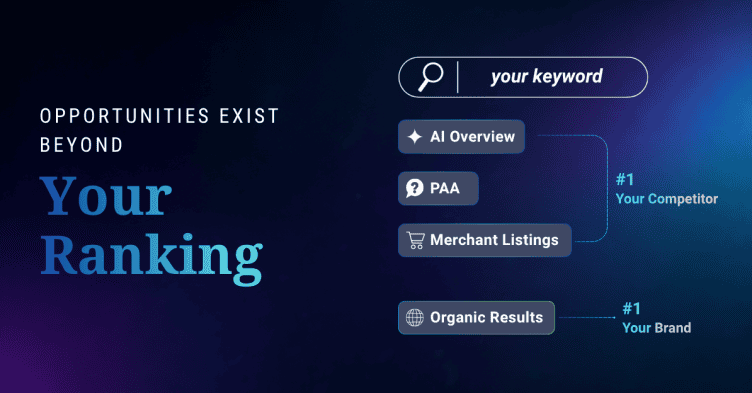
This guide is built around one core idea: SEO in 2026 is not about earning a ranking. It’s about earning a place on a search results page that has become a genuine multi-surface competition — AI Overviews, featured snippets, People Also Ask boxes, knowledge panels, local packs, and, yes, still the ten blue links, all fighting for a shrinking pool of attention. Every statistic below is dated and sourced. Where sources disagree — and on a topic this fast-moving, they often do — we say so rather than pretend to a precision the data doesn’t support.
Executive Summary — Read This If You Only Read One Section
- Zero-click is now the majority outcome, not the exception. 68.01% of US Google searches in early 2026 ended without a click (SparkToro/Similarweb, June 2026).
- AI Overviews cover roughly 43–50% of US queries depending on the measurement window and provider, and Google itself has confirmed a figure near 50% (BrightEdge, Google, February 2026).
- Position one still matters, but its ceiling has dropped. Ahrefs found AI Overviews can cut position-one CTR by up to 58% versus the same query without one (December 2025).
- Citation beats ranking as the new primary KPI for informational content. Brands cited inside an AI Overview see meaningfully higher downstream organic and paid CTR than uncited competitors on the same query.
- Content quality is the single heaviest ranking factor at roughly 23% of algorithm weight, ahead of backlinks (13%) and on par with topical/niche expertise (13%) — First Page Sage’s continuous algorithm study.
- Generative Engine Optimization (GEO) is now a distinct, measurable discipline with its own tooling category — not a rebrand of SEO, but a necessary complement to it.
1. The Zero-Click Reality in 2026
The SEO industry has known about zero-click search for years. Rand Fishkin’s SparkToro first put a serious number on it back in 2019, when roughly half of Google searches ended without a click. Most of the industry treated that as a curiosity — a footnote about “brand awareness” before returning to rank-tracking as usual. The measurement systems didn’t change. The dashboards didn’t change. The client pitches didn’t change.
Seven years later, that curiosity is the majority behavior of Google’s users.
It’s worth being honest about how messy this data landscape actually is, because that honesty is itself useful information. Different research firms use different panels — Similarweb, Datos, Jumpshot’s now-defunct panel, Bain’s Dynata-based survey work — and their numbers don’t always agree. SparkToro’s own historical figures place zero-click at roughly 45% in 2016, 49% in 2019, 60.45% in 2024, and 68.01% in the first four months of 2026. Other firms measuring different panels or geographies report figures ranging from the high 50s to the high 60s for the same rough period. The methodologies aren’t directly comparable across years. What every credible source agrees on, without exception, is the direction and the speed: the share of searches that never leave Google has been rising for a decade, and it accelerated sharply after AI Overviews launched broadly in May 2024.
Now, here’s the reframe that turns this from a crisis into a strategy. Zero-click does not mean zero-value. It means the point of value capture has moved upstream, from the click to the impression. A brand cited inside an AI Overview earns exposure and a trust signal even when nobody clicks — and multiple 2026 studies now find that cited brands see materially higher click-through on the traffic that does convert to a visit, compared with competitors on the same query who go uncited. The practical shift: stop measuring search success purely in sessions. Start treating the SERP itself as a brand channel, with clicks as the highest-value event on a spectrum that also includes impressions, citations, and downstream branded search.
If your content calendar is built around capturing traffic from informational, how-to, or definitional queries, you’re publishing onto real estate that Google is actively narrowing. That’s not a future risk — for the majority of informational queries today, it’s already the baseline reality your analytics are reporting, whether your dashboards are built to show it or not.
2. The SERP Real Estate Framework v2 — An Original Model
Most SEO mental models still treat the results page as a one-dimensional list: positions one through ten, with a steep traffic curve that makes anything past position five feel irrelevant. That model made sense when the SERP genuinely was a list. It no longer is.
The results page is now a composed layout with distinct zones of different value, different intent, and different rules for winning them. Treating them all identically is like a retailer pricing every inch of shelf space the same, regardless of whether it’s at eye level near the entrance or on the bottom shelf at the back. Below is an updated version of the framework we introduced for this guide, revised against the most current CTR and prevalence data available.
| Asset Class | SERP Feature | 2026 CTR / Prevalence Signal | Click Intent | Primary Optimization Lever | Win Difficulty |
|---|---|---|---|---|---|
| Tier 0 — Synthetic | AI Overview citation | Low direct click, high brand/entity value; cited brands see meaningfully higher downstream CTR than uncited peers | Informational | Domain authority + extractable, self-contained answers | Hard |
| Tier 1 — Premium | Featured Snippet | ~42.9% CTR when present (First Page Sage, 2026) | Informational | Format-matched direct answer, 40–70 words | Medium |
| Tier 1 — Premium | Local Pack #1 | Significant CTR lift over standard positions 4–10 | Navigational / transactional | Google Business Profile + proximity + reviews | Medium |
| Tier 2 — Expansion | People Also Ask | Appears on ~64.9% of searches (Semrush) | Informational | FAQPage schema + explicit Q&A structure | Easier |
| Tier 2 — Expansion | Video Carousel | Moderate, growing on how-to and product queries | Mixed | VideoObject schema + strong thumbnail/title | Medium |
| Tier 3 — Standard | Organic Position #1 (no features present) | ~39.8% CTR on a clean SERP (First Page Sage, May 2025) | Mixed | Traditional on-page + off-page SEO | Hard |
| Tier 3 — Standard | Organic Position #1 (AI Overview present) | Reduced by up to 58% vs. the clean-SERP baseline (Ahrefs, Dec 2025) | Mixed | Same as above, plus AIO-citation strategy | Hard |
| Tier 4 — Rich results | Review stars / Ratings | Rich results consistently outperform plain listings on click share | Commercial | Review / AggregateRating schema | Easier |
The strategic inversion the framework highlights: Tier 0 and Tier 1 assets now carry more real-world weight in most informational niches than Tier 3 — even though Tier 3, plain organic position one, is what the entire SEO industry spent two decades optimizing toward by default. Before writing a word of content, run the target query and map what’s actually on that page. Which features appear? Which does your domain already own? Which are competitors sitting on? That audit should determine your content’s format and structure before any keyword-level optimization begins — doing it in the other order is building the house before surveying the lot.
3. AI Overviews: What Actually Earns a Citation
Prevalence estimates for AI Overviews vary meaningfully depending on who’s measuring and when. Google’s own February 2026 disclosure put the figure at roughly 50% of US queries. Similarweb’s mid-2026 Generative AI Landscape report, covered by TechCrunch, measured 43% — up from about 15% a year earlier, a jump of 28 percentage points in twelve months. Other trackers using different keyword samples have reported figures as high as 60% for specific query categories. None of these numbers are wrong; they’re measuring somewhat different things. What’s consistent across every source: AI Overview coverage roughly tripled or more between early 2025 and mid-2026, and the rate skews heavily by topic — healthcare, education, and B2B technology queries trigger overviews far more often than entertainment or e-commerce queries.
What Actually Gets Cited
The popular advice — “add FAQ schema and a direct-answer paragraph” — is necessary but far from sufficient. Based on the available research, citation correlates with three compounding factors:
- Domain-level authority. A well-structured page on a brand-new domain still doesn’t get cited reliably. One widely cited 2026 analysis found that over 92% of AI Overview citations came from domains that also rank in the traditional top 10 for the same query — meaning classic ranking signals haven’t been replaced by AI citation, they’ve become a precondition for it.
- Extractability. Google’s summarization systems favor content that can be cleanly lifted out of context: direct answers under specific headers, structured lists, comparison tables, and passages that make sense on their own without the surrounding article.
- Citation network and entity recognition. Content already linked or cited by other authoritative sources in the same topic space has a measurably higher chance of inclusion. The AI is, in effect, following existing authority signals rather than inventing new ones from scratch.
The most reliable structural tactic for citation is a direct, self-contained answer of roughly 40 to 70 words at the top of every major section — not a warm-up sentence, but a standalone response written as though it will be lifted out and quoted elsewhere. In 2026, it usually will be.
The CTR Picture Is Genuinely Contested — Here’s the Honest Version
Different research teams have reached different numbers for how much AI Overviews suppress clicks, and a trustworthy guide says so rather than picking whichever figure sounds cleanest. Ahrefs’ December 2025 analysis found position-one CTR can drop by up to 58% when an AI Overview appears. Seer Interactive’s longitudinal study, tracking millions of queries from mid-2024 through early 2026, found organic CTR on AI-Overview-present queries collapsed from 1.76% to a low of 0.61% by September 2025 — then partially recovered to roughly 2.4% by February 2026, suggesting the earliest, harshest phase of suppression may be easing as users adapt to the new layout and as Google tunes overview length and citation display. Both findings can be true simultaneously: the relative drop is severe, and the absolute numbers have started to recover somewhat as the format matures.
What ties both datasets together: the clicks that still happen after an AI Overview tend to be more qualified. The user has already read a summary and is clicking to go deeper — not to find a basic answer. Content written to catch that click needs to assume baseline familiarity and deliver the nuance, not repeat the summary.
4. Featured Snippets: Scarcer, and More Valuable Where They Survive
Featured snippets are the original SERP feature, and the story in 2026 is a genuine two-sided one. On one side, prevalence has collapsed: Ahrefs’ analysis of one million randomly sampled SERPs found featured-snippet visibility fell 64% between January and June 2025 alone, from 15.41% down to 5.53% of desktop queries — displaced almost entirely by the expansion of AI Overviews into the same query space. On the other side, where a snippet still appears, First Page Sage’s 2026 CTR research puts its click-through rate at roughly 42.9%, higher than a standard position-one result on a clean SERP (about 39.8%).
The practical read: featured snippets are no longer a volume play. They’re a precision play, worth chasing specifically for transactional and bottom-of-funnel queries where AI Overviews are least likely to appear, rather than for the broad informational questions that now default to an AI summary.
Format Discipline Still Decides Who Wins
Paragraph snippets — still roughly 70% of all snippets — reward a single declarative answer of 40 to 70 words placed directly under a header that mirrors the query, with no throat-clearing before the answer. List snippets require genuine HTML ordered or unordered list markup; Google’s extraction does not reliably parse numbered prose. Table snippets remain the most underused, highest-leverage format: a clean HTML table comparing two to four entities across four to eight attributes, using semantic <th> headers, is one of the densest SERP-capture structures available, and tables are increasingly favored by AI summarization for the same reason they’re easy for a snippet algorithm to parse.
If Google is consistently showing a list snippet for your target query, a beautifully written prose paragraph — however authoritative — will rarely displace it. Run the query, look at what format is currently winning, and match it precisely. This is obvious advice that gets ignored constantly.
5. People Also Ask: The Most Underused Surface in 2026
There’s a specific admission worth making here. For a stretch of 2022 and 2023, it was common industry advice to deprioritize PAA optimization on the grounds that the boxes were low-CTR and expanded unpredictably. That advice aged badly, and the reason is instructive: PAA was never primarily a traffic feature. It’s a topical-coverage diagnostic and an authority signal, and in the AI Overview era it has become something more — a direct input into what Google’s summarization systems choose to say.
People Also Ask boxes now appear on roughly 64.9% of Google searches, according to Semrush’s tracking, and co-occur with AI Overviews at a very high rate. That overlap matters: the sub-questions Google surfaces in a PAA box on a given SERP are frequently the same sub-questions its AI systems are drawing on to construct the overview above it. Systematically answering them on your page is, in effect, answering the AI’s own research queries before it has to look elsewhere.
The practical mechanics: extract the full PAA question tree for your target queries using a rank tracker (each click reveals more questions — go three or four levels deep), group the questions thematically, and answer each in a dedicated subsection with explicit FAQPage schema and a 40–80 word answer. A single article that captures eight to twelve PAA positions across related queries reliably outperforms eight to twelve thin, separate articles each barely ranking on their own.
6. E-E-A-T After the September 2025 Guidelines Update
Google’s Search Quality Rater Guidelines — the 182-page manual its human raters use to score search results and, in turn, train its ranking systems — was last substantially updated on September 11, 2025. That update expanded the definition of YMYL (“Your Money or Your Life”) content to explicitly cover civics, elections, and government topics, and it added new worked examples for how raters should evaluate AI Overview output specifically. It remains the current, active version as of this writing.
Two structural changes are worth understanding on their own. First, the Helpful Content System — the standalone classifier Google introduced in 2022 — was formally folded into the core ranking system on March 5, 2024, and is no longer a separate signal; content quality assessment now runs continuously as part of core ranking rather than as a periodic overlay. Second, 2026 has already brought two major core updates: one in late March (March 27–April 8) that SE Ranking measured as the most volatile in Google’s history, with 79.5% movement among top-3 results, and a second beginning May 21, 2026. Analysts including Lily Ray observed a specific pattern in the March update: Google in some cases demoted established, high-E-E-A-T publishers in favor of the primary sources — government agencies, nonprofits, original research bodies — that those publishers had themselves been citing.
That pattern is the clearest evidence yet that E-E-A-T isn’t a checklist to satisfy once. It’s a relative judgment Google is willing to revise in favor of whoever is genuinely closer to the primary source.
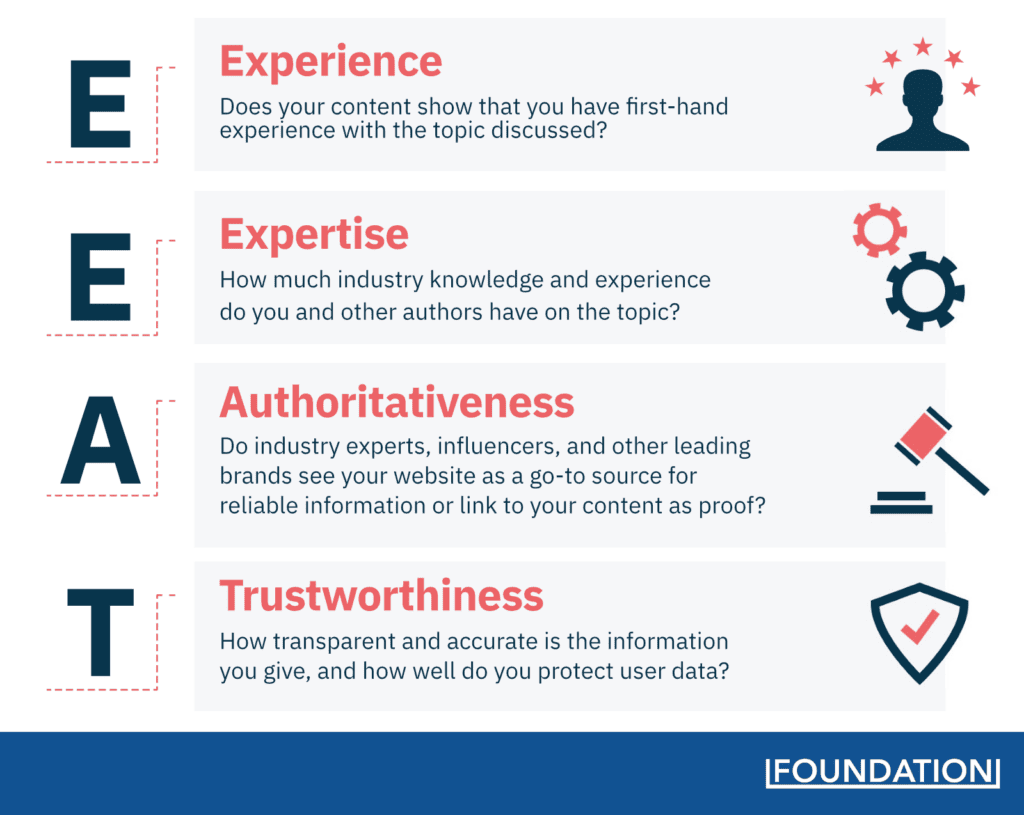
The Four Layers, From Surface to Root
Experience is the layer AI-generated content struggles hardest to fake, because it requires demonstrated first-person engagement — specific failure modes, exact tool versions, the kind of counter-narrative detail that synthesis alone doesn’t produce. Expertise is domain depth: verifiable credentials and institutional affiliation for YMYL topics, and accurate command of nuance and vocabulary for everything else. Authoritativeness is external and slow-building — third-party citations, brand mentions without links, inclusion in curated resource lists — and it cannot be shortcut by publishing more. Trustworthiness is the floor beneath all three: accuracy, source transparency, clear disclosure of commercial relationships, and the absence of patterns raters are trained to flag as deceptive. A site with strong trust and moderate expertise consistently outperforms a site with strong expertise but weak trust on YMYL topics.
For each priority page: (1) Is there a named author with a verifiable professional profile? (2) Does the content cite primary sources — studies, official data, named experts — rather than other blog posts summarizing those same sources? (3) Is there at least one piece of counter-evidence or an admitted limitation? (4) Is there concrete evidence of first-hand engagement — specific numbers, specific failure modes, specific version numbers? A “no” on any of these is worth fixing before touching keyword optimization.
7. Topical Authority and the Hub-and-Spoke Model
The single largest structural shift in ranking behavior over the past several years is the move from keyword-level competition to topic-level competition. First Page Sage’s continuous algorithm study places “Niche Expertise” — essentially topical authority — at 13% of algorithm weight, tied with backlinks, which once dominated at over 50%. The practical implication: a site with comprehensive, well-interlinked coverage of a topic will consistently outrank a site with one technically excellent article on the same query. Google is increasingly ranking sources, not individual pages.
The Hub-and-Spoke Architecture
- 1Identify a topic domain — a coherent information space, not a keyword list. “Core Web Vitals” is a topic domain; “how to fix a high LCP score” is one cluster article inside it.
- 2Build a pillar page covering the full domain at moderate depth, with clear internal links to every meaningful sub-topic. This is the authority hub that passes topical signal outward.
- 3Publish cluster articles — one per meaningful sub-topic — that each go deep on a narrow question, link back to the pillar, and cross-link to at least two sibling clusters.
- 4Fill the PAA tree systematically. Every question surfacing in the PAA boxes for your pillar and cluster queries is a content gap somewhere in the architecture.
- 5Refresh on a schedule, not an emergency basis. First Page Sage’s data shows pages updated at least once a year gain an average of 4.6 positions versus stale pages; freshness has risen into the top handful of algorithm signals.
A common mistake: building the pillar page last, after most cluster content already exists. Build the pillar first, even imperfectly, and let new clusters publish as spokes into an existing hub — the internal link equity accelerates each new article’s indexation and early ranking signal far more than the reverse order.
8. Core Web Vitals in 2026: A Threshold, Not a Growth Lever
Core Web Vitals generate more cargo-cult behavior than almost any other technical SEO topic. Teams spend months shaving LCP from 2.3 seconds to 2.1, present it as quarterly proof of SEO progress, and meanwhile publish content with no schema, no structured answers, and no topical depth. The correct calibration: Core Web Vitals are a threshold condition, not a ranking multiplier. Below the threshold, you’re penalized. Above it, you’re competing on the factors that actually separate winners — content quality, topical authority, and citation-readiness.
Page Experience was formally deprecated as a standalone named ranking signal in 2023; Core Web Vitals remain measurable inputs that feed into overall quality assessment rather than a discrete system of their own. The current “Good” thresholds, unchanged since Interaction to Next Paint replaced First Input Delay on March 12, 2024, are:
| Metric | What It Measures | “Good” Threshold | Most Common 2026 Failure Cause |
|---|---|---|---|
| Largest Contentful Paint (LCP) | Time to render the largest visible element | ≤ 2.5 seconds | Unoptimized hero images; render-blocking head resources; weak CDN coverage |
| Interaction to Next Paint (INP) | Responsiveness across the full page lifecycle | ≤ 200 milliseconds | Heavy JavaScript from page-builder blocks and third-party scripts |
| Cumulative Layout Shift (CLS) | Visual stability during load | ≤ 0.1 | Late-loading ad slots and web fonts without reserved dimensions |
For a site already passing Core Web Vitals, further technical optimization has a low marginal ranking return — that time is better spent on content architecture and structured data. For a site failing CWV, especially on mobile, fixing it is genuinely urgent. It’s a repair, though, not a growth strategy in its own right.
9. Schema Markup: A Signal Amplifier, Not a Shortcut
Google has been actively rationalizing its structured-data ecosystem, retiring visual enhancements for markup types that had become gaming vectors while keeping the types that demonstrably help both classic rich results and AI extraction. The principle that survives every change: schema tells Google what your content is; it cannot manufacture what your content isn’t. FAQ schema on a page with weak Q&A content will not produce a PAA appearance. Organization schema on a site with no external brand footprint will not generate a knowledge panel.
| Schema Type | 2026 Status | Rich Result Impact | AI Extraction Value | Priority |
|---|---|---|---|---|
| Article / NewsArticle | Active | Byline and date display | Author credibility signal | High |
| FAQPage | Active, reduced visual display | Limited rich display | Strong Q&A extraction for PAA and AIO | High |
| HowTo | Active, mobile-limited | Step display on mobile | Process extraction | Medium |
| Product / Offer | Active | Price and review display | Moderate | High |
| Review / AggregateRating | Active, entity-specific | Star ratings in results | Strong trust signal | High |
| Organization / Person | Active | Knowledge panel signals | Entity recognition | High |
| VideoObject | Active | Video carousel eligibility | Moderate | Medium |
| Speakable | Limited support | None visual | Minimal | Low |
10. The Honest Ranking-Factor Weight Table
Every ranking-factor list is either too long — two hundred factors that are mostly noise — or too vague to act on. Below is a calibrated table built on First Page Sage’s continuous algorithm study, the most consistently cited independent weighting model in the industry, cross-checked against 2026 commentary from Whitehat SEO and other analysts.
The top five factors — content quality, keyword-in-title, backlinks, niche expertise, and searcher engagement — together account for roughly three-quarters of algorithm weight. The practical implication for publishing operations: consistency and quality of publication are now a direct ranking input, not merely a growth tactic layered on top of “real” SEO. Annual or more frequent content refresh produces a measurable, quantified position gain — not just a vague sense of freshness.
11. Generative Engine Optimization — and How to Actually Measure It
By mid-2026, “GEO” has moved from buzzword to budget line. It is not a rebrand of SEO — traditional ranking signals remain the foundation most AI citations still draw from — but it is a distinct measurement problem, because none of the classic tools (Google Search Console, Ahrefs, Semrush rank trackers) were built to answer the question that now matters most: is my brand actually being mentioned inside AI-generated answers, and where is that mention coming from?
A small but maturing category of tools now exists specifically to answer that question. They work by running a defined set of prompts against multiple AI engines on a schedule and logging whether, where, and how a brand is cited.
| Tool | Best Fit | Engines Tracked | Entry Pricing (2026) | Notable Strength |
|---|---|---|---|---|
| Otterly AI | Small teams starting GEO measurement | ChatGPT, Google AI Overviews, Perplexity, Copilot | From ~$29/mo (15 prompts) | Fastest, lowest-friction setup; clean share-of-voice reporting |
| Peec AI | Teams wanting daily competitive tracking | ~5 major engines | From ~€89/mo | Visibility, position, and sentiment refreshed daily with audit screenshots |
| Profound | Enterprise / regulated industries | 10+ engines | From ~$499/mo | Deepest citation-source graphs and real user-query datasets |
| Ahrefs Brand Radar | Teams already inside the Ahrefs ecosystem | Major AI engines | Included in relevant Ahrefs tiers | No new vendor relationship; integrates with existing SEO workflow |
Pricing and feature sets in this category move quickly — confirm current limits directly with each vendor before purchasing. The methodological point that matters more than any single tool choice: citation share is the closest thing this category has to a ranking metric, since AI engines typically name only a handful of sources per answer. Track it monthly rather than daily; citation behavior shifts over weeks, not hours, and daily monitoring mostly generates noise.
GEO tooling reports on visibility inside AI answers — it does not, and currently cannot, prove causation between a specific content change and a specific citation gain. Treat citation-share trends as directional evidence to combine with your traditional SEO and analytics data, not as a standalone attribution system.
12. SEO Unit Economics: What a Ranking Is Actually Worth Now
“SEO is important” without numbers attached produces bad prioritization. Below is an illustrative unit-economics model — the inputs are parameterized so you can substitute your own — built around a keyword where an AI Overview is confirmed present.
GIVEN: Monthly search volume: 5,000 searches Query intent: Informational, AI Overview confirmed present Organic position #1 CTR (AIO-suppressed, mid estimate): ~15% (Ahrefs Dec 2025: up to -58% vs. clean-SERP baseline of ~39.8%, First Page Sage May 2025)TRAFFIC: Monthly organic clicks = 5,000 x 0.15 = 750 visits/month Est. branded-search lift from AIO citation = +90 visits/month Effective reach events = ~840/monthCONVERSION (B2B SaaS illustrative benchmarks): Blog-to-lead CVR: 0.8% Monthly leads = 840 x 0.008 = 6.7 leads Lead-to-opportunity rate: 30% Monthly opportunities = 2.0REVENUE: Close rate: 20% Avg. contract value (ACV): $18,000/yr Monthly MRR contribution = 2.0 x 0.20 x ($18,000/12) = $600/month Annual revenue = ~$7,200/yearCOST BASELINE: Content production (one-time): $1,800 Monthly maintenance: $150 Payback period: ~4 months 12-month ROI: ~280%FOR COMPARISON — SAME KEYWORD, PRE-AI-OVERVIEW ERA (illustrative, ~2023): CTR: 28% Monthly clicks: 1,400 Monthly MRR contribution: $1,240/month Annual: ~$14,880/yearDELTA: an AI Overview on this query reduces the illustrative revenuepotential of a single position-one ranking by roughly half.
The ROI is still strongly positive — this isn’t a case for abandoning content investment. It’s a case for changing the portfolio logic. Where a team in 2023 might have concentrated budget on one or two high-volume informational keywords, 2026 budgets typically produce better returns spread across: one high-intent transactional keyword with lower AIO suppression, one winnable featured-snippet target, two or three PAA-cluster articles, and one mid-volume informational keyword in a category where AI Overviews are still relatively rare, such as e-commerce.
13. The Measurement Gap — and How to Close It
Standard analytics captures sessions, bounce rate, and search-attributed conversions. It systematically misses AI Overview impressions where no click occurred, brand lift from SERP presence generally, PAA appearances that drove downstream branded search days or weeks later, and featured-snippet impressions where the searcher read the answer and left satisfied. Multiple 2026 industry surveys have found that only a small minority of marketing teams actively track AI Overview impression share or PAA share-of-voice as a formal metric — meaning most SEO programs are still being judged on a shrinking slice of their actual impact.
A Three-Layer Measurement Stack
Layer 1 — Baseline (Google Search Console). Impressions, clicks, CTR, and average position, segmented by intent type. GSC is the only reliable source of impression data on queries where no click occurred — your AI Overview appearances generate impressions there even without a single click, and most teams never look.
Layer 2 — SERP feature tracking. A rank tracker with feature detection (Semrush, Ahrefs, or STAT) to log which target keywords trigger which features and whether your domain appears in them, tracked as a share-of-voice metric over time.
Layer 3 — Brand visibility and downstream signals. Branded-search-volume trends as a proxy for SERP-to-brand-awareness conversion, plus a GEO tool from Section 11 for direct AI-citation monitoring across ChatGPT, Perplexity, and Google’s AI surfaces, tracked as a category distinct from organic traffic.
The minimum viable version of this stack: add a “SERP feature presence” column to your existing keyword tracking sheet, updated monthly. Snippet? PAA? AI Overview? That single column changes how you read every other number in the report.
14. The 90-Day SERP Real Estate Action Plan
Days 1–30: Audit and Map
- Export your top 50 organic landing pages from Google Search Console by impressions.
- For each, manually run the target query and document which SERP features appear, which your domain owns, and which competitors hold.
- Score each page by “feature opportunity gap” — the count of features present that your domain is absent from.
- Identify your five highest-opportunity pages and treat them as priority-one rewrites.
- Configure SERP feature tracking in your rank tracker of choice.
Days 31–60: Reformat and Restructure
- Rewrite priority-one pages with explicit feature targeting: a 40–70 word direct-answer block opening each major section, FAQPage schema on Q&A content, comparison tables where the SERP shows table snippets, HowTo schema on process-oriented queries.
- Validate every schema implementation with Google’s Rich Results Test before moving on.
- Build or strengthen your topic hub: identify your highest-authority pillar, map existing clusters, and identify PAA-coverage gaps.
- Add named-author markup with a linked professional profile, and Organization schema, to every page that lacks it.
Days 61–90: Amplify and Measure
- Publish two to three new cluster articles targeting high-priority PAA questions, using the 40–70 word answer structure throughout.
- Run structured outreach to two or three authoritative sites in your space for genuine co-citation — guest contributions, expert-quote requests, resource-page inclusion — not link volume alone.
- Stand up your Layer 2 and Layer 3 measurement and run a first SERP feature and AI-citation share-of-voice baseline.
- Compare GSC data on priority-one rewrites: are impressions up? Is CTR up? Are you now appearing in features that were previously absent? Partial answers should be visible within 60–90 days — not the six-month horizon traditional SEO timelines assume.
Key Takeaways from the Action Plan
- Start with the SERP, not the keyword. The feature landscape determines what your content needs to be before any keyword-level work begins.
- Reformat existing pages before you republish new ones. Structural changes often outperform net-new content in the medium term.
- Schema is mandatory vocabulary, not optional polish. Use it consistently across every priority page.
- Measure features and citations, not just position. A position-three result with a PAA appearance can outperform a position-one result on a feature-dense SERP.
- Track AI citations as a separate KPI category from organic traffic — they behave differently and need different tooling.
15. Myth vs. Fact: Nine Claims Worth Retiring
Zero-click search is a fringe phenomenon that only affects a handful of “position zero” queries.
It’s the majority outcome — 68.01% of US Google searches in early 2026 ended without any click, per SparkToro.
Backlinks are still the single most important ranking factor.
Content quality now carries roughly 23% of algorithm weight versus backlinks’ 13%, per First Page Sage’s continuous study.
Word count is a ranking factor — longer always wins.
Google has repeatedly stated word count is not a quality signal; comprehensiveness relative to search intent is what correlates with rankings, not length for its own sake.
Featured snippets are dying and not worth pursuing anymore.
Prevalence dropped 64% in 2025, but CTR when a snippet does appear (~42.9%) still exceeds a clean position-one result.
Core Web Vitals are one of the biggest ranking levers you can pull.
They function as a pass/fail threshold. Once you clear it, further optimization has diminishing marginal ranking return.
Schema markup can manufacture rich results and AI citations on its own.
Schema amplifies content that already qualifies — it cannot create eligibility a page doesn’t otherwise have.
AI Overviews always kill your traffic on any query where they appear.
Impact varies sharply by query type and vertical, and brands cited inside the overview see meaningfully higher downstream CTR than uncited competitors on the same query.
The Helpful Content System is a separate algorithm you can optimize against directly.
It was fully integrated into core ranking on March 5, 2024, and no longer operates as a standalone system.
GEO is just SEO with a new name.
It shares the same foundation but requires distinct measurement tooling, since most AI citation behavior is invisible to Google Search Console and traditional rank trackers.
16. The Uncomfortable Truth About Most SEO Content
Here’s the part of this guide the industry would generally rather not hear stated plainly.
Both of Google’s 2026 core updates continued a trend that began with the March 2024 and March 2025 core updates: targeting content that exists primarily to capture search traffic rather than to provide genuine value to the person reading it. That description fits a meaningful share of the content produced under the banner of “SEO strategy” by well-resourced, professional content teams — not spam, but the thoroughly researched, properly structured, 3,000-word guide that got greenlit because a keyword tool showed an attractive volume-to-difficulty ratio, not because the team had a genuine perspective or lived expertise on the subject.
Google’s systems have gotten materially better at detecting this pattern — not by chasing individual gameable signals, but by building a broader model of what genuine site-level expertise looks like over time. Sites whose content patterns suggest real, sustained engagement with a domain tend to weather core updates. Sites built on keyword-first, expertise-last production tend not to, and the March 2026 update’s tendency to favor primary sources over secondary summarizers of those sources is a direct expression of that shift.
Content built this way — technically clean, competently written, genuinely useful in the moment, but produced from SERP synthesis rather than subject-matter conviction — can rank for a year or two on weak competition, then lose the bulk of its traffic in a core update and never fully recover. It did nothing wrong by the old checklist. It simply never did anything distinctly right for the reader, and that distinction, once more forgiving, is now load-bearing.
The SERP Opportunity Matrix: Where to Focus First
An original decision framework that synthesizes this guide into one prioritization tool. Plot each target keyword on both axes and allocate budget by quadrant.
Frequently Asked Questions
What percentage of Google searches are zero-click in 2026?
SparkToro’s analysis of Similarweb clickstream data found that 68.01% of US Google searches in the first four months of 2026 ended without any click to an external website, up from 60.45% in 2024. That works out to roughly 276 clicks reaching the open web for every 1,000 searches.
How often do AI Overviews appear in Google search results in 2026?
Estimates range from about 43% (Similarweb, mid-2026) to roughly 50% (Google’s own February 2026 disclosure), depending on measurement window and sample. The rate is significantly higher for healthcare, education, and B2B technology queries than for entertainment or e-commerce.
How much does an AI Overview reduce organic click-through rate?
Ahrefs’ December 2025 analysis found AI Overviews can reduce position-one CTR by up to 58% versus the same query without one. Seer Interactive’s tracking found organic CTR on AI-Overview queries fell to a low of 0.61% by September 2025 before partially recovering to roughly 2.4% by February 2026.
How do you optimize content for Google’s AI Overviews?
Write a direct, self-contained 40–70 word answer at the top of each section; implement FAQPage and Article schema; build genuine domain-level topical depth rather than isolated articles; cite primary sources; and build the entity recognition and external citation footprint that AI systems draw from, since most citations still come from domains that also rank in the traditional top 10.
Is traditional SEO dead in 2026?
No, but its role has narrowed to a threshold condition rather than a differentiator. Technical SEO, link building, and keyword optimization remain necessary foundations. The factors that now separate winners are SERP feature strategy, topical authority, E-E-A-T, and AI-citation readiness — none of which replace traditional SEO, but all of which now outweigh its classic differentiators like keyword density and raw link counts.
How often should I update existing content for SEO?
First Page Sage’s continuous study found pages updated at least once a year gain an average of 4.6 positions versus stale content, with quarterly or monthly refresh producing larger gains still. For competitive keywords, a systematic annual refresh schedule is now a defensible ranking strategy in its own right.
Glossary
- Zero-click search
- A Google search that ends without the user clicking any result — answered directly on the results page itself.
- AI Overview (AIO)
- Google’s AI-generated summary that appears above traditional organic results for a growing share of queries.
- AI Mode
- Google’s fully conversational, chat-style search interface, distinct from the AI Overview shown on standard results pages.
- SERP feature
- Any non-standard element on a results page — featured snippet, PAA box, local pack, knowledge panel, video carousel, and similar.
- GEO (Generative Engine Optimization)
- The practice of optimizing for citation and visibility inside AI-generated answers, distinct from but built on top of traditional SEO.
- E-E-A-T
- Experience, Expertise, Authoritativeness, Trustworthiness — the framework Google’s human quality raters use to assess content, which trains its ranking systems.
- YMYL
- “Your Money or Your Life” — content categories (health, finance, civics) held to a stricter quality and trust bar.
- Topical authority
- The degree to which a domain demonstrates comprehensive, interlinked expertise across a subject area, rather than isolated single-article competence.
- INP (Interaction to Next Paint)
- The Core Web Vitals metric measuring page responsiveness throughout the full interaction lifecycle; replaced First Input Delay in March 2024.
- Citation share
- The proportion of tracked AI-generated answers in which a given brand or domain is named as a source, the primary metric used in GEO tooling.
Where to Go From Here
The single most clarifying exercise after reading this guide: pick your highest-impression page that isn’t converting well, and spend ninety minutes answering these questions about its actual SERP. What features appear? What does your domain own, and what does it not, and why? Is your content format aligned with the dominant feature format? What would a 40–70 word answer block look like at the top of each section? Does the page have FAQPage schema? Is there a comparison table where the SERP is already showing one?
The answers will tell you more about your priorities than any keyword-difficulty score. And if you want a fast, structured read on the optimization level of any piece of content before you publish or update it, Content Evaluator Online offers a free post-quality evaluation tool built to surface exactly these structural gaps before they cost you in the SERPs.
The game isn’t won at the keyword level anymore. It’s won at the SERP level, the topic level, and the trust level — and given the pace of core updates in 2026, the next meaningful shift in that game is probably a matter of weeks, not months, away.