

Affiliate SEO · Internal Architecture · Advanced Strategy
The Best Internal Linking System for Affiliate SEO Websites
Most affiliate sites are PageRank pressure-washing the wrong walls. Here’s the complete architecture for routing link equity straight to the pages that earn money — built from 23 million data points, Google’s leaked API, and hard lessons from sites that got it right and wrong.
The Architecture Nobody Actually Builds
Let me tell you about the stupidest mistake I watched an affiliate site make in 2024. They had built a genuinely excellent 300-page review site in the home appliances niche. They’d earned 180 referring domains. They published consistently. Their content was better than half the stuff on page one. And they were stuck — hemorrhaging rankings every time Google updated.
The diagnosis took eleven minutes with Screaming Frog. They had 67 orphan pages, including four of their highest-converting “Best X Under $500” review roundups. Their authority-rich homepage linked to 220 different pages. Their most-linked informational post — a 6,000-word how-to guide with 38 referring domains — linked to exactly zero money pages. All that PageRank, flowing into a black hole.
I’ve since audited dozens of affiliate sites. The same pathology appears every single time: people who obsess over content and backlinks and treat internal linking like housekeeping. Something you do when you have time. Something a plugin handles automatically.
It isn’t. It’s the closest thing to free money in affiliate SEO, and almost nobody is doing it right.
This guide is different from everything else you’ll read on internal linking. It’s not going to tell you “use descriptive anchor text” and “build topic clusters” and call it strategy. We’re going to build an actual system — a Revenue Architecture Model — that treats your affiliate site’s internal link graph as a financial instrument. Because that’s exactly what it is.
It’s also going to be honest with you about what we don’t fully know, what the data actually says versus what people claim it says, and where the conventional wisdom is actively wrong for affiliate sites specifically — as opposed to generic content sites or SaaS blogs, which have completely different optimization targets.
What PageRank Actually Does in 2026 (After the Leak)
Before we build a system, we need an honest accounting of the mechanism. Because the 2024 Google API documentation leak changed what we know — or more precisely, it confirmed things practitioners suspected and demolished some comfortable myths.
The short version: PageRank is very much alive. It didn’t quietly retire when Google stopped showing the Toolbar metric in 2016. The leaked API documents from March 2024, confirmed as genuine by Google (who then tried to suppress them), revealed multiple active PageRank variants running simultaneously inside Google’s ranking pipeline:
- RawPageRank — the classic link-volume calculation, still active
- PageRank2 — an updated version with trust-weighting
- PageRank_NS (Nearest Seed) — measures proximity to trusted “seed” sites in the link graph; appears to be used to assess new pages before they accumulate their own PageRank history
- FirstCoveragePageRank — specific to initial discovery and indexation
- HomepagePageRank — every document on a domain inherits a measure of its homepage’s authority as a baseline proxy
That last one is crucial for affiliate site architecture. Every page you publish starts life with a shadow score borrowed from your homepage’s authority. Which means your homepage’s internal link decisions radiate across the entire domain — for better or worse.
“The internal links on pages that receive external backlinks determine how much PageRank actually reaches your money pages. A link to a poorly-connected page wastes authority. A link to a well-structured hub page can lift dozens of others.”
— Dan Hinckley, Co-Founder, Go Fish Digital (LinkedIn, 2025)The leaked documents also confirmed something about the damping factor — the ~0.85 multiplier that PageRank loses with each hop. At each link level, roughly 15% of equity evaporates. This isn’t new — it’s been in the original PageRank paper since 1998. But most affiliate site owners have never actually mapped what this means in practice for their specific site architecture. We will in the next section.
What the leak also confirmed: link placement matters significantly. The leaked API documentation revealed that anchor text relevance is weighted against link placement and surrounding content context. Links in the main content area carry materially more weight than sidebar or footer links. This aligns with Google’s longstanding “Reasonable Surfer” patent (2004), which acknowledges that not all links have an equal probability of being clicked — and that probability affects how much PageRank they pass.
Source: Google Content Warehouse API Leak, March 2024 (confirmed by Google). Analysis: ipullrank.com, hobo-web.co.uk
There’s one more nuance that the SEO industry has mostly glossed over: the leaked docs show a module called QualityNsrPQData with attributes called linkIncoming and linkOutgoing — which appear to score the value of a page’s inbound and outbound link profile directly. This means your internal linking decisions affect not just crawl discovery but a page’s quality signal composite. Every orphan page isn’t just unfindable — it’s actively scored as low-quality.
The composite output of all this is what the leaked docs call siteAuthority — an integer stored in the CompressedQualitySignals module. This is the modern evolution of what Panda and Penguin were attempting to measure: a holistic domain health score. And it’s shaped, in part, by how well your internal architecture distributes and directs authority. You do not control your backlinks. You completely control your internal link architecture. This asymmetry is the entire opportunity.
The Revenue Architecture Model: A New Framework for Affiliate Sites
Everything I’ve seen in internal linking strategy is written for generic content sites. Pillar-cluster, hub-and-spoke, flat architecture, silo structure — these frameworks were designed with informational sites or e-commerce in mind. They don’t account for the specific economic topology of an affiliate site, where different page types have radically different commercial value and different relationships to the PageRank graph.
I want to introduce a framework I call the Revenue Architecture Model (RAM). It treats your affiliate site as a hydraulic system where link equity is the water pressure, and your job is to route it to the pages that convert.
The Revenue Architecture Model (RAM)
An affiliate site’s internal link graph has four distinct page types with different equity roles:
- Reservoirs — High-authority pages receiving most external backlinks. Often informational guides, data studies, comparison pieces. They store the most equity but convert poorly directly.
- Conduits — Hub pages that receive equity from Reservoirs and pass it forward. Category pages, “Best Of” overview pages, comparison roundups.
- Nozzles — Deep-funnel money pages. Specific product reviews, “X vs Y” comparisons, coupon/deal pages. They need to receive equity but don’t need to redistribute it widely.
- Dead Ends — Pages with no commercial value that receive equity and waste it. Privacy pages, tag archives, thin “about” content. Identify and noindex or reduce their incoming link count.
Most affiliate sites route equity like a broken sprinkler: scattered everywhere, useful nowhere. The RAM framework asks you to map every page to one of these four categories, then design your internal link graph to deliberately push pressure from Reservoirs → Conduits → Nozzles while starving Dead Ends.
Framework: Revenue Architecture Model (RAM) — original framework, SEOHack.info / contentevaluator.online. VPN site used as illustrative example.
The RAM framework has one counterintuitive implication that I want to make explicit: your best content should not be your most-linked-to content internally, unless it earns money. Most affiliate sites have the opposite problem. The informational guides — the ones that attracted backlinks in the first place — receive the most internal links because writers naturally link to “related reading.” Meanwhile the review pages sit in the dark.
You need to reverse this. The informational Reservoirs should be sources of internal links pointing at Conduits and Nozzles, not destinations of them.
The Equity Decay Problem: Numbers Every Affiliate Should Run
Let’s get quantitative about something most people only wave their hands at. PageRank uses a damping factor of approximately 0.85 — meaning each link hop retains about 85% of the previous page’s equity and discards 15%. This is from the original 1998 PageRank paper by Page and Brin. The 2024 Google leak confirms this mechanism is still operative (with some nuance that the factor isn’t always fixed at 0.85 and can vary by link type and context — but 0.85 is still the useful working approximation).
Here’s what that looks like in practice for a real affiliate site scenario. Suppose your “Ultimate Guide to VPNs” receives a backlink from a moderately authoritative domain, giving that page a normalized equity score of 100.
Calculation: PageRank damping factor ~0.85 (Page & Brin, 1998; consistent with 2024 Google API leak evidence). Note: real-world equity is also divided by the number of outbound links on each page, compounding decay further.
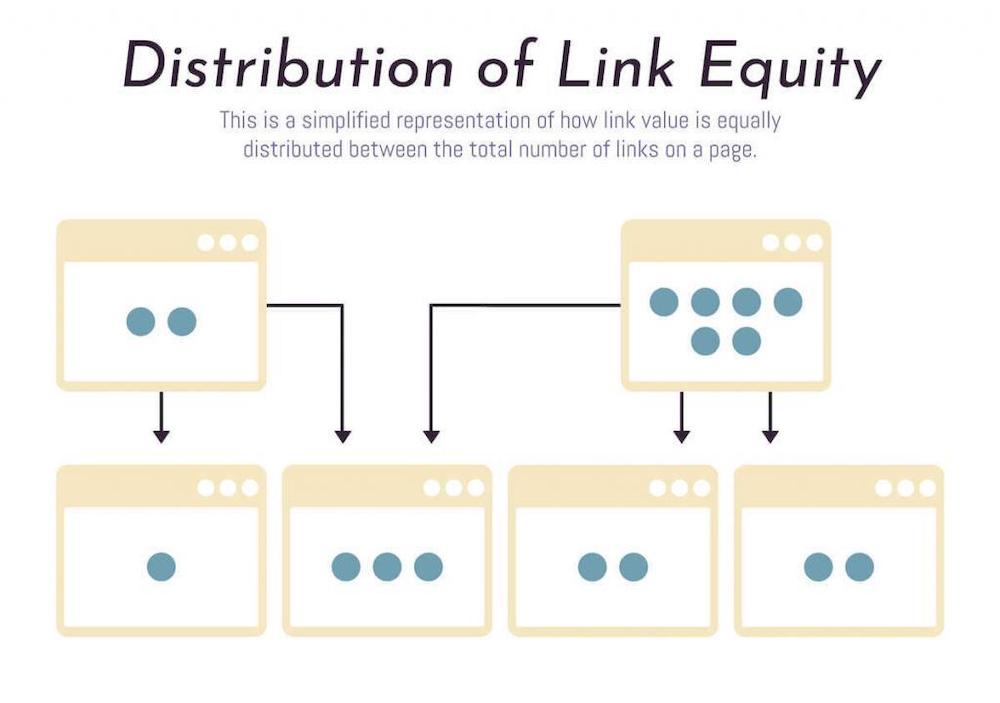
Now here’s the part most people miss. The decay above assumes a single link path. But if the Reservoir page links to 50 other pages, each of those links carries only 1/50th of the page’s equity before the 0.85 decay is applied. If your homepage links to 200 pages, each internal link from the homepage carries approximately 0.5% × 0.85 = 0.425% of the total homepage equity. Compared to a tightly structured hub page linking to just 8 pages, where each link carries 12.5% × 0.85 = 10.6% of that page’s equity.
This is the math behind the “link dilution” problem, and it’s severe. Let me put real numbers on it:
| Scenario | Page Equity (normalized) | Outbound Links | Equity Per Link | After 0.85 Damping |
|---|---|---|---|---|
| Homepage → 200 pages | 100 | 200 | 0.50 | 0.43 |
| Reservoir → 50 pages | 80 | 50 | 1.60 | 1.36 |
| Reservoir → 12 pages | 80 | 12 | 6.67 | 5.67 |
| Conduit hub → 8 pages | 60 | 8 | 7.50 | 6.38 |
| Conduit hub → 4 pages | 60 | 4 | 15.0 | 12.75 |
The practical implication: a tightly-curated Conduit page that links to only four money pages passes 29× more equity per link than a homepage linking to 200 pages. This is why your internal linking structure is sometimes worth more than another backlink — and why “add more internal links everywhere” is advice that can actively hurt you.
📊 The Equity Efficiency Score
A simple diagnostic metric: divide a page’s normalized equity (Ahrefs UR or Semrush Authority Score approximation) by the number of its outbound internal links. Any page scoring below 2.0 on this metric is a poor equity distributor. Any page scoring above 8.0 is a high-efficiency hub. Build your Conduit pages to score above 8.0, and route your Reservoir pages to link no more than 10–15 times to money-adjacent targets.
Anchor Text: What 23 Million Links Actually Show
I want to be careful here, because this is where a lot of bad SEO advice circulates. The Zyppy study — 23 million internal links across 1,800 sites with Google Search Console access — is one of the most cited pieces of data in internal linking discussions. It’s also widely misquoted. Let me tell you what it actually found, and what the caveats are.
The key findings, with their stated confidence levels:
- Pages with exact-match anchor text (at least one) had 5× more traffic than pages without. This correlation held “no matter how many ways we sliced the data.” However, the study authors explicitly note this could reflect that pages with exact-match anchors are simply better-optimized overall. Correlation, not causation.
- Anchor text variety correlated strongly with higher traffic. “The relationship was so strong we ran the data three times.” Pages with more unique anchor text variations pointing to them tended to rank higher. This makes intuitive sense: it signals to Google that different contexts find the page relevant.
- The traffic sweet spot for incoming internal links was 40–44. Pages with 40–44 internal links received 4× more clicks than pages with fewer than 5. Above 45–50, traffic correlation plateaued or slightly declined — likely because the ultra-high-link pages were receiving mostly sitewide navigation links (same anchor text, from every page) rather than contextual body links.
- Naked URL anchors didn’t hurt. Pages with naked URL internal links actually saw ~50% more traffic — probably because they were better-linked overall and the URL itself adds variation.
- Empty anchor text cost nothing surprising — but ~6% of all links had no anchor text. Don’t waste the signal.
Source: Zyppy, “23 Million Internal Links – SEO Case Study” (Cyrus Shepard, 2022). Data approximated from published findings. Correlation study — not causal. Post-2023 algorithmic changes may affect specific thresholds.
The practical anchor text framework for affiliate sites specifically:
The Affiliate Anchor Text Stack
Because affiliate sites compete for highly commercial terms, anchor text strategy has specific requirements that differ from SaaS or news sites. Here’s the system I use:
| Anchor Type | Usage | Example | Priority |
|---|---|---|---|
| Primary exact-match | ~25% of links to money pages | “best VPN 2026” | HIGH |
| Partial match / synonym | ~35% of links | “top VPN services”, “VPN recommendations” | HIGH |
| Branded | ~15% — specific product names | “NordVPN review”, “ExpressVPN deal” | HIGH |
| Contextual phrase | ~15% — natural sentence anchors | “if you need solid privacy protection” | MED |
| Generic / navigational | Limit to ≤10% | “read more”, “see our review” | LOW |
| Naked URL | Occasional only | https://yoursite.com/nordvpn-review/ | MED |
⚠ The First Link Priority Trap
Google’s “First Link Priority” rule (confirmed by Googlers and referenced extensively by Cyrus Shepard) means that when a page links to the same URL twice, only the first link’s anchor text is likely to be counted as the meaningful signal. This means if your navigation menu links to your review page with anchor text “Reviews” — and then your article body links to the same page with your target anchor — the body anchor may not register. The fix: use a hash link (#anchor) for the navigation version, or ensure body links appear before footer/nav links in the source code. Most themes render navigation before body content, which can silently sabotage your internal anchor strategy.
Mapping Affiliate Content Types to Link Roles
Every affiliate site produces the same rough content mix, but almost nobody maps it deliberately to a link architecture. Here’s the definitive taxonomy for affiliate content and how each type should behave in your RAM system:
Framework: original (SEOHack.info). Bubble size indicates relative importance of incoming link equity. Position represents ideal quadrant in the RAM system.
The matrix tells you the linking rule for each content type at a glance:
| Content Type | RAM Role | Should Receive | Should Send To |
|---|---|---|---|
| How-To / Educational Guides | Reservoir | External backlinks; few internal | Best-of roundups, category pages, 2–3 reviews |
| Data Studies / Original Research | Reservoir | External backlinks; few internal | Relevant roundups, methodology pages |
| “Best Of” Roundups | Conduit | Internal links from all Reservoirs | Individual reviews in the list (5–8 Nozzles) |
| Category Landing Pages | Conduit | Homepage, Reservoirs | All reviews in that category |
| Individual Product Reviews | Nozzle | Every Conduit that mentions the product | 1–2 related comparisons only |
| X vs Y Comparisons | Nozzle | Relevant roundups, reviews of both products | Individual reviews of compared products |
| Deals / Coupon Pages | Nozzle (deep funnel) | Reviews, roundups, any mention of brand | Almost nothing — conserve equity |
| Glossary / FAQ | Supporting | Minimal internal links needed | Relevant roundups where topic applies |
| About / Legal / Tag Archives | Dead End | Starve of incoming links | Nothing commercially relevant |
The Orphan Audit System That Actually Works
According to large-site crawl studies cited consistently across multiple SEO analytics platforms, roughly 25% of web pages receive zero internal links — making them effectively invisible to Google’s crawlers regardless of how good their content is. For affiliate sites specifically, orphan pages tend to cluster around the most commercially valuable content: new reviews added without being linked from roundups, comparison pages created in isolation, deal pages that nobody remembered to reference.
The conventional advice is “run Screaming Frog, find orphans, fix them.” That’s accurate as far as it goes, but it misses the sequencing problem. You can’t fix orphans intelligently without first knowing the commercial value of the orphaned pages. Here’s a three-phase audit system that prioritizes by revenue impact:
Phase 1: Commercial Triage (Week 1)
Export all URLs from your site. For each page, score it on commercial intent from 1–5 using this rubric:
- 5 — Direct affiliate revenue: Contains affiliate links, CTA buttons, product comparison tables. Losing this page = losing commissions directly.
- 4 — Pre-purchase research: “Best of” roundups, X vs Y comparisons. User is close to buying; page assists conversion.
- 3 — Awareness/consideration: How-to guides, educational content. Generates traffic that can be redirected toward money pages.
- 2 — Topical support: Glossary terms, FAQ pages. Supports topical authority but low direct conversion value.
- 1 — Administrative/Dead End: Privacy, About, Tag archives. No commercial function.
Phase 2: Crawl Audit (Week 1–2)
Use Screaming Frog (or Sitebulb for larger sites) to identify all orphan pages — URLs in your sitemap that have zero internal links pointing to them. Cross-reference with your commercial triage scores. Any page scoring 4 or 5 that is an orphan is Priority 1 for remediation.
Phase 3: Systematic Reconnection (Week 2–4)
For each Priority 1 orphan, run this reconnection protocol:
- Find your 3 highest-equity Reservoir pages that are topically adjacent (use Ahrefs “Link Intersect” or manual search for content overlap)
- Add a contextual internal link with varied, descriptive anchor text from each of those pages to the orphan
- Ensure the orphan links back to 1–2 appropriate Conduit pages (creating bidirectional relevance signal)
- Update the sitemap and ping Google Search Console for re-crawl
- Track position changes in GSC over 30–60 days
The 90-day timeline in that case study is realistic for structural fixes. Expect weeks 1–6 to show crawl improvements (you can verify via Google Search Console’s Crawl Stats), weeks 6–12 to show indexation improvements, and weeks 8–16 to see meaningful ranking changes. Internal linking is not a switch — it’s a pressure system that takes time to repressurize.
Internal Links in the AI Search Era: A Shift Nobody’s Ready For
Here’s something that isn’t getting nearly enough attention in affiliate SEO circles: AI search systems — Perplexity, ChatGPT Search, Google AI Overviews — don’t just look at content. They use link relationships to understand topical authority and content depth. They treat your site’s link graph as a knowledge graph.
Research from Wellows and Yext (2025) found that bidirectional internal linking — pages that link to each other reciprocally — increases AI citation probability by 2.7×. The reasoning is intuitive once you hear it: AI systems are built to identify the most authoritative, interconnected sources on a topic. A well-linked cluster of pages about, say, VPN security signals to an AI retrieval system that this site is a coherent, comprehensive source — not a collection of isolated pages.
This creates a second strategic dimension for affiliate sites that nobody in the “pillar-cluster” conversation is talking about: your internal link architecture is now simultaneously your SEO architecture and your AI visibility architecture.
💡 The AI Citation Strategy
If you want your money pages cited in AI Overviews or referenced by LLM-powered search, they need to be well-connected within a topically coherent cluster. A standalone review page with three internal links pointing to it is nearly invisible to AI retrieval systems. The same review page, connected bidirectionally to your roundup, three related comparisons, and two informational guides, starts to look like an authoritative node in a knowledge graph. Build for AI citation the same way you build for Google rankings: cluster density, bidirectional linking, and semantic anchor text that maps relationships explicitly.
There’s a practical implementation implication here that most affiliate sites miss: your “Best X” roundup pages should link to individual reviews, AND individual reviews should link back to the roundup. This bidirectional relationship is standard cluster-linking advice, but the reason to do it is now stronger than ever. It’s not just about passing PageRank in both directions. It’s about telling AI systems that these pages are part of a coherent topical authority structure.
Single Grain’s 2026 analysis of SEVO (Search Everywhere Optimization) and AEO (Answer Engine Optimization) makes this explicit: systems that reward clear topical relationships, descriptive anchors, and predictable click paths are increasingly determining visibility across not just Google but all AI-mediated search surfaces. The internal link graph that works best for Google PageRank in 2026 is, non-coincidentally, the same structure that gets cited by LLMs. Build it once, win everywhere.
The Uncomfortable Truth About Internal Linking Tools
I need to say something that will probably generate some pushback: automated internal linking plugins are a trap for most affiliate sites. Link Whisper, Yoast’s suggestions, NeuronWriter’s recommendations — these tools are genuinely useful for large content operations where manual linking is genuinely impractical. But for a 100–300 page affiliate site, they train you to think about internal linking as a volume game when it’s actually an architecture game.
Here’s what I mean. These tools scan your content and suggest internal links based on keyword matching. They’re good at that. They are not good at understanding the RAM hierarchy — whether a proposed link routes equity toward a Nozzle or drains it into a Dead End. They don’t know which of your pages are Reservoirs and which are dead weight. They optimize for link count, not link architecture.
I’ve seen affiliate sites with 800 internal links in total — “great coverage” by any plugin’s metric — where the top 10 money pages had an average incoming link count of 3. The plugins were happily linking all the informational content to each other, leaving the commercial pages isolated. That’s worse than useless. It gives you a false confidence score while the revenue pages starve.
The right approach: use these tools to identify opportunities and orphans after you’ve mapped your RAM architecture manually. Let the tool find unlinked mentions of your money pages. Then evaluate each suggestion against your architecture — does this link route equity toward a Nozzle, or away from one? Keep the ones that do, discard the ones that don’t.
One more uncomfortable point: the “3 clicks from homepage” rule is directionally right but applied incorrectly by most sites. The rule is that important pages should be reachable within 3 clicks. Most sites interpret this as “everything should be 3 clicks from the homepage.” But for a site with real authority, a money page that’s 3 clicks from an authoritative Reservoir and 4 clicks from the homepage will outperform the same money page 2 clicks from the homepage but linked from nowhere authoritative. Click depth matters less than the quality of the path.
I got this wrong for years, incidentally. I used to obsessively flatten site architecture — shorter paths everywhere. What I should have been doing is maximizing the authority quality of the path, not just shortening it. The two aren’t always the same thing.
The 12-Week Implementation Playbook
Enough theory. Here’s the sequenced implementation — what to do, in what order, and what to measure at each stage.
Weeks 1–2: Map and Triage
- Export all URLs from your CMS and sitemap
- Score every page 1–5 on commercial intent (use the Phase 1 rubric from the Orphan Audit section)
- Run Screaming Frog or Sitebulb crawl; export inbound link counts for every URL
- Flag all pages scoring 4–5 with fewer than 5 incoming internal links as Priority 1
- Flag all pages with 100+ outbound links (homepage, category pages) for link pruning review
- Identify your top 10 Reservoir pages by external backlink count (Ahrefs or Semrush)
Weeks 3–4: Architecture Design
- Map each page to its RAM role: Reservoir, Conduit, Nozzle, or Dead End
- Build your Conduit pages (Best Of roundups, category hubs) if they don’t exist — these are the linchpin of the system
- Create a link architecture spreadsheet: for each Nozzle, list which Conduits should link to it and which Reservoirs should link to those Conduits
- Design bidirectional linking pairs for every Conduit ↔ Nozzle relationship
Weeks 5–8: Execution
- Start with Priority 1 reconnections — get all 4–5 scored orphans linked within 3 weeks
- Edit your top 10 Reservoir pages to add contextual links toward Conduits (1–3 links per Reservoir to relevant roundups)
- Audit and edit your Conduit pages to ensure each links to all relevant Nozzles with varied, descriptive anchor text
- Add reciprocal links from each Nozzle back to its parent Conduit(s)
- Reduce outbound link count on your homepage if above 100 — remove or consolidate navigational links to Dead Ends
Weeks 9–12: Monitoring and Iteration
- Track Crawl Stats in Google Search Console — you should see increased crawl frequency on recently linked pages
- Monitor position changes weekly for your Priority 1 pages in GSC or your rank tracker
- Run a second Screaming Frog crawl to verify orphan elimination
- Calculate Equity Efficiency Scores for your top Reservoir and Conduit pages
- Identify the next tier of pages to link — now work on Priority 2 (pages scoring 3 on commercial intent)
Framework: original. Timeline is approximate; results depend on crawl frequency, site authority, and competition.
The 2026 Tools Stack (Honest Edition)
I’ll be direct about what each tool actually does well and where it falls short, because the vendor marketing on these is universally overstated.
| Tool | Best For | Limitations | Cost |
|---|---|---|---|
| Screaming Frog | Definitive internal link crawl; anchor text audit; crawl depth analysis; detects JS-rendered links (in rendering mode) | No built-in equity scoring; requires manual analysis layer; JS rendering is slow at scale | £259/yr (free version: 500 URLs) |
| Sitebulb | Visual link diagrams; stakeholder reporting; large-site crawls; orphan detection | More expensive; slightly slower than Screaming Frog for quick audits | From $13.50/mo |
| Ahrefs | Identifying high-authority Reservoir pages; “Best by links” export; internal link opportunities report | Internal link data lags real-time by days to weeks; doesn’t replace a live crawl | From $129/mo |
| Semrush Site Audit | Internal LinkRank (ILR) scoring 0–100; ongoing monitoring; flags pages with ILR <10 and 100+ outbound links | ILR is a proprietary metric, not a Google signal; use as triage tool not ground truth | From $139.95/mo |
| Google Search Console | Crawl Stats (actual Googlebot behavior); coverage reports; position tracking for money pages | No direct internal link visualization; doesn’t show anchor text distribution | Free |
| Link Whisper (WordPress) | Identifying unlinked mentions of target pages; finding orphans within WordPress; bulk link suggestions | Optimizes for link volume, not architecture; suggestions need manual RAM-filter before implementing | $97/yr (1 site) |
| JetOctopus | Large sites; pairs crawling with log-file analysis; shows what Googlebot actually fetches vs. what you think it crawls | Overkill for sites under 5,000 pages; steeper learning curve | From $35/mo |
For most affiliate sites (100–500 pages): GSC + Screaming Frog free tier or paid + Ahrefs is sufficient. You don’t need Semrush’s ILR or JetOctopus until you’re managing thousands of pages. Resist the impulse to add more tools before you’ve exhausted what these three can tell you.
Seven Mistakes That Kill Affiliate Revenue (And Why They’re So Common)
1. The Homepage Dilution Problem
Linking from the homepage to 150+ pages. Each link passes a fraction of 1% of homepage equity. Fix: limit homepage links to your top 8–12 Conduit pages. Let the Conduits handle distribution downward.
2. Reservoir Isolation
Building great informational content that attracts backlinks — and then not routing that equity anywhere commercially useful. Every Reservoir page should link to at least one Conduit. No exceptions.
3. Review Page Orphaning
Publishing new product reviews without adding them to any existing roundup or category page. New reviews are orphaned by default in most CMS workflows. Build a publishing checklist that requires “add to roundup” as a step before any review goes live.
4. Anchor Text Uniformity
Linking to the same money page from 40 articles with the exact same anchor text every time. This isn’t just a missed ranking opportunity — it can trigger algorithmic suspicion. Vary your anchors meaningfully while keeping exact-match present in at least some links.
5. The Content Pruning Trap
Deleting underperforming pages without redirecting them, destroying their inbound link equity. Any page with meaningful inbound links — internal or external — should be redirected to the most topically relevant surviving page before deletion, not simply removed.
6. Ignoring Redirect Chain Link Leakage
Every redirect chain loses a small amount of equity at each step. A link pointing to a URL that 301s to another URL that 301s to a third URL is leaking at two points. Audit your internal links to ensure none point to redirected URLs; update them to point directly to the final destination.
7. Treating noindex Pages as Safe to Link To
Internally linking to noindexed pages (tag archives, thin category pages, admin pages) leaks equity to pages that can never rank. Audit all internal links pointing to noindexed URLs and either nofollow those links or restructure so they point to indexable targets instead.
The Final Framework: RAM in 30 Seconds
Everything in this guide reduces to one insight: your affiliate site’s internal link graph is a revenue routing system. You control 100% of it. Most of your competitors have never mapped it. Here’s the entire framework on one page:
Framework: Revenue Architecture Model (RAM), original. contentevaluator.online
The system isn’t complicated. It just requires discipline that most affiliate site operators don’t apply to internal linking because they’re busy on “more important” things like content production and link building. But here’s the asymmetry that should change how you think about it: a backlink costs money, time, or both, and you get it once. An internal link costs thirty seconds, you can add it today, and it works immediately at the next crawl. The maintenance cost of a well-built internal architecture is trivially low compared to its compounding returns over months and years.
The affiliate sites that will dominate in 2026 and beyond aren’t the ones with the most backlinks or the most content. They’re the ones that treat their internal link graph as the financial infrastructure it actually is — routing pressure precisely where it creates revenue, starving the dead ends, and keeping every money page bathed in earned authority rather than buried in it.
Start with the orphan audit. Map your RAM. Run the Equity Efficiency Score on your top 20 pages. The findings will probably surprise you. They surprised me.
Further Reading and Sources
- Zyppy: 23 Million Internal Links SEO Case Study — the most rigorous data study on internal link correlation with traffic
- iPullRank: Secrets from the Google Algorithm Leak — definitive analysis of the March 2024 API documentation
- Hobo SEO: Linkbuilding After the Content Warehouse Leak — forensic mapping of siteAuthority and PageRank variants
- Digital Applied: Internal Linking Strategy 2026 Large-Site Guide — best current resource on pillar-cluster topology at scale
- ContentEvaluator — evaluate your content’s internal linking structure and authority signals