

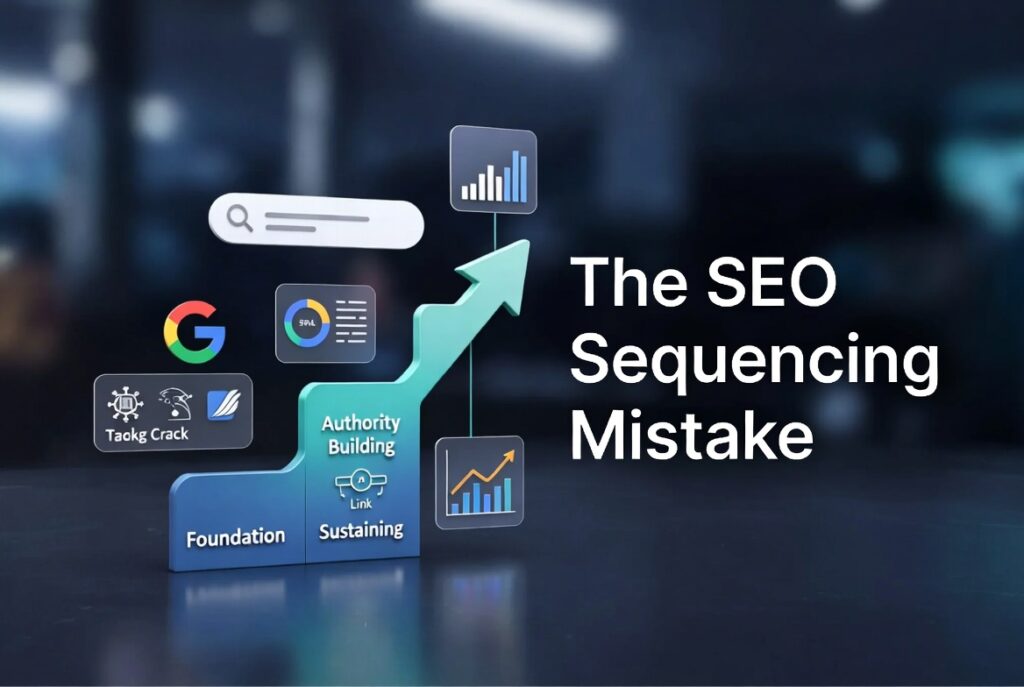
You are probably not bad at SEO. You are doing the right things in the wrong order. That single sequencing mistake is why smart, diligent practitioners spend months producing content, earning backlinks, and fixing technical issues — and still watch their organic traffic flatline. This guide exists to fix that.
https://www.contentevaluator.online/2026/05/16/seo-tactics/
The central argument here is direct: SEO failure is almost never a tactics problem. It is an ordering problem. Practitioners optimise the wrong variable first, then blame the algorithm when effort compounds into nothing. By the end of this guide, you will have a clear framework for the correct sequence, the two mistakes that derail most advanced campaigns, and a concrete 6-week playbook you can execute immediately.
https://www.contentevaluator.online/2026/06/16/zero-click-seo-tactics/
“Relevance earns rankings. Authority sustains them. One without the other is a temporary result.”
https://www.contentevaluator.online/2026/05/14/20-website-growth-tactics/
This is not a beginner’s primer. The basics — keyword research, meta tags, internal linking — are assumed. What follows is the layer most guides skip: the nuance and sequencing that separate practitioners who get consistent results from those who get occasional wins they cannot explain or repeat.Contents — jump to any section
SEO is the practice of making a page so clearly the best answer to a specific search query that Google has no defensible reason not to rank it first. Everything else — the technical work, the content, the links — is in service of that single outcome.
https://www.contentevaluator.online/2026/06/10/zero-click-searches/
That definition is more useful than the standard one (“improving visibility in search engines”) because it tells you something about mechanism. It points you toward the user, not the algorithm. It implies that the question “what does this page do for the person who finds it?” must be answered first, before keyword placement, before meta descriptions, before any of the tactical work practitioners obsess over.
https://www.contentevaluator.online/about-us/
The Working Definition Practitioners Actually Use
Ask a practitioner with a consistent track record how they think about SEO and you will hear some version of this:
- Relevance — the page unambiguously matches the true intent behind a query, not just its keywords
- Authority — enough of the web has explicitly pointed to this domain as a reliable source that Google treats it as a default
- Trust — the page delivers what it promises and signals credibility at every level: author, site, content, and external validation
All three are required. Relevance without authority produces pages that Google indexes but never commits to. Authority without relevance produces domain-level strength that does not translate to individual page rankings. Trust is what Google’s Helpful Content evaluation is specifically designed to assess — and what most campaigns fail to build deliberately.
https://www.contentevaluator.online/2026/03/06/google-content-evaluation-standards-2026/
Why the Textbook Version Creates Confusion
The theoretical definition centres on search engines. The practical definition centres on the person searching. That is not a semantic distinction — it determines every downstream decision.
When practitioners optimise for the algorithm first, they produce content that reads like it was written for a machine. Keyword density gets calculated. Headings get stuffed with exact-match phrases. Content length gets inflated to match competitors. The result is something Google can parse but humans abandon — and user behaviour signals (time on page, scroll depth, click-through rate, return-to-SERP rate) feed directly back into Google’s ranking evaluation.
The practical implication: Before writing a single word of any piece of content, the only question that matters is: “What does the person who typed this query actually need to leave satisfied?” The answer to that question is your brief. Everything else is formatting.
https://www.contentevaluator.online/2026/04/04/the-4-types-of-content-evaluation/
Google’s entire engineering investment over the last five years has been in making “what ranks” and “what genuinely helps the searcher” converge. The practitioners winning in 2026 treated those two things as the same question years before the algorithm caught up.
How SEO Actually Works: The Real 3-Phase Framework
SEO has three sequential phases, and most campaigns fail because they execute Phase 2 before Phase 1 is solid. They build links to pages that have no business ranking. They produce content clusters on domains with crawl budget problems. They wonder why effort fails to compound.
Here is the framework that consistent results are built on:
Phase 1: The Foundation Most People Skip
Before any other work, Google must be able to reach, render, and understand your pages. This phase is invisible when done right and catastrophic when skipped.
Phase 1 covers:
- Crawlability — no orphan pages, no blocked critical URLs, no crawl budget wasted on paginated or duplicate content
- Canonicalisation — every page has exactly one canonical version Google is meant to index; no conflicts between self-referencing canonicals and cross-domain tags
- Core Web Vitals — LCP under 2.5 seconds, CLS under 0.1, INP under 200ms on mobile (these are ranking signals, not just UX metrics)
- Indexation clarity — the pages you want ranked are indexed; the pages you do not (thank-you pages, staging, admin paths) are not
The real-world cost of skipping Phase 1: A regional law firm spent eight months on outreach — emailing journalists, sponsoring directories, writing guest posts. Forty percent of their target pages had duplicate canonical tags pointing to a staging domain left live after a site migration. Every link they built distributed equity across two competing versions of the same URL. The fix took three days. The recovery took four months. Not one link had been wasted in the sense of being low-quality — every placement was legitimate. But the foundation was broken, so nothing compounded.
Phase 1 is never optional and never “done once.” Run a full crawl audit every time you migrate, redesign, or significantly restructure. Use a technical SEO audit checklist before any Phase 2 work begins.
Phase 2: Building in the Right Sequence
This is where most of the real SEO work lives, and where the highest-leverage decisions are made. Phase 2 is about building topical authority before chasing link volume — in that order.
The mechanism: Google’s Helpful Content evaluation now assesses whether a site has demonstrated depth across a topic, not just on a single page. A backlink to a standalone page on a thin site carries meaningfully less weight than the same link pointing to a page surrounded by substantive related content. The architecture — hub pages linking to spoke pages, spoke pages reinforcing the hub — is not decorative structure. It is how link equity and topical authority accumulate together.
| Step | Action | Why This Order Matters | Common Mistake |
|---|---|---|---|
| 1 | Map topical gaps using GSC + competitor keyword analysis | Identifies where Google is already willing to rank you but hasn’t committed | Skipping this and writing topics based on interest rather than data |
| 2 | Build or strengthen the hub page for your target topic cluster | Hub page authority flows to spoke pages via internal links | Building spoke pages first with no hub to pass authority from |
| 3 | Produce 6–10 high-depth spoke pages that answer sub-questions | Signals topical depth; spoke pages support hub ranking | Publishing thin spoke content just to hit a page count target |
| 4 | Build external links to the hub page first | Hub authority distributes to spokes via internal link structure | Building links to homepage instead of the topic hub |
| 5 | Target position 4–20 pages for link uplift | Pages already ranking have Google’s attention — links here produce faster movement | Prioritising new page promotion over existing page improvement |
https://www.contentevaluator.online/2026/04/26/googles-evaluation-stack/
Before committing to any link-building campaign, identify your position 4–20 pages in GSC. Filter for queries with over 50 monthly impressions. These are your highest-leverage link targets — they already have Google’s attention, they just need a final authority signal to break into the top 3.
Common Phase 2 error: Most practitioners build links to their homepage or their highest-traffic pages. Both are typically wrong. Links to pages already ranking above position 3 produce diminishing returns. Links to position 4–20 pages produce position shifts within 4–8 weeks on established domains. The maths is straightforward — the restraint is not.
Phase 3: Sustaining Results Over Time
Rankings are not permanent states. They are positions that require active maintenance. Content decay — pages that ranked well in 2024 and are slowly sliding in 2026 — is the most undertracked metric in most SEO programmes.
The practice: once per quarter, pull every page ranking in positions 1–10 from Search Console. For each, check whether the content still accurately reflects current reality. Ask whether a user reading the page today would finish with the correct, complete picture. If not, update substantively. Google’s systems detect whether an update changes the information density of a page, not just its modification date — adding a paragraph about current events while leaving the core content unchanged does not register as a meaningful update.
Also track link decay. Backlinks disappear over time as referring pages are updated, removed, or deindexed. Quarterly link profile audits catch this before it translates to ranking drops. A structured link-building strategy addresses acquisition and retention.
The Two SEO Mistakes Quietly Destroying Your Results
Two failure modes account for the majority of SEO underperformance in established campaigns. Both are invisible from inside the work — which is exactly why they persist for months before practitioners notice them.
Mistake 1: Optimising for Keyword Position When Click-Through Rate Drives Compounding
Position is an output, not a goal. This distinction sounds philosophical until you see what it means in practice.
Google’s ranking systems incorporate user behaviour signals — including click-through rate — as feedback on whether the ranked result actually satisfied the query. A page in position 2 with a 9% CTR will, over time, compete seriously with a page in position 1 with a 3% CTR, because user behaviour data signals which result people actually wanted. This is not a secret — Google has discussed the role of user signals in ranking quality assessments for years. The practitioners who have internalised it treat title tags and meta descriptions as conversion copy, not label copy.
The root cause is a cognitive bias that might be called the position-zero fallacy: reaching the top rank feels like the end of the optimisation process. Practitioners stop experimenting with titles and descriptions once they hit position 1 or 2. Meanwhile, a competitor at position 3 with a sharper hook and a more specific promise is quietly eating the click share — and the algorithm is watching.
Self-audit: Pull your top 20 ranked pages from GSC. Compare your CTR against the average for that position (Ahrefs publishes position-by-position CTR benchmarks annually). For every page where you are below the position average, your CTR is the variable to fix — not your ranking.
| Version | Title Tag | Position | CTR | Monthly Clicks |
|---|---|---|---|---|
| Before | “Project Management Software | Features & Pricing | Acme” | 4 | 2.1% | 147 |
| After | “Why Most Teams Switch Project Tools by Month 3 (And How to Avoid It)” | 4 | 6.8% | 476 |
| Change | +4.7pp | +224% more clicks. Same position. No link building required. | ||
No ranking change. No new backlinks. No new content. The only change was specificity — the new title addressed a real anxiety the audience had, rather than describing a product category they already understood.
Mistake 2: Confusing Content Publication with SEO Progress
Publishing new content creates the sensation of progress. That sensation is often wrong.
Content calendars make teams feel productive. Columns get filled, word counts accumulate, publication frequency gets reported to stakeholders as a performance metric. None of this is SEO unless the content being published has a realistic path to ranking — meaning it targets a keyword gap your domain can credibly close, addresses an intent your existing content does not serve, and is substantively better than what currently ranks.
The root cause is that most content calendars are built around topic ideas, not keyword opportunity gaps. The right starting point is always the distance between what your site currently ranks for and what users in your domain are actively searching. Everything else is speculation — and speculation published at scale looks exactly like thin content to Google’s Helpful Content classifier.
Self-audit: Of your last 10 published pieces, how many were based on a keyword gap identified in actual search data? If the answer is fewer than 7, your content calendar is guesswork dressed as strategy.
The contrarian take the data supports: A site publishing one deeply-researched, gap-driven piece per month will outperform a site publishing four under-researched pieces per week over any 12-month window. Consistent publication is valuable — only if the standard for each piece justifies the effort of ranking it. Volume that does not rank is cost, not investment.
What SEO Strategies Actually Work in 2026?
The SEO landscape changed materially between 2024 and 2026, and the change is not cosmetic. AI Overviews, expanded use of large language model synthesis in search results, and Google’s spam and Helpful Content updates have shifted which signals drive rankings in ways that require adjusting strategy — not just tactics.
https://www.contentevaluator.online/2026/04/19/build-an-seo-strategy/
What Has Changed in the Last 18 Months
Google’s AI Overviews now appear for a significant share of informational queries in English-language search. The traffic impact is asymmetric:
- Queries with AI Overviews show reduced click-through rates for organic positions 1–3
- Queries where a site’s content is cited inside an AI Overview show meaningful brand impression increases
- The sites getting cited are overwhelmingly those with original data, institutional credibility, or first-person practitioner evidence — not those with the highest word counts or most backlinks
This is not a future trend. It is the current reality that should already be shaping your content strategy. Search Engine Land‘s ongoing coverage of AI Overview impact provides the most rigorous external tracking available.
https://www.contentevaluator.online/2026/03/27/seo-tips-2026/
Tactics That No Longer Deserve Your Time
- Mass-produced topical authority content at AI scale — Google’s classifier identifies these accurately. Publishing 50 AI-generated articles per month to “cover a topic” produces nothing except a diluted quality signal that suppresses the pages that actually matter
- Exact-match anchor text in link building — triggers spam signals faster than it builds authority. Vary anchor text naturally; any link profile where exact-match anchors exceed 10–15% of total anchors is a manual review risk
- Guest posting on content farms for link volume — link equity from low-authority placements has been close to zero since the 2024 spam update. One legitimate editorial placement from a real publication outperforms 40 guest posts on aggregator blogs
- Keyword stuffing in headings — Google’s NLP understands semantic equivalence. A heading that reads naturally and addresses the user’s question performs better than one with an exact-match phrase forced into it
What Has the Strongest Evidence Right Now
| Strategy | Why It Works | Best When | Realistic Timeline | Evidence Level |
|---|---|---|---|---|
| Position 4–20 page updates + CTR optimisation | Google already trusts these pages. Freshness + improved click signals push them over the threshold. | Domain is 12+ months old with 50+ indexed pages | 2–6 weeks for measurable movement | High — reproducible across domains |
| Original data/research production | Creates a citable asset no competitor has. Journalists and bloggers must link to the primary source. | You have access to proprietary data or can conduct a survey of 300+ respondents | 3–9 months for link accumulation | High — consistently cited in case studies |
| Topical cluster architecture | Signals demonstrated expertise. Hub+spoke link structure distributes authority efficiently. | You have 6+ high-quality spoke pages planned and a hub that can compete | 4–8 months to see cluster-level authority build | High — widely supported by domain growth analysis |
| Digital PR and editorial link earning | One high-authority editorial link outperforms 40 low-quality placements in equity and trust signals | You have a genuine story, data point, or expert perspective a journalist can build a piece around | Unpredictable — but 1–3 placements per quarter is a realistic target | High — though campaign ROI varies significantly |
| Content refresh programme | Existing pages already have authority and indexation. Freshness signals apply faster than to new content. | You have pages that ranked in 2022–2024 and have decayed by 2+ positions | 3–8 weeks per page after republication | High — fastest compound-return strategy available |
Quick Wins You Can Apply This Week
- Rewrite the title tags on your 3 highest-impression, lowest-CTR pages. Use a specific hook that addresses an anxiety or desired outcome, not a category label. Test for 4 weeks and measure CTR change in GSC.
- Add one internal link from a high-authority page to each of your position 4–10 target pages. Pull your most-linked internal pages from Screaming Frog, find topically relevant anchor opportunities, and add the links. No outreach, no budget — just equity redistribution.
- Republish your most-decayed page with substantive updates. Add a “Last updated” date, update any statistics or examples that are more than 18 months old, and re-submit via GSC URL inspection. Track position weekly for 6 weeks.
Which SEO Tools and Sources Can You Actually Trust?
The tools market is saturated with products that report similar underlying data through different interfaces. The ones worth paying for solve specific workflow problems. The ones to avoid charge enterprise prices for metrics you can replicate free — or that do not correlate reliably with ranking outcomes.
Essential Tools: When Each One Earns Its Place
| Tool | Cost | Best For | Limitation to Know |
|---|---|---|---|
| Google Search Console | Free | First-party impression, click, and position data. Gap analysis. Decay tracking. The one tool that shows you what Google is actually doing with your pages — no estimation involved. | 16-month data limit. No competitor data. Position averaging can obscure volatility. |
| Ahrefs | From ~$99/mo | Backlink profile analysis, competitor gap identification, keyword difficulty scoring. Best-in-class for link data accuracy. Essential for any active link-building programme. | Keyword volume estimates are approximations, not absolutes. Overkill for sites under 500 pages with no active link strategy. |
| Screaming Frog | Free up to 500 URLs; £259/yr | Full-site crawl audits. Canonical conflict detection. Redirect chain mapping. No browser-based alternative matches its depth for sites over 1,000 pages. | Does not assess content quality. Crawls what’s crawlable — won’t catch JavaScript rendering issues without additional config. |
| Google Analytics 4 | Free | Organic traffic to conversion mapping. Pairing GSC data with GA4 gives full funnel visibility from impression to outcome. | Requires significant setup to produce meaningful reports. Default configuration undercounts conversions from organic search. |
| Semrush | From ~$139/mo | Keyword research at scale, content gap analysis, local SEO features. Broader keyword database than Ahrefs. Better for discovery; Ahrefs is better for link analysis. | Significant overlap with Ahrefs. Most sites need one, not both. Keyword volume data can be inflated for long-tail terms. |
| PageSpeed Insights | Free | Core Web Vitals diagnostics using real field data (not just lab simulations). Run before and after any infrastructure change or hosting migration. | Field data requires sufficient traffic to generate. New pages or low-traffic pages show lab data only, which can diverge from real-world scores. |
| Surfer SEO / Clearscope | From ~$89/mo | Content optimisation and semantic coverage analysis. Useful for identifying topic gaps between your draft and currently-ranking content. | Correlation-based, not causal. These tools reflect patterns in what ranks, not directives from Google. Treat outputs as signals, not mandates. |
https://www.contentevaluator.online/2026/02/13/seo-in-2026/
The Most Reliable Sources to Follow
Use a short list of genuinely reliable sources and ignore the rest. The SEO commentary ecosystem produces enormous volume; very little of it is based on controlled testing or primary data.
https://www.contentevaluator.online/2026/02/18/google-content-quality/
- Google Search Central — the only authoritative source for Google’s actual guidance. Read everything published here before adopting any third-party claim about algorithm behaviour. When Google’s documentation and a popular SEO blog disagree, Google’s documentation is correct.
- Search Engine Land — covers algorithmic updates with editorial rigour. Their documentation of the 2024–2025 spam and Helpful Content updates is the most accurate external record available.
- Lily Ray (Amsive) — publishes primary research on E-E-A-T signals and update impact with transparent methodology. Her data-backed approach separates her from the majority of SEO commentators who offer opinions dressed as findings.
- Barry Schwartz (Search Engine Roundtable) — fastest public index of confirmed algorithm updates and practitioner impact reports. Treat as signal aggregation, not analysis — he surfaces what is happening before it is explained.
- Moz Blog — useful for foundational content and the annual Search Ranking Factors survey, which, while imperfect, is the most systematic publicly available attempt to correlate signals with rankings.
https://www.contentevaluator.online/terms-and-conditions/
Sources to Treat with Scepticism
Any publication that presents “Google’s ranking factors” as a definitive numbered list is doing speculation, not reporting. Google’s ranking systems are not a ranked checklist. They are a collection of models, evaluations, and real-time signals that interact in ways Google’s own engineers do not fully explain publicly.
https://www.contentevaluator.online/2026/05/28/brand-keyword-search/
The “200 ranking factors” genre of content has been misrepresenting how search works for over a decade. Use it for brainstorming, never for decision-making. Similarly, treat any SEO case study without a disclosed methodology — domain, industry, timeline, baseline, control conditions — as an anecdote rather than evidence.
https://www.contentevaluator.online/2026/04/30/10-seo-benefits/
Your 6-Week SEO Playbook: Week-by-Week Actions
The first six weeks of any serious SEO programme should be diagnostic before they are creative. Building new pages before you understand what is already broken with your existing ones is how practitioners waste the next six months producing content that ranks for nothing.
https://www.contentevaluator.online/2026/05/30/broad-authority-sites/
This playbook is built around the three-phase framework from Section 2. Each week has specific deliverables and a measurable success criterion — not vague goals.
Week 1: Foundation Audit
Goal: confirm that everything Google needs to index your key pages is working correctly.
- Day 1–2: Run Screaming Frog across your entire domain. Export all pages with 4xx/5xx errors, duplicate title tags, missing or conflicting canonical tags, and pages with noindex tags that should be indexed. Fix critical errors before proceeding — anything else you do in weeks 2–6 builds on this.
- Day 3–4: Verify GSC coverage. Confirm your 20 most important pages are indexed. Check the Coverage report for any Excluded pages that should not be excluded.
- Day 5: Run PageSpeed Insights on your 5 highest-traffic pages. Document any Core Web Vitals failures. If LCP exceeds 4 seconds on mobile, treat this as a Phase 1 blocker — not a Phase 3 refinement.
Success metric: Zero critical crawl errors on target pages. Complete technical issue log with owner assigned to each item.
Week 2: Opportunity Mapping
Goal: build a data-driven priority list of pages and queries to work on — in the correct order.
- Day 1–2: Export 12 months of GSC performance data. Filter for queries in positions 4–20 with more than 50 monthly impressions. Sort by impression volume. This is your actual priority queue — not editorial instinct, not stakeholder requests.
- Day 3: For your top 10 position 4–20 pages, pull the current CTR and compare it to position benchmarks. Every page below the position average is a CTR problem, not a ranking problem.
- Day 4–5: Manually search the target keyword for your top 5 priority pages in an incognito browser. Read the top 3 results. Document exactly what depth, format, data, or structure those pages have that yours does not. This becomes your update brief.
Success metric: Documented update brief for your top 5 priority pages. Shortlist of 3 title tags to rewrite immediately.
Week 3: Priority Page Updates
Goal: push your highest-potential existing pages over the ranking threshold.
- Days 1–3: Update your top 3 priority pages. For each: close the content gaps you documented, update any data or examples older than 18 months, add a “Last updated” date, and add one internal link from a higher-authority page on your domain pointing to this page.
- Days 4–5: Rewrite the title tags on your 3 lowest-CTR position 4–20 pages. Test the new title using a headline analyser or a small paid search ad if you want pre-publication validation. Re-submit all updated pages via GSC URL inspection.
Success metric: 3 pages updated and resubmitted. 3 new title tags live. Position and CTR tracked as a baseline from this week.
Week 4: Internal Link Audit and Equity Redistribution
Goal: redistribute existing domain authority to your highest-leverage target pages without any new content or external links.
- Days 1–2: Use Screaming Frog to identify your most internally-linked pages. These pages pass the most authority through their outbound links. Review each for opportunities to add a contextual internal link to one of your priority target pages.
- Days 3–4: For each of your top 5 target pages, aim to add 2–3 new internal links from topically relevant, high-authority pages elsewhere on the site. Anchor text should be descriptive and natural — not exact-match to your target keyword.
- Day 5: Update your topical cluster hub page (if you have one) to include links to all relevant spoke pages. Ensure spoke pages link back to the hub. Check for orphan pages — any important page with fewer than 3 internal links pointing to it is invisible from the inside of your site.
Success metric: 10+ new internal links placed. Zero high-priority pages with fewer than 3 internal links.
Week 5: Content Gap Closure
Goal: fill the highest-value gaps in your topical cluster — based on data, not assumption.
- Days 1–2: Use your competitor gap analysis (from Ahrefs or Semrush) to identify queries where your top 3 competitors rank and you do not. Filter for queries with realistic difficulty given your domain authority. These are your highest-priority new content targets.
- Days 3–5: Begin production on one gap piece. Before writing, confirm: the intent is clear and specific, your domain has a credible case for ranking, and the content you will produce will be substantively better than the current top result — not just longer. Use a content quality evaluation framework before publishing.
Decision point: If your position 4–20 list from Week 2 is not exhausted, return to it before producing new content. Updated pages move faster than new pages on established domains. The temptation to publish new work is real — resist it until existing opportunities are closed.
Success metric: One new gap piece in production, fully briefed and at least first-drafted. All items on the position 4–20 shortlist actioned.
Week 6: Measure, Learn, and Plan the Next Quarter
Goal: assess what has moved, understand why, and set the next quarter’s priorities before momentum is lost.
- Days 1–2: Pull GSC data for all pages updated in weeks 3–4. Compare impressions, position, and CTR against the baseline recorded at the end of Week 3. Expect fluctuation — the signal you are looking for is a directional trend, not a clean number.
- Day 3: Document what moved and what did not. For pages that did not move: was the update substantive enough? Was the internal link from a sufficiently authoritative page? Is the competition too strong for the current domain authority level? These answers shape your Q3 strategy.
- Days 4–5: Build your next quarter’s priority list. It should contain: 3–5 pages to continue monitoring from this cycle, the gap piece from Week 5 ready to publish, and a quarterly decay audit date blocked in your calendar.
Success metric: At least 2 of the 3 updated pages show measurable position or CTR improvement. Q3 priority list documented and assigned.
Week 1 Priority Checklist
If you do only three things this week, make them these:
- Run Screaming Frog and fix every canonical and redirect error before anything else
- Pull your GSC position 4–20 data — this is your actual SEO priority queue
- Rewrite the title tag on your highest-impression, lowest-CTR page using a specific hook rather than a category label
FAQ: 13 High-Intent SEO Questions Answered
What is the most important first step in SEO?
Verify that Google can crawl, render, and correctly understand your pages before any other optimisation. A technical audit using Google Search Console and Screaming Frog should confirm that your key pages are indexed, carry no canonical conflicts, and have no redirect chain issues. Building links or content on a site with Phase 1 problems is equivalent to renovating a house with a structural fault — the surface work compounds into nothing. Every significant site migration, redesign, or structural change requires a fresh Phase 1 audit.
How long does it take to see SEO results?
It depends on what you are doing. Updates to existing pages on established domains can produce measurable position movement in 3–8 weeks. New pages on established domains typically take 3–6 months to rank competitively. New domains on any content take 6–18 months to accumulate the authority needed for consistent first-page rankings. Each missing element — technical health, content quality, relevant external links — extends these timelines substantially. The fastest reliable path to organic traffic growth is optimising pages that are already ranking in positions 4–20.
What is the most common SEO mistake advanced practitioners make?
Optimising for ranking position as the end goal, rather than for click-through rate and user satisfaction. Most sites have more pages in positions 4–20 than they realise — pages where Google is willing to show the result but users are not clicking on it. Fixing CTR on these pages produces faster, cheaper traffic growth than any new content or link-building campaign. Practitioners overlook this because publishing and link building feel like active progress; rewriting a title tag feels trivial. The data consistently disagrees.
How do I know if my SEO programme is actually working?
Track organic clicks and impressions in Google Search Console weekly, not monthly. Specifically: position movement without click growth is a CTR problem; impressions growing without position improvement means Google is testing but not committing — usually a content quality signal. The clearest indicator of a working programme is a consistent week-over-week increase in clicks from non-branded organic queries over a 90-day window. Branded traffic growth is valuable but does not indicate SEO performance; it indicates brand awareness.
What is topical authority and does it actually affect rankings?
Topical authority refers to a site’s demonstrated depth of coverage across a subject area — not just its presence on a topic. It affects rankings because Google’s Helpful Content evaluation assesses whether a domain has genuine expertise in its subject, which it infers partly from the breadth and depth of related content. A backlink to a page on a topically authoritative domain carries more weight than the same link to an isolated page on a general-purpose site. Building topical authority requires producing substantive, interlinked content across the sub-questions within a topic cluster — not just a single strong page.
How important are backlinks in 2026?
Backlinks remain a significant ranking signal, but their role is increasingly about quality and context rather than quantity. A single editorial link from a domain with genuine authority in your topic outperforms 50 links from low-authority placements. The 2024 spam update substantially reduced the ranking impact of mass guest posting and paid link schemes. The most durable link-building strategy in 2026 is creating original data or research that journalists and practitioners want to cite — link earning rather than link acquisition.
Does publishing AI-generated content hurt SEO?
Google’s official position is that the production method is less relevant than the quality and helpfulness of the output. In practice, mass-produced AI content at scale — published without editing, fact-checking, or original insight — produces measurable ranking suppression, particularly following Helpful Content updates. The issue is not AI authorship; it is information density. AI-generated content that adds no original perspective, data, or experience to what already ranks is classified as unhelpful regardless of how it was produced. Human expertise used to direct, review, and enrich AI-assisted drafts produces different results.
How does Google’s Helpful Content system affect content strategy?
Google’s Helpful Content evaluation assesses content at both the page and site level. A high proportion of unhelpful content on a domain suppresses the rankings of every page on that domain, including pages that would otherwise rank well. The practical implication: auditing and removing or substantially improving existing thin content often produces faster ranking improvements than publishing new content. Before expanding a site’s content library, it is worth assessing whether existing content meets the standard Google uses — written for the user, demonstrating real expertise, and satisfying the query without requiring the user to return to search.
What are Core Web Vitals and how much do they affect rankings?
Core Web Vitals are Google’s page experience metrics: Largest Contentful Paint (page loading speed), Cumulative Layout Shift (visual stability), and Interaction to Next Paint (responsiveness). Google confirmed they are ranking signals, but their weight is moderate — significant enough to suppress pages that fail them, not significant enough to override content quality and relevance. A page that fails CWVs but is unambiguously the best answer to a query will still rank. A page that passes CWVs but is mediocre content will not be rescued by its scores. Fix failures as Phase 1 foundation work, not as a primary ranking lever.
Is SEO suitable for new websites or new domains?
SEO is appropriate from day one of any site, but the expectations and strategy must match the domain’s current authority level. New domains should prioritise: building topical authority through a focused content cluster on a narrow topic, earning initial links through digital PR or partnerships, and targeting lower-competition long-tail queries rather than high-volume head terms. Competing for competitive head terms on a new domain before building foundational authority typically produces no results for 12–18 months regardless of content quality. Patience and topic focus are the correct strategies for new domains, not volume.
How does AI Overview impact organic traffic, and what should I do about it?
AI Overviews reduce click-through rates for the top organic positions on informational queries — users who get their answer directly in the overview do not need to click through to a source. The sites most insulated from this shift share one characteristic: they produce original data, first-person expertise, or primary research that AI systems need to cite. Creating citable original assets — surveys, proprietary datasets, practitioner case studies — positions your content to appear as a cited source inside AI Overviews rather than being displaced by them. The adaptation strategy is to shift from information delivery toward verified primary sources.
What is content decay and how do I fix it?
Content decay is the gradual loss of ranking position experienced by pages whose content has become outdated, been surpassed by fresher competitors, or accumulated lower click-through rates over time. Fix it by conducting a quarterly decay audit: pull all pages ranking in positions 1–10 from GSC and review each for factual currency, depth compared to current competitors, and CTR relative to position benchmarks. Update substantively — add new data, correct outdated claims, improve the title tag — and republish with a “Last updated” date. Cosmetic additions without information density improvement do not register as meaningful updates.
Should I prioritise technical SEO or content quality?
They are sequential, not competing. Technical SEO (Phase 1) must be sufficient before content quality can express itself in rankings — a page with canonicalisation errors or crawl budget problems will not rank regardless of its content quality. Once Phase 1 is solid, content quality and topical authority (Phase 2) become the primary ranking drivers. The error is treating these as a binary choice; they are sequential dependencies. A technically perfect site with mediocre content does not rank. Excellent content on a technically broken site does not rank either. Phase 1 first, Phase 2 second — always.
The One Thing to Do in the Next 24 Hours
Open Google Search Console. Pull performance data for the last three months. Filter for keywords where your pages appear in positions 4–20 with more than 30 monthly impressions. Sort by impressions, descending.
The page at the top of that list is your first target. Not a new piece of content. Not outreach. Not another audit. That page, updated this week with substantive improvements and a sharper title tag, will produce a measurable result faster than anything else available to you right now.
If you want a structured way to evaluate your content’s quality before you update it, use the content evaluation framework here to identify exactly what gaps to close before you republish.
About the Author
SEO Strategist & Content Systems Architect
I have spent 10+ years working on organic growth for sites across SaaS, publishing, e-commerce, and professional services — from 500-page startups to domains with over 1 million indexed URLs. My approach is evidence-first: if I cannot point to a mechanism or a replicable result, I do not recommend the tactic. I write about what works in practice, including when that contradicts popular advice.
More articles on SEO strategy and content systems →