

Ninety-five percent of affiliate marketers quit. Not because the model is broken, but because the system they built was structurally incapable of surviving. A forensic autopsy — with numbers.
Let me tell you about the worst thing I ever did as a publisher. In 2021, riding the early post-pandemic content wave, I built out a 140-article affiliate review cluster across three niches — home appliances, personal finance tools, and VPN software. The content was competent. The keyword research was thorough. The internal linking was by the book. By late 2022, the whole operation was pulling around 90,000 monthly organic visitors and generating roughly $11,000 a month. I was proud of it.
By December 2023, that same cluster was generating $800 a month from 6,000 visitors. Not a gradual decline. A cliff edge. Three months of watching dashboards and not quite believing what I was seeing. I’d built something that looked like a content system but was, underneath, a traffic-harvesting operation with no identity, no reader loyalty, and no reason to exist beyond its search rankings. When the ground shifted, there was nothing underneath.
That experience is why I can write this article honestly. I’m not going to give you the standard affiliate marketing failure list (“you’re not being consistent enough,” “your niche is too broad,” “you need better SEO”). Those pieces are everywhere. What I want to do here is go deeper — into the structural architecture of failure — because the problem isn’t behavior, it’s design.
The Real Failure Rate — And Why It’s Worse Than Reported
The widely-cited figure is that 95% of affiliate marketers fail and quit. You’ll find this number referenced across industry reports from MyLead, EntrepreneursHQ, and Authority Hacker’s annual surveys. But here’s what that number hides: it conflates two very different kinds of failure.
The first kind — call it naive failure — is the person who starts a blog in January with no strategy, posts eight times, gets bored, and abandons it by March. That’s not a system failure. That’s an experiment that didn’t get far enough to be a system at all.
The second kind — and this is the one that should terrify you if you’re past the beginner stage — is structural failure. This is the publisher who did everything right by the standards of 2018–2022, built a real traffic asset, and watched it collapse anyway. These are people with years of work and real revenues who got wiped out. And by the data from multiple independent studies conducted after Google’s 2023–2024 Helpful Content Update cycles, this cohort is enormous.
Only ~1% of affiliate marketers exceed $1M/year in earnings. Roughly 57.5% earn under $10K annually. The distribution is far more extreme than the “average affiliate earns $8,038/month” figures suggest — that average is dominated by the top tier. Sources: Authority Hacker (2024), AffStat (2024), DemandSage (2026).
What this pyramid obscures is the mechanism. Most people look at it and think “I need to work harder to climb up.” But the real question is: why is the pyramid this shape at all? The answer has almost nothing to do with effort and almost everything to do with system design. The top 15% of affiliate earners don’t just publish more — they’ve built fundamentally different structures.
The 7 Structural Flaws Hidden in Plain Sight
These aren’t the mistakes people usually list. I’m not talking about “choose the right niche” or “build better backlinks.” Those are tactical. What follows is structural — the load-bearing walls of your content system that, if built wrong, will fail regardless of how hard you try to decorate the rooms.
You Built a Traffic System, Not a Publishing Business
The clearest marker of a doomed affiliate blog is that it exists only in relationship to Google’s algorithm. Everything — niche selection, topic choice, content format, publishing cadence — was decided based on what ranked, not on what served a defined reader with a defined problem. When you build a traffic system, Google is your business partner. When Google changes its mind (and it will), you have no business.
A publishing business asks: “Who reads us, why do they trust us, and what would they miss if we disappeared?” A traffic system asks: “What keywords have search volume and manageable KD?” These questions look similar. The businesses they produce are completely different.
The Inverted Content Funnel: Too Much Bottom, No Top
Most affiliate blogs are built almost entirely of commercial intent content — “best X,” “X vs Y,” “X review” — with thin or nonexistent informational coverage of the same topic space. This is the inverted funnel problem. You’re trying to convert people who haven’t been warmed up. You’re also sending an unmistakable signal to both Google and readers: this site exists to sell, not to inform.
The data on mid-funnel optimization is instructive here. Research from Anstrex (2025) found that affiliates who master mid-funnel conversion optimization see conversion rate improvements of 40–60% when directing pre-warmed traffic to commercial pages. That’s the difference between a funnel that works and one that converts at 0.5%.
Topical Shallowness Disguised as Niche Focus
“I’m in the home security niche” sounds like a niche focus. But if you have 30 review posts about security cameras and zero articles about home security legislation, false alarm protocols, neighborhood watch data, or the psychology of residential crime prevention, you don’t have topical authority — you have a collection of product comparisons. These are not the same thing, and Google’s Quality Rater Guidelines know the difference.
Real topical authority means owning a subject area so completely that your site is the reference, not a stop along the way to somewhere else. It requires genuine informational depth — content that serves readers who aren’t ready to buy yet and content that serves professionals who will never buy through your links. Most affiliate publishers find that commitment terrifying because it doesn’t produce immediate affiliate commissions.
Anonymity as the Default Identity Setting
Here’s the one that stings to admit: a shocking number of affiliate blogs have no verifiable human behind them. There’s a “John D.” with a stock photo, a vague “About” page, and a contact form that goes nowhere. This worked until it didn’t. Google’s algorithms — specifically the entity trust signals that became a core part of the 2023–2024 updates — require a verifiable real-world identity behind a site before they extend meaningful trust.
SEO researcher Shaun Anderson at Hobo Web, analyzing dozens of HCU-affected sites through 2024–2025, identified what he calls the “Disconnected Entity Hypothesis”: many demolished sites didn’t have bad content, they lacked a verifiable entity. If Google cannot confirm who owns the site and why it exists in the real world, the content is treated as “unhelpful” regardless of its actual quality.
Single-Channel Distribution — The Single Point of Failure
If 95% of your traffic comes from Google organic search, you don’t have a distribution strategy. You have a dependency. The affiliate bloggers who survived the HCU carnage were disproportionately the ones with email lists, YouTube presences, social media audiences, or community presence on platforms they owned or partially controlled. Distribution diversification isn’t a “nice to have” growth tactic — it’s existential risk management.
The data from Authority Hacker (2024) makes this concrete: affiliates using email marketing earned 66.4% more than those who did not. Email subscribers are an audience you own. They don’t evaporate when an algorithm changes. Every week you spend building content without building email is a week you’re increasing your single-channel exposure.
The Cost-Blindness Problem: Producing Content Without Tracking Its Economics
Most affiliate bloggers track revenue. Very few track cost-per-article against revenue-per-article in any systematic way. This is catastrophic from a business management standpoint. You can be earning $6,000 a month from 200 published articles while spending $5,500 a month producing them — and feel like a success because the revenue number is going up. The margin is a disaster. Without unit economics tracking, you cannot make rational decisions about scaling, pivoting, or cutting.
Chasing Commission Rates Instead of Audience Alignment
The standard advice in affiliate circles is to target high-commission products. This creates a perverse incentive: publishers write about whatever pays the most rather than whatever their audience actually needs. The result is a disconnect between editorial voice and product recommendation that sophisticated readers (and Google’s quality raters) can detect immediately.
Research from Authority Hacker (2024) found that marketers who choose products based on trends — presumably products their audience is actually interested in — earned 47.16% more revenue than those who chose based on commission rates or personal preference. The algorithm for maximizing affiliate revenue is not “find the highest commission.” It’s “find what your specific reader wants to buy, then find the best program for that.”
The HCU Reckoning: What Google Actually Did to Your Niche
In September 2023, Google’s Helpful Content Update began reshaping the search landscape in ways that most SEO commentary dramatically understated. Then in March 2024, Google folded the Helpful Content System into its core ranking algorithm permanently — no longer a periodic event but a continuous signal embedded in every ranking decision.
“Websites can regain traffic by improving quality, but returning to pre-update levels isn’t realistic.”
— John Mueller, Google Search AdvocateThe Paul Teitelman SEO study — analyzing niche and affiliate sites over an eight-month period from December 2023 to August 2024 — produced a finding that should stop you cold: nearly 50% of sites in their cohort lost more than 90% of their monthly organic traffic. Not a dip. A near-total wipeout. The sites that suffered the most were not the obvious spam operations; they were legitimate content publishers who had built their traffic primarily through SEO mechanics.
Data from Paul Teitelman SEO’s independent study. ~77% of studied niche/affiliate sites lost more than 50% of traffic. Travel publishers saw 32% of sites lose more than 90% of organic traffic (Boomcycle analysis of 671 travel publishers).
What made the HCU different from previous algorithm updates is captured in a finding from Moz data scientist Tom Capper: the update was not, primarily, a content quality assessment. It was likely a mathematical ratio check between Domain Authority (DA) and Brand Authority (BA). Sites where the link profile significantly outpaced navigational demand — where DA was high but brand search volume was low — were flagged as “over-SEO’d” and treated as synthetic. These were sites built on link manipulation rather than genuine audience interest.
This reframes the whole HCU conversation. It wasn’t primarily punishing thin content. It was punishing the structure of sites that had no real-world presence beyond their search rankings. The technical term is a “disconnected entity.” The human translation is: Google looked at your site and could not find evidence that anyone cared about you specifically, as opposed to whatever you happened to rank for.
Sites that have “recovered” from HCU typically see about one-third of their original traffic return — considered a win in current SEO circles. Full recovery to pre-HCU traffic levels has not been widely documented. The Boomcycle analysis of recovery cases confirms this sobering benchmark.
At Google’s October 2024 Creator Summit, attendees (small site owners who had already drastically wound down their businesses) reported clear admissions from Google staff that quality content was being penalized, but no clear recovery pathway was offered. As one attendee, Morgan McBride of Charleston Crafted, summarized afterwards: “If you were hit by HCU and depend on Google, move on.”
The practical implication: if your site was hit, the strategic question is not “how do I recover to where I was?” It’s “do I rebuild this correctly, or do I start fresh?” Those are very different projects, and the answer depends entirely on the structural integrity of what you already have.
The Unit Economics Nobody Runs (Until It’s Too Late)
I’ve talked with dozens of affiliate bloggers over the past two years who were shocked — genuinely surprised — when I walked them through the actual economics of their content operation. The revenue dashboard looks fine. The unit economics tell a different story entirely.
Here’s how to think about this correctly. The core metric for an affiliate blog isn’t total revenue. It’s Revenue Per 1,000 Visitors (RPM) against Cost Per Published Article (CPA) against Average Monthly Traffic Per Article (AMTPA). The ratio between these three determines whether your content system is economically viable or just a slow bleed.
The Failing System: A Worked Example
📉 Scenario A: The Typical Failing Affiliate Blog
Nine and a half months to break even on a single article, at current traffic levels — which are probably declining. This is a common situation and almost nobody runs this calculation. The blog “feels” like a success because revenue is nominally there, but the economics are deeply underwater. The system is kept alive by hope and publishing momentum, not financial logic.
📈 Scenario B: A Viable Content System
Less traffic. Less content volume. Dramatically better economics. The difference is the RPM — which in the viable system is over 4× higher despite the traffic being lower. That RPM difference comes from funnel architecture: informational content warming readers toward high-ticket affiliate products, email capture adding recurring revenue layer, and product selection aligned to genuine reader intent rather than commission rates.
The $149.76 industry-average RPM (Authority Hacker, 2024) masks enormous variance. Thin review sites often operate below $35 RPM while niche-authority publishers in finance and SaaS can exceed $350 RPM. Strategy — not traffic volume — is the primary driver.
The industry benchmark RPM for affiliate websites is approximately $149.76 per 1,000 visitors, according to Authority Hacker’s 2024 research. But this average is pulled significantly upward by top-tier operators. Most mid-range affiliate blogs operate at $30–$60 RPM — and many run below their content costs without realizing it.
The DA/BA Trap: Why Your Backlinks Are Killing You
This is the finding that stopped me cold when I first encountered Tom Capper’s analysis at Moz. The HCU, he argued, was not primarily a content quality classifier — it was more likely a ratio check between two kinds of authority: Domain Authority (DA) and Brand Authority (BA).
DA is the traditional measure: how many links point at you, weighted by their quality. BA is something different: navigational demand. How often do people search for your brand name specifically? How often does your brand appear in searches that aren’t about your content, but about you?
HCU “losers” in Capper’s data had markedly lower BA (Brand Authority score: 37) compared to HCU “winners” (62). They were “over-SEO’d” — possessing strong link profiles that their real-world presence couldn’t justify. When DA meaningfully outpaces BA, Google appears to classify the site as “synthetic” — traffic engineered rather than earned.
An affiliate blog with a DA of 45 and a Brand Authority of 20 is at significantly higher HCU risk than a blog with a DA of 28 and a Brand Authority of 30. The second site has a more credible link-to-brand ratio — even though its raw authority metrics are lower. This inverts the conventional wisdom that “more links = safer site.”
The fix is not to stop building links. It’s to build brand signals at least proportionally: branded search demand, social presence, YouTube mentions, press coverage, community engagement. Brand is the floor your link strategy needs to stand on.
The DA/BA ratio framework, based on Tom Capper’s Moz analysis of HCU-affected sites. Sites in the “Danger Zone” (high DA, low BA) face the highest algorithmic risk regardless of content quality. Recovery requires brand signal building, not technical fixes.
Content Factory vs. Entity: The Core Distinction That Separates Winners from Corpses
I want to introduce a distinction that I think cuts closer to the truth than most affiliate SEO frameworks. The fundamental divide in this industry is not between good content and bad content, or between high-DA and low-DA sites. It’s between Content Factories and Entities.
A Content Factory is an operation oriented around production: keyword research → article production → publication → repeat. The product is content. The customer is Google’s crawler. The measure of success is ranking position and organic traffic. This model worked beautifully from approximately 2015 to 2022. It is now in structural crisis.
An Entity is an operation oriented around a specific reader with a specific problem. It produces content, yes, but the product is actually help — a genuine service to a defined audience. The customer is a person. The measure of success is whether that person got what they needed and whether they’d come back. This model works across algorithm updates because it’s aligned with what algorithm updates are ultimately trying to surface.
| Dimension | Content Factory | Entity |
|---|---|---|
| Primary orientation | Search engine rankings | Reader outcomes |
| Content selection driver | Keyword volume + KD | Audience problem mapping |
| Identity | Anonymous or vague | Named, verifiable, transparent |
| HCU vulnerability | High — dependent on single algo signal | Low — brand signal protects |
| Distribution | Google organic (single channel) | Multi-channel (email, social, referral) |
| RPM range | $18–$55 (typical) | $120–$500+ (typical) |
| Email list | Negligible or absent | Core asset — 35%+ revenue contribution |
| Response to core updates | Significant volatility | Moderate — recovers with next cycle |
| Topical coverage | Commercial keywords only | Full semantic coverage (info + commercial) |
| Long-term trajectory | Declining without continuous SEO investment | Compounding — brand builds over time |
The transition from Content Factory to Entity is not primarily a content quality upgrade. It’s an identity and architectural transformation. You don’t become an entity by writing better articles. You become one by deciding, clearly and publicly, what you stand for, who you serve, and what you will and will not cover — and then building everything around that decision.
The Viable Content Engine (VCE) — A New Framework
I want to propose a framework for rebuilding correctly. This is not a repackaging of existing advice. It’s an architectural model based on what I’ve observed working across publisher portfolios over the past three years — specifically what differentiates the operators who weathered the HCU from those who didn’t.
I’m calling it the Viable Content Engine (VCE). It has four components, and critically, they operate in a specific dependency order — you cannot shortcut component two before building component one.
The Viable Content Engine (VCE)
Four interdependent components. Must be built in order. Each unlocks the next.
Define and publish who you are, what you specifically cover, and why you’re qualified to cover it. Named authors, verifiable credentials, real “About” page with actual history, consistent brand identity across web presence. This is the foundation — without it, nothing else holds.
Map the full semantic universe of your niche — not just commercial terms but the informational, navigational, and investigative queries. Build content that covers this entire space, including content that earns zero affiliate revenue but establishes genuine topical authority. Aim to be the reference, not a waypoint.
Design deliberate pathways from informational content to commercial content. Use email capture at mid-funnel. Map which informational articles should ladder to which commercial reviews. Track RPM by funnel position — informational pages should warm, not just attract. Build comparison and alternative content to capture high-intent bottom-of-funnel queries.
Treat Google as one channel among several. Build email (targeting 20%+ of monthly new readers converting to subscribers). Establish brand presence on at least one social platform. Pursue press mentions, podcast appearances, and expert citations. These brand signals protect you algorithmically and independently generate traffic.
Most failing affiliate blogs score below 25/100 on the VCE framework — not because of content quality, but because the foundational components (entity clarity and topical depth) were never built. A viable site doesn’t need perfection across all four; it needs a solid score on components 01 and 02 to make 03 and 04 effective.
The Rebuild Playbook: 90 Days to a System That Can Survive
This section is practical. Not inspirational. Here is an actual sequence I’ve seen work for mid-sized affiliate blogs (50–200 published articles, 10K–100K monthly organic sessions) attempting a structural rebuild. Adjust for your specific situation, but don’t skip components.
Days 1–30: Triage and Entity Foundation
Start with a content audit — not a quality audit, a performance audit. Pull every article. Record: monthly organic traffic, affiliate click-through rate, affiliate revenue attributed, content cost (estimated or actual), months since publication. Calculate a simple Revenue-Per-Article-Per-Month (RPAPM) score for each piece. Sort ascending. The bottom 20% by RPAPM that also get less than 50 visits/month are candidates for consolidation, noindexing, or deletion. Don’t delete lightly — consolidate into stronger pieces where topically appropriate.
Simultaneously, build the entity layer. This means: a real author bio with a verifiable name (even a pen name can work if it’s consistent and accompanied by real credentials), a transparent About page that explains why this site exists and who built it, real contact information, updated privacy policy and disclosure pages. These are not decorative. They are signals that Google’s quality assessment machinery actively checks against its Quality Rater Guidelines (specifically section 2.5.2, which requires clarity on ownership and authorship).
Register your brand name as a social handle on at least Twitter/X, LinkedIn, and Pinterest (or wherever your audience actually lives). Even if you don’t post actively yet, the existence of branded social profiles creates entity signals that feed into Google’s understanding of who you are.
Days 31–60: Topical Depth Architecture
This is the hardest phase, because it requires publishing content that won’t directly generate affiliate revenue. You need to map your topical universe completely. Take your core topic (say, “home security”) and build a comprehensive map of every information need in that space: definitional (“what is a home security system”), investigational (“how effective are security cameras”), how-to (“how to install a doorbell camera”), data/research (“home burglary statistics 2026”), and situational (“best home security for renters”).
Produce 6–8 genuinely deep informational pieces that cover the most important of these gaps. These should be 2,000–3,500 words, grounded in real data, and should make no commercial pitch whatsoever. Their purpose is to establish that your site is a genuine authority on the subject — not just a product review machine. Internal link from these to your commercial reviews naturally, but the informational pieces should stand alone.
At the same time, set up email capture. A simple opt-in with a genuinely useful lead magnet (a checklist, a comparison chart, a calculation tool — something your reader actually wants) on your highest-traffic pages. Even a 1–2% opt-in rate on 20,000 monthly visitors is 200–400 new email subscribers per month. In 12 months, that’s a list of 2,400–4,800 engaged readers you own.
Days 61–90: Commercial Funnel Redesign
Audit your commercial pages with fresh eyes, specifically looking for conversion architecture gaps. Are your comparison tables actually comparing what your reader wants to compare, or what’s easiest for you to affiliate-link to? Are your review pages based on actual product use or on manufacturer spec sheets reorganized? Are there “best alternative to X” pages targeting readers who’ve already considered and rejected the market leader?
Redesign the commercial section around documented buyer intent at each funnel stage. A reader who finds your “what is a home security system” informational post is at awareness stage — their commercial content should be a gentle “how to choose” guide, not a direct “best systems” listicle. A reader who lands on your “ADT vs Ring” comparison already knows what they want — they need the decisive detail that will tip their decision. These are different conversion moments requiring different content treatments.
Most affiliate blogs publish almost exclusively at the Decision and Purchase stages (bottom two layers). This creates conversion bottlenecks because readers aren’t warmed up. A properly built VCE distributes content across all five funnel stages, with email capture at the Interest stage creating an owned audience layer.
The Traffic Diversification Imperative
Here’s the number that should end every argument about whether traffic diversification matters: affiliates using email marketing earned 66.4% more than those who did not, per Authority Hacker’s 2024 research. Email publishers using newsletters earn 35% more revenue per subscriber than those relying only on blogs, per the NewMedia.com 2026 affiliate statistics report.
The email channel survives algorithm changes. The email channel compounds. An email subscriber who joined three years ago is still reachable today regardless of what Google has done since. A search ranking from three years ago is almost certainly different today. Building an audience you own is not a supplementary strategy. For any affiliate operation with aspirations beyond a year or two, it’s the core business.
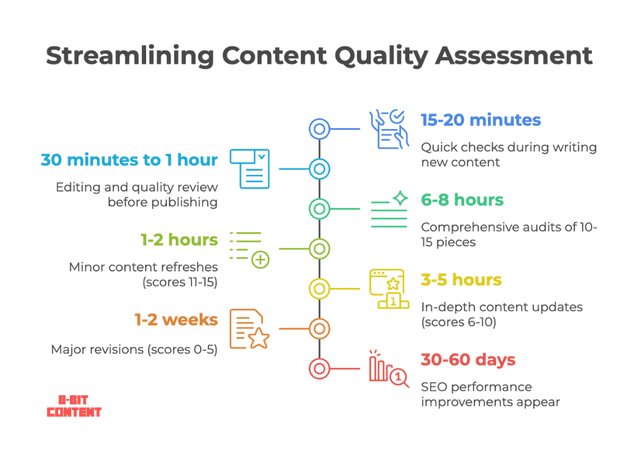
One of the most underused habits among affiliate publishers is systematic pre-publication content scoring. Use the Post Quality Evaluator at ContentEvaluator.online to assess your content before it goes live — checking readability, structural balance, and informational depth. Post-production evaluation is where most feedback happens; pre-publication evaluation is where quality is actually controlled.
The systematic pre-publication review process aligns directly with the VCE framework’s topical depth component: it forces you to check whether an article genuinely serves its stated reader intent, or whether it’s content-shaped SEO bait.
The Unpopular Take: Most of You Should Stop Writing More
Every piece of advice in the affiliate space defaults to “create more content.” More articles. More keywords. More volume. The instinct is understandable — it feels productive, it’s measurable, and it has historically correlated with traffic growth.
But here’s what nobody says in affiliate SEO communities because it’s deeply uncomfortable: for most struggling affiliate blogs, publishing more content is actively making things worse.
If you have 120 articles and 70 of them get fewer than 100 monthly organic visits each, publishing article 121 is not your solution. You have a portfolio depth problem, not a portfolio size problem. Adding more thin content to a site that Google is already treating with algorithmic skepticism does not help — it extends the ratio of underperforming content that may be dragging down your site’s overall quality signal.
The counterintuitive repair move is often: stop publishing, consolidate, deepen, and wait. Audit everything. Merge articles that should have been one piece. Delete articles that cannot be meaningfully improved. Update your 20 strongest pieces to be definitively comprehensive on their topics. Then wait for the next core update cycle to see your quality signal reassessed.
This is not a popular position. The content marketing industrial complex thrives on volume. Agencies, tools, freelancers — all of them benefit from a world where “more content” is always the answer. It often isn’t.
Illustrative model based on portfolio performance patterns observed in Authority Hacker’s 2024 affiliate survey data. After approximately 100 articles, a volume-first strategy tends to produce diminishing RPM returns as low-performing content drags portfolio average down. A depth-first strategy shows continued RPM growth through quality compounding. The inflection point varies by niche competition level.
Scoring Your Current System: An Honest Checklist
Before you decide whether to rebuild or repair, you need a realistic read on where you are. Here’s a weighted self-assessment across eight dimensions. Score each 1–10, then multiply by the weight. A total below 45 suggests structural rebuild. 45–65 suggests targeted repair. Above 65, you likely have a sound system needing tactical optimization.
| Dimension | Weight | What 10/10 Looks Like | Your Score |
|---|---|---|---|
| Entity Clarity | ×2.0 | Named authors, verifiable credentials, transparent About page, consistent brand cross-platform | ___ × 2.0 = ___ |
| Topical Depth | ×1.8 | Full semantic coverage; informational content ≥ 40% of portfolio; recognized as a reference in niche | ___ × 1.8 = ___ |
| Distribution Independence | ×1.5 | Email list generating ≥15% of revenue; 2+ non-Google traffic channels contributing ≥25% total | ___ × 1.5 = ___ |
| Funnel Architecture | ×1.4 | Clear content pathways from informational to commercial; email capture at mid-funnel; RPM tracked by funnel stage | ___ × 1.4 = ___ |
| Unit Economics Tracking | ×1.2 | RPAPM tracked for all articles; content costs known; monthly margin calculated; CPA vs RPM dashboard active | ___ × 1.2 = ___ |
| Content Quality Score | ×1.0 | Systematic pre-publication quality review; top 20 articles are genuinely best-in-class on their topic | ___ × 1.0 = ___ |
| DA/BA Ratio Health | ×1.0 | Brand search volume growing; DA not dramatically outpacing brand authority; press mentions exist | ___ × 1.0 = ___ |
| Product/Audience Alignment | ×1.1 | Products promoted are what readers actually buy (verified by survey or conversion data), not highest commission | ___ × 1.1 = ___ |
Maximum possible score: 100. Interpret: below 45 = structural rebuild; 45–65 = targeted repair; 65–80 = optimization phase; 80+ = scale mode.
Want an objective content quality read before you publish?
Use the Post Quality Evaluator at ContentEvaluator.online to score your articles for readability, depth, structure, and E-E-A-T signals before they go live. Free to use — paste your content and get detailed, actionable feedback.
Evaluate My Content →The Actual State of Play in 2026
The global affiliate marketing market is estimated at around $17 billion in 2026, growing toward a projected $27.78 billion by 2027. The channel is not dying. But the operator profile of who succeeds in it is changing sharply. The era of the anonymous keyword farmer — the person who assembled content to rank, collected commissions, and scaled by publishing more — is functionally over. Not because that approach stopped being clever, but because the environment it relied on has permanently changed.
The new successful affiliate operator looks more like a small media company than a traditional SEO practitioner. They have a recognizable name (or brand) attached to what they publish. They have readers who chose to subscribe to them specifically. They produce content at lower volume but higher depth. They track their economics rigorously. They are not wholly dependent on any single traffic source.
The market data suggests this is already separating outcomes dramatically. Niche authority sites — publishers with tight topical focus and genuine expertise signals — achieve conversion rates of 4–6%, nearly double the rates of broader lifestyle sites, according to NewMedia’s 2026 affiliate statistics analysis. The RPM gap between the operators who’ve made this transition and those who haven’t is not 10–20%. It’s 300–400%.
You can still build a substantial affiliate business. But you cannot build it the way it was built in 2019. The structural requirements are different. The entity expectations are higher. The funnel engineering is more deliberate. And the willingness to publish less — but build more — is the mental shift that separates the operations that will compound over the next five years from the ones that will quietly die.
If you found yourself uncomfortable reading this, good. Comfort is what keeps people in broken systems long after the evidence says to leave. The affiliate bloggers who’ll win in 2027 are the ones having the most honest conversations with themselves right now, in 2026, about what they’ve actually built.
Frequently Asked Questions
Why do most affiliate blogs fail?
Most affiliate blogs fail due to structural design flaws rather than poor execution of their current plan. The primary causes are building content systems optimized for search engines rather than readers, targeting commercial keywords without establishing topical authority, ignoring unit economics (RPM vs. content cost), and lacking the verifiable entity signals that Google’s quality systems rely on. After Google’s March 2024 integration of the Helpful Content System into its core ranking algorithm, nearly 50% of niche and affiliate sites in independent studies lost over 90% of their organic traffic.
Can an affiliate blog recover from the Google HCU?
Recovery is possible but rare and slow. Sites that have “recovered” from HCU typically see about one-third of their original traffic return — which SEO professionals often describe as a win. Full recovery to pre-HCU levels has not been widely documented. Google’s John Mueller stated directly that “websites can regain traffic by improving quality, but returning to pre-update levels isn’t realistic.” The most effective path forward is rebuilding as an entity-first publishing business rather than attempting to reverse-engineer the penalty through technical fixes.
What affiliate blog RPM should I be targeting?
The industry benchmark for affiliate websites is approximately $149.76 RPM (revenue per 1,000 visitors), according to Authority Hacker’s 2024 research. However, this average masks enormous variance. Thin review sites commonly operate below $35 RPM. Entity-first publishers in high-ticket niches (finance, SaaS, legal) regularly achieve $200–$500+ RPM. The correct benchmark depends on your niche, funnel sophistication, and product-audience alignment — not industry averages.
What is the DA/BA ratio, and why does it matter for affiliate SEO?
The DA/BA ratio refers to the relationship between a site’s Domain Authority (link profile strength) and its Brand Authority (navigational search demand — how often users search for your brand specifically). Moz data scientist Tom Capper’s analysis of HCU-affected sites found that “losers” consistently had markedly lower Brand Authority (average score: 37) compared to “winners” (average score: 62). Sites where the link profile significantly outpaced brand signal were classified as “over-SEO’d” and received algorithmic penalties. The fix is building brand signals proportionally to link acquisition, not reducing link building.
Should I delete old underperforming articles?
Deletion is a last resort. The better sequence is: (1) audit all articles by Revenue-Per-Article-Per-Month; (2) attempt to consolidate closely related thin articles into one comprehensive piece; (3) update articles that have genuine potential but outdated information; (4) noindex articles that cannot be meaningfully improved; (5) delete only articles that are genuinely irreparable and whose removal would improve the portfolio’s average quality signal. Blanket deletion of low-traffic articles has produced mixed results — the impact depends heavily on the specific site’s quality profile.
Sources and Further Reading
- Marketing LTB — Affiliate Marketing Statistics 2026
- EntrepreneursHQ — 71 Affiliate Marketing Statistics 2026
- DemandSage — 82 Affiliate Marketing Statistics 2026
- Paul Teitelman SEO — 6-Month HCU Impact Study (2024)
- Hobo Web / Shaun Anderson — HCU and Its Relevance in 2026
- Boomcycle — Google’s Helpful Content Update Analysis
- Surfer SEO — 13 Steps to Recover from HCU
- NewMedia — 200+ Affiliate Marketing Statistics 2026
- CrakRevenue — How Affiliate Sites Cope with 2025 Google Algorithm Updates